Against Chaos: Nancy Callan
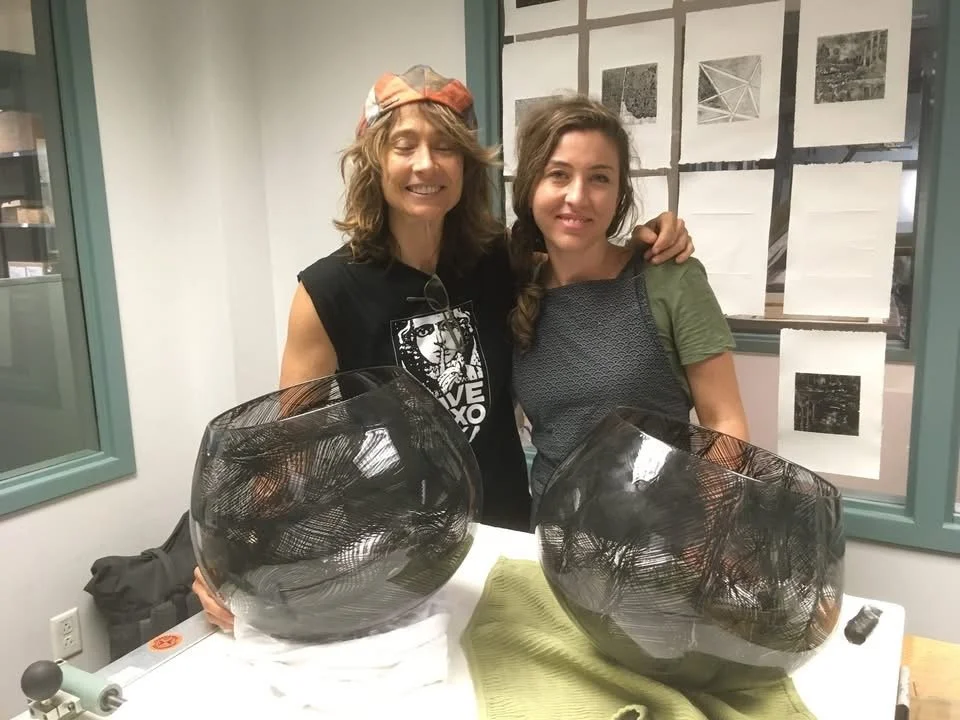
Art is stable, it can be an anchor. Those of us in the artworld should be so thankful for our enduring friendships, and for art. Here, a few photos of Nancy Callan and her art, taken at her Seattle studio, and various encounters in Chicago and Corning over the years.
And below, my essay about her work:
Nancy Callan by William Warmus
Published in Glass Quarterly Spring 2019
During her “Ted x East” talk at the New York Times building in Manhattan on May 9, 2011 Nancy Callan said:
“I love glass. I love the fire, the heat, the passion. I love the history, the masters. I love how difficult it is to conquer the techniques. I love the sound of the furnace roaring.”
And what do I love about her work? Its athletic effortlessness and pioneering purity. The way she arrives at simple yet bold solutions to complex problems. Her crisp color sense. And the fresh ways she builds nets and webs and grids of glass cane that ensnare, entrap, and delineate the bubbles of molten glass that form her canvas. As an art historian, I’m grateful for the ways in which her work honors the venerable Venetian tradition in which it is anchored while at the same time extending that tradition in ways that are purely American.
Nancy grew up in Peabody, a suburb of Boston. A sheltered upbringing, she was not exposed to a lot of art. Her mother was a hair stylist and her father worked for the telephone company. He had excelled at baseball as a young man, was even signed by the Yankees, but never played for them due to a medical condition.
She always drew in school as a youngster, yet also loved time outdoors to build tree forts, log cabins, slingshots. Loved the team aspect of sports: Baseball and softball were her favorites. But she also enjoyed skiing, the feeling of flying down the mountain as fast as possible. Not a great student, she was held back by reading comprehension, responding instead to all her art classes. Callan was a bit of a party girl in the 1980s, felt that going directly to college might not end well. So she took a job in Peabody at a graphic design firm: Underground Silkscreen (this was c. 1979-80—around the time of the New Glass show at the Corning Museum of Glass), graduating high school in 1982. The owner was also the manager of the Nervous Eaters, among Boston’s first punk rock/new wave bands, and she became a roadie for them. And for 15 years she also worked for Mr. G’s Pizza, making pizza: because of that, she says that she is “good at timing and keeping things on center,” skills she has carried over into her career as a glassblower.
In 1989 she decided to go to Massachusetts College of Art and Design to learn how to better use the computer for graphic design. She took some ceramics classes, liked those more and the computer classes not so much. But she soon changed her major to glass and began blowing it at age 30. This was when Dan Dailey was teaching one semester a year, one day a week. The hotshop was shut down during her first year, so she focused on cold working, but it was hot glass and glassblowing that intrigued her. She went on to study with Kelmis Fernandez, Bernie D’Onofrio and Alan Klein. She met the artist Robin Grebe and worked for her for a year, and worked for Dan Dailey in the summer of 1996, the year she graduated.
The year she completed her bachelors degree in fine art, her education ramped up. In 1996, she met Lino Tagliapietra, who taught an inaugural class of the newly opened Studio of The Corning Museum of Glass. A student in the class, Callan did everything possible to get Lino to notice her: she shielded him (from heat), chopped cane, cleaned the shop. She even volunteered to drive his tools from Corning to the Glass Art Society Conference in Boston, and this turned out to be her entry to work on his team. Her role was to start the piece and pick up cane. Fellow glassblower Dave Walters would swing and turn and John Kiley would gather and bring the punty.
Lino got her a job at Manifesto in Seattle and, in September 1996, she drove across country in her dad’s two-door copper-colored 1982 Cadillac Eldorado—ultimately driving that car, which she “loved to death” into the ground. (She still keeps the grill.). Manifesto had six color furnaces and made all the lights for Starbuck’s in the early days.
She planned to stay in Seattle for a year to see what they knew about glass: it turned out they knew a lot, and she is still there. Meeting masters like Dante Marioni was humbling for her. When Lino was in Seattle, she would work on his team at Manifesto. “We would be making production lighting fixtures for weeks on end, so Lino’s work was what we looked forward to.I did many jobs for Lino. In the beginning, I started by chopping and preparing the cane. I feel like this was an amazing foundation for learning how to look at the cane with a critical eye. As I got better with my glass blowing skills, Lino would allow me to do the next level job. I finally got the chance to roll the cane up. This was my favorite job on the Lino Team. I got to do all of the murrini and cane and start the pieces for his sculptures. This means I would prepare the pattern on the bubble to his specifications and hand it off to Lino, who made the piece.”
She would work latemaking her own work, but left after 2 ½ years in 1999:” Working production at Manifesto taught me a lot! I've always said it's a great way to refine your skills because you do simple things like drop color, trim lips, blow into a mold, or bring the punty thousands of times and gather, gather, gather. It becomes automatic. It's too bad that so few opportunities exist to work as a production glassblower, because that is the only way a young artist can get hundreds of hours glassblowing experience under their belt and get paid for it.”
After Manifesto, she started working for individual artists including Josiah McIlhenny, Ginny Ruffner, and the collaborators Flora Mace and Joey Kirkpatrick. Callan was on Dale Chihuly’s team for a few months, and made prototypes for Glassybaby. Her friendship with artist Katherine Gray developed during this time.
In 2000-2001 she was awarded a fellowship and residency at Wheaton Arts in Millville, New Jersey, as well as given a show at Vetri Gallery in Seattle. These landmarks signaled her emergence as an independent artist, although she continued working on Lino’s team until 2016. The “Bee Butts” (2001) is the first series she considers all her own, and recognizing the success of the Vetri show, she was given a show at Traver Gallery in Seattle in 2003. The main gallery is a big space and so allowed her to develop the “Stinger” series, which have the brash colors and bold graphics of superheroes and villains like Robin, Batman, Wonder Woman, Aquaman, and the Joker. Although Callan freely mixes pop culture references with traditional techniquesshe feels they are quite elegant. As she says “People enjoyed it, it made them smile. I want to make them happy.” Callan is comfortable revisiting series, and she feels that this one got better around 2014, with crisper incalmos on a larger scale: “You want your superhero to be big.”
Regarding Lino Tagliapietra, she says simply “He is glass.” Lino was her direct link to the history of Venetian glass. Working for Lino “has been a huge influence on my life, my work, and the scope of my ambition.” He taught her to find her own voice. She never wanted her work to look like Lino’s, and was even worried about using cane out of a concern to respect the maestro, to respect his respect for the sacredness of glass: When first working with Lino, she saw him pick up a fragment of cane from the hotshop floor, kiss it, and put it on the bench.
Now widely considered one of the best glassblowers of her generation, she is especially “grateful to the first generation of female glassblowers and artists including Flora Mace, Joey Kirkpatrick, Sonja Blomdahl, and Ginny Ruffner who worked so hard to break down barriers. I want to inspire women and men to see that you don’t have to be a big guy to work in glass.” Her own team consists of Dave Walters, Alix Cannon and Isaac Feuerman.
Other artists who have influenced her include Andy Warhol, who Callan says that “is still my hero.” She saw his work early in her art education and was immediately drawn to his graphic sensibility. “He used familiar subjects but made you look at them in a new way.” About Agnes Martin, she appreciates her clarity and structure, the way she creates mood with very few elements. Regarding Martin Puryear: “Even when he is working with something like tar or 4” x 4” dimensional lumber, the result is clean and smart.” She cites Oskar Schlemmer, especially the Triadic Ballet: “I love how low- tech the costumes are, yet the illusions are so real and convincing.” And Marcel Dzama, for his creepy and curious, delightful yet violent drawings.
Callan makes heavy use of traditional Italian cane techniques as the building blocks for her art: she produces the rods of glass from scratch and manipulates them into varying lengths and diameters and color compositions, adding that you have to train your eye for what to look for in selecting sections of the cane for inclusion in a design. For example, a clear cane with a colored center will exhibit many variations when sliced: in the thickness of the clear wall as well as the shades of the colored center. “The canes are the brush, the pencil, the scribble, the pattern, the fiber. Zanfirico cane is like lace, it translates into fabric.”
She explains: “To create a particular pattern, the artist cuts short lengths of cane and arranges them in a row on a metal plate. After pre-heating this arrangement, sometimes called a pick-up, a hot bubble of the correct diameter is rolled over the plate, sticking the canes to the outside. These are then melted into the bubble and the piece is formed, or additional layers are added. Reticello is the pattern created by criss-crossed layers of straight canes. The color for this cane is encased in clear glass, and must be perfectly uniform to produce a pleasingly symmetrical pattern of bubbles. That is one of the very few techniques in which bubbles are desirable! Usually we are trying to avoid bubbles.”
Callan set out to “take these Venetian traditions and translate them into my own imagination. A defining moment was when I started doing things I did not think possible.” Like what? She loves rolling up cane, and she found a way to do it without trapping air bubbles in the design of the Anemone patterns.
She generally employs two to four layers of glass to get more depth in her work, but also as a way to overlap and blend colors. In the Vortex series the cane is pulled up into the point, although it may seem to unfurl down from the point like a flag on a pole. In the Seeds series, the cane are offset on one layer of the bubble and on a second layer they go all the away around. The result is that although these look like two hemispheres put together, it is not an incalmo technique: the vertical crease is torched in so that the work looks like a seed, with a tiny sprout, or point, at the top. Sometimes the decoration on the sculptures seems to imitate a Morse code of dots and dashes: “I use different line widths, broken canes, and distorted and overlaid patterns to create new surface treatments.” ( “American Art Collector” May, 2012, p.122)
Callan admires the points of objects because they represent conclusions, and because they are a challenge to her skills as a glassblower: they can be difficult to execute elegantly. But how to avoid the problem of the “finial” in sculpture, which means how to finish the top or peak without looking decorative, like the cover of a sugar bowl? She has found ways to give her points a pointed meaning. In one black “Vortex” series form, a delicate strand of white filigrana cane unfurls downward from the curved point to become a flying banner or flag.
Around 2009 she started the “Clouds” series, which “is a difficult shape to make if you want to get the clouds just right. They went from clam clouds to clouds full of gesture and movement. I love the way the cane moves over the bumps like clouds over mountains.” The points on some of the clouds are like a meteorological symbol indicating the direction of movement of the weather front.
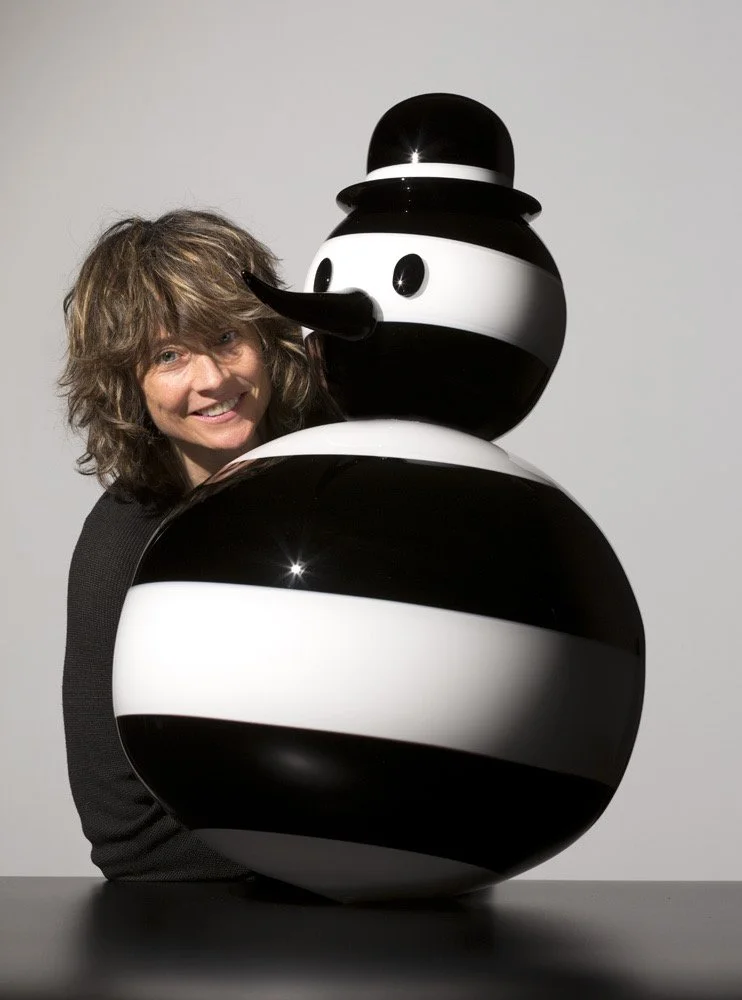
Just when we think the points are predictable in their subtlety, Snowmen appear. They still have her signature point which in this case becomes a nose, but the cane decoration has been magnified into broad black and white bands. The “Palomas” of 2011 are meant to be figurative but are inspired by fashion colors and textures. “I like playing with the position of the “head” until I get it just right.”
In 2016, Katherine Gray suggested that she document all her patterns, and thinking about that led to the “Panels”, which she sees as large sample swatches. Most are black and white, like the initial sketches in her notebooks. The stiff white glass can be used as a drawing material when it is made into different types of cane, and the dense black is the perfect ground. This also has the advantage of hiding the hanging hardware for the wall panels.
As with all her work, the panels benefit from close looking. The eye naturally traces the path of the canes on the black ground. Some are like topographical maps. Others, the ones with wide bands of white, are as if milk and heavy cream were poured out, mingled, blurred, shaded to grays but always with real depth not illusion because the canes are rounded, not flat like the line drawn by a pencil. While painters can surely build up dimensionality by applying paint thickly, canework begins life as a solid structure melted into a surface, and that makes all the difference. Look for that difference in her work.
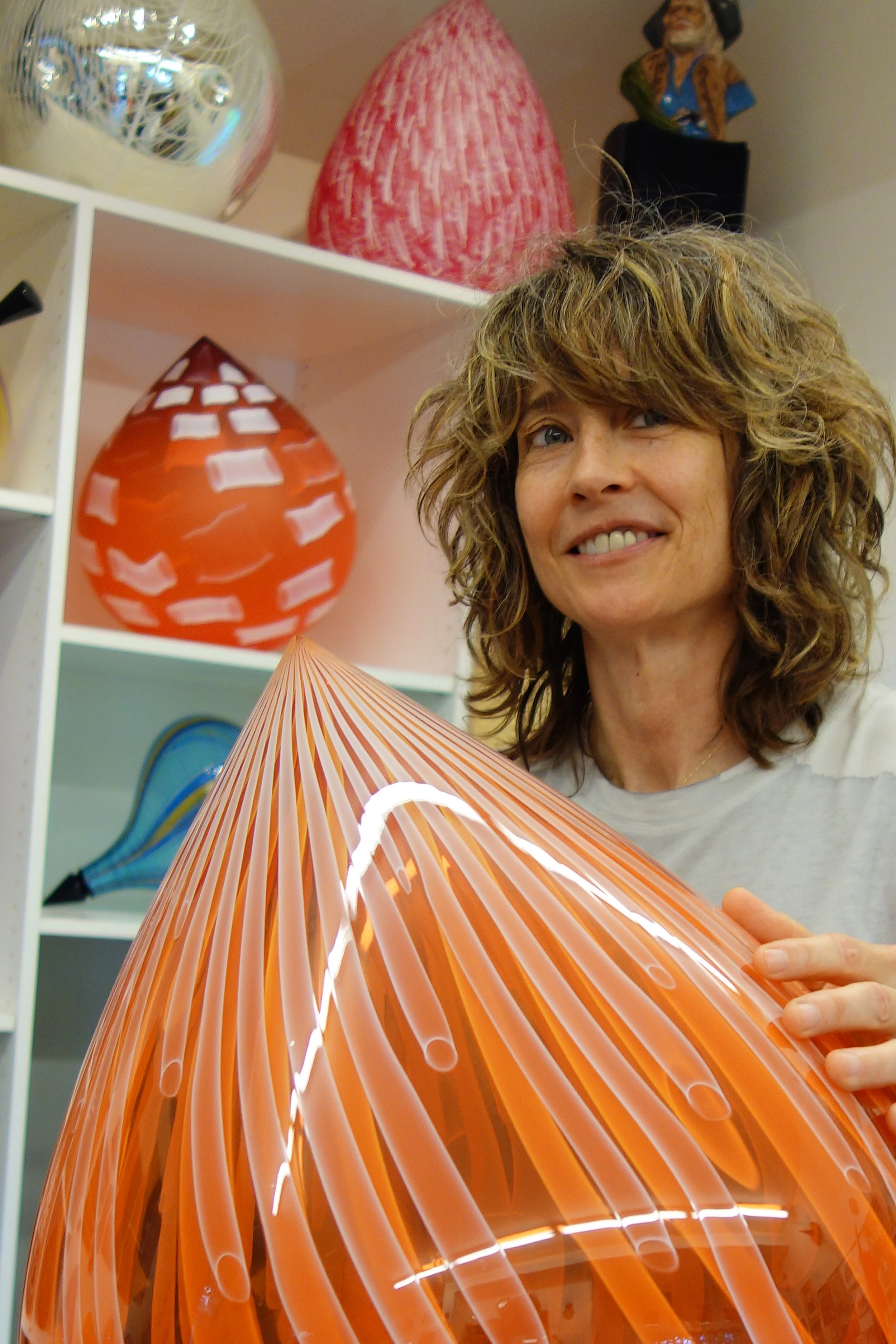
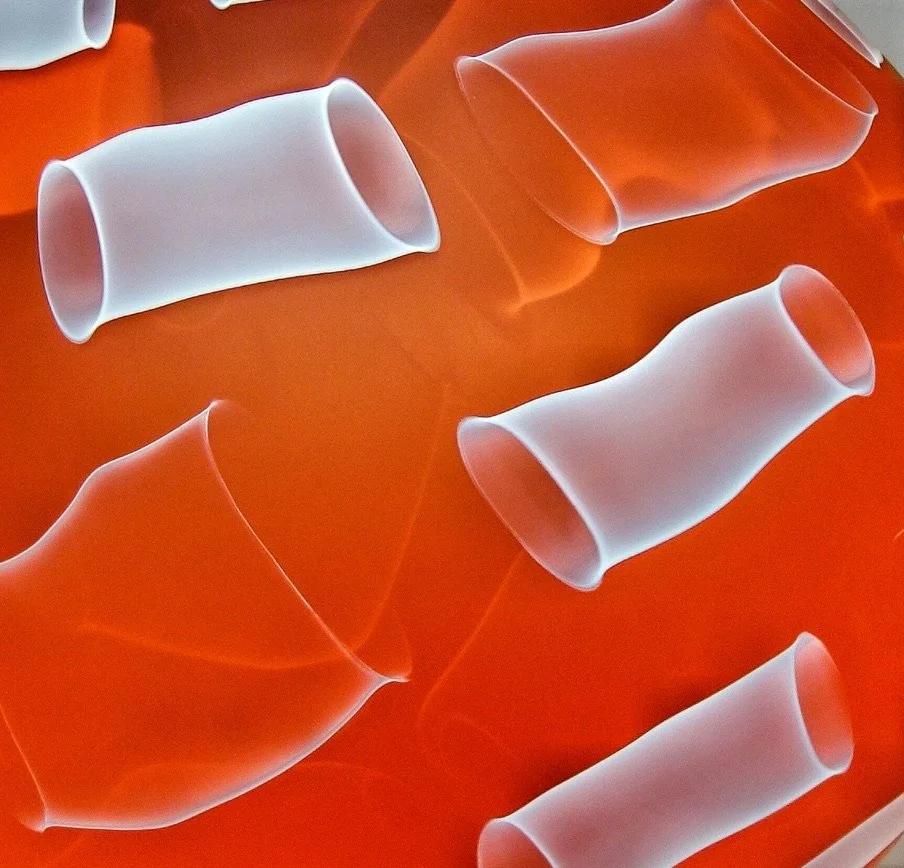
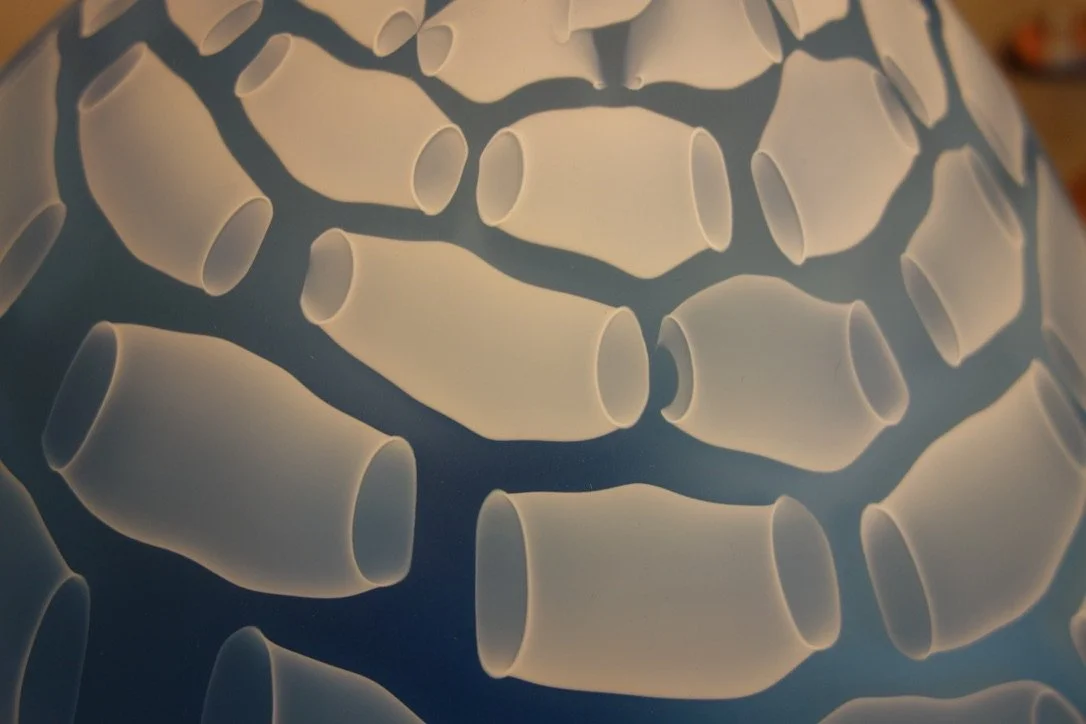
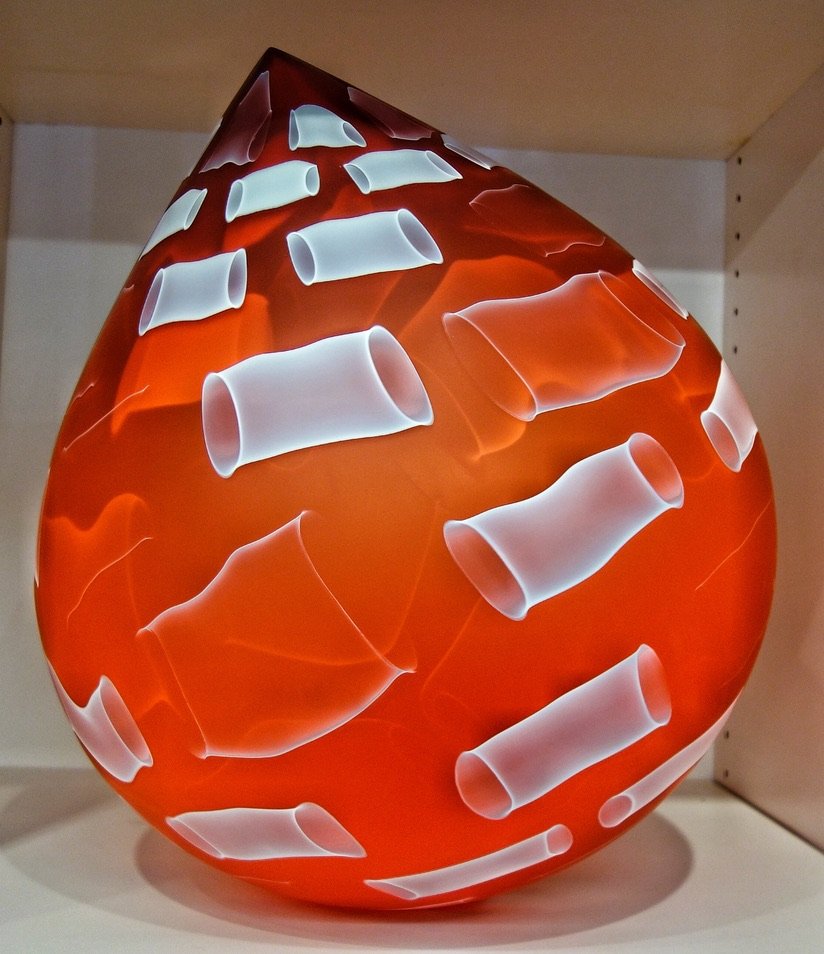
The “Droplets” series developed around the time of the panels. Making a panel, she saw a cane sticking up in three dimensions with a little hollow cup on top, and she began to wonder how to show these exposed ends in a blown sculptural form. The result she calls “Anemones”. More recently, the “Droplets” have evolved from single-color grounds with white cane on top to complex fades of adjacent colors – “Sunrise Droplet” fades from a vivid orange to yellow-orange at the top. The “Droplets” also use transparent colors that are hand-sanded to give a glowing, translucent finish. The structures she gets with these cut up canes are fresh, unusual, biological: like microbes in a drop of water?
CALLAN PUSHES SHAPE AND PATTERN, BUT SHE IS PERHAPS MOST OF ALL A COLORIST.
She greatly appreciates the colorful world in which we live, and tries to put hues together that may not seem to go together in a glassy palette. She explores the “odd” color combinations of the 1970s, yellows and browns or oranges and blues. The challenge is to find the right shades that work together in order to make good work. Pulling cane helps her experiment with color: she can overlap canes of different colors on a light table or hold them up in a window to see how transparent colors work together. Sometimes she also knocks chips from color bars and keeps them in plastic booklets for reference.
“Limiting my color choices brings a concept into focus for a particular piece or series. Those choices affect the mood and reading of the piece – making it more playful, for example. Over time new ideas can emerge from accidental combinations or unusual choices. “Clouds” don’t always have to have soft colors – they can be bright or dark or neutral too.”
Sometimes the color selection is closely tied to the concept, as in the “Superhero Stingers” series where each piece represents a comic-book character, so the colors are chosen from their iconic costume – red, white & blue for “Captain America” and aqua, orange and white for “Aquaman”. Transparency or opacity is also a huge factor in glass color selection. ‘The “Orbs” show off the many beautiful transparent colors that I have access too, with an emphasis on primary colors and their variations. She uses Kugler, Gaffer, and Reichenbach colors.
In 1989 I curated “The Venetians: Modern Glass 1919-1990” for Muriel Karasik Gallery in New York City. It explored the evolution of high style Venetian glass from Carlo Scarpa and Napoleone Martinuzzi forward. The show was at heart an exploration of what the poet Edmund Spenser wrote about in the “House of Busyrane,” the ever changing balance between lust and love, the necessity in life of being bold, and ever more bold, tempered by knowing when to “”Be not too bold.”
I concluded: “That in essence is the artistic legacy of the Venetians, now passed along to America: achieve symmetry, fear symmetry. Deny craft, never stray far from the love of craft. Delight in balancing the pungent with the pure.” When I wrote that, Nancy Callan was a freshman at Mass Art. It might be argued that the boldest gesture Callan represents is that she is a female glassblower, something truly new in the 3500 year history of glassmaking, and one of the very best glassblowers by any standards, male or female. But many aspects of her art, from her use of color to broad sweeping gestures, are also bold.
Yet Nancy Callan’s boldness is anchored in the noble and pure traditions of Venetian glassmaking. She seeks to challenge those traditions in order to create fresh new work, and she finds inspiration in popular American culture, bringing to mind the way in which Richard Marquis created new work from old traditions while at Venini in 1969. But while Marquis is a realist, Callan gives greater weight to abstraction in her work, which skillfully blends geometrical and color field tendencies. And in her concern to pack as much structure as possible into the thin wall of the blown glass form, I would say that she reminds me of the French art nouveau artist Emile Gallé.
In a final email exchange, I asked Callan if she thought
that the web or net of intricate cane work she creates is a way of capturing the object, of making the object her own. She answered that “I wouldn't say I "cast the net" to possess the object. It's an embedded part of the form and not overlaid on top, in my thinking. I use the cane more as a lure, to draw the viewers in to look closely, to intrigue them.” “Lure” of course can mean to seduce or to lead astray. To make bold. And ever more bold. In an era seemingly unmoored, Venetian traditions are noble because they are not too bold. Adhering to them is a way forward without going over a cliff, a way to seduce without leading astray, a way to live a life and create an art.
WILLIAM WARMUS curated the exhibition “New Glass” in 1979 while at the Corning Museum of Glass and is the founding editor of the New Glass Review. He curated, with Tina Oldknow, an exhibition that explores the Venetian influences on American glassmaking, which opened at the Stanze del Vetro in Venice in 2020