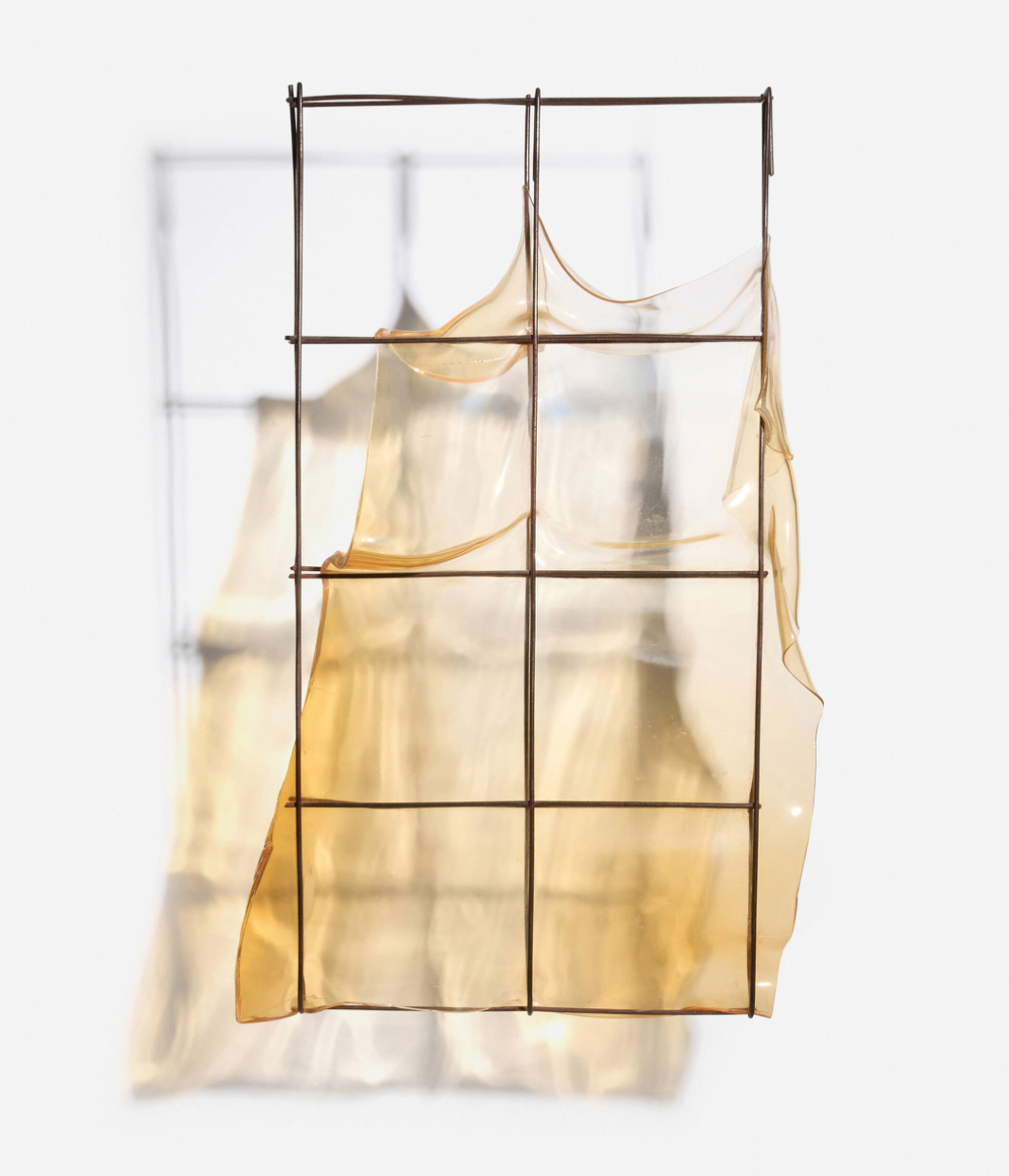
Mary Shaffer
William Warmus
This essay appeared in the book “Behind the Curtain: The Glass Art of Mary Shaffer” in 2020. Schiffer Craft. ISBN: 9780764360527 With Commentaries by Lucy R. Lippard and William Warmus.
Fire in the Wind
I look at art for selfish reasons. I look at art because it helps me underståand the world and by extension my place in the world. I look at art because it makes me whole.
I first saw Mary Shaffer’s art when I curated the exhibition New Glass for the Corning Museum of Glass in 1979. Her sculpture, Hanging Series #15 (1977), was included in the show, which traveled to the Metropolitan Museum of Art, The Smithsonian, The Victoria and Albert Museum, and the Louvre, among other locations. Shaffer wrote that, at the opening in Corning, she “became friends with the Czech artists, with Oldřich Plíva, Marián Karel, and his wife Dana Zámečníková. They were about to take a bus trip across America and had no money [this was during the cold war and many Eastern European countries placed severe restrictions on currency exports]. They had brought pieces in their suitcases to sell. I emptied out my pockets and gave them every dime I had, then hitched a ride to get home.” Both Shaffer’s innovative work, as well as her act of kindness, made an enduring impression on me, so from that date I have kept in touch with her and her work.
Mid-air Slumping
The art that Shaffer produced in the 1970s and 1980s is central to the definition of the classic period of studio glass, a time of great experimentation when remarkably few truly innovative processes and technologies emerged. One was the invention of the small glass furnace that would fit into an artist’s studio; another was Tom Patti’s fusion of flat and blown glass in the same object; and Shaffer’s contribution was mid-air slumping.
Although glass has been cast and slumped over molds in kilns since ancient times, Shaffer’s innovation was to hang the glass inside the kiln, much as clothes are hung from metal hangers inside a closet, and then allow the glass to melt and slump down from the hanger until it reached toward the floor of the kiln. With practice, she found that she could control the shapes achieved. As Shaffer says: “Once I found the slumping and bending of glass, that was a completely new door for me-- the temporal aspect of the material, that could transform itself from a sheet of glass, move into a beautiful molten shape, and then return to a sheet of glass, was very powerful.”
Some of her earliest slumped pieces make reference to windows and mullions, often slumped within a metal wire armature. The armature is also a kind of grid or "graph paper" that measures the progress and dimensions of the slumped object, capturing the history of the slumping movement somewhat in the way that the staff of five horizontal lines in musical notation forms a lattice that captures notes.
Mid-air slumping became much more than a technique for Shaffer: it became a founding metaphor. She has said that the fundamental principle behind her work is the exploration of how the female yields and joins forces with gravity, in opposition to the masculine tendency to dominate. We should recall in this context that Shaffer was in the first wave of women glassmakers in a field traditionally dominated by male glassblowers. She had found an intensely original and very elegant way to open a path to an entirely different approach to making glass. And she loved that her process was all about capturing motion: “I love all movement in nature—wind, water, snow, mud, tectonic plates, glaciers, and geology in general.”
A Darkness More than Light
I am very interested in works Shaffer makes in duplicates, such as the Inversion Series, where she might pair a work in glass and one in bronze. She has said that these explore "the concept of opposite materials becoming the same thing." And what is the nature of this "same thing" that they become? Shaffer writes:
“Opposites are not truly the same thing…except as dualities…up down, left right, hot cold. We perceive that they are opposites but of similar categories, such as direction and temperature. I like to talk about duality in terms of pairs and coupling. I made many pairs with anthropomorphic forms talking to each other, and then I made a conscious partnering with the Inversion Series. At first it was using opposite materials, then it was actually making molds of the glass and re-creating the paired form in bronze.”
As I ponder these dual sculptures, I ask myself, do they evoke a state between two things, or another state of matter entirely, a place where neither the glass nor the bronze exists, perhaps a realm of the non-existent? In other words, do the two paired works cancel each other out, or do they join together to create something greater than either alone? Shaffer has sensed how oddly evocative these pairings are, for example when she wrote:
“At OK Harris Gallery in New York I made an installation where metal forms with glass were on one side of the wall and on the opposite side glass forms with metal. There was one particular piece where the language for each component was so different. In one you could say light flowed from darkness, and [in] the other you had to say that darkness flowed from light. Which of course is not our reality and a very foreign concept to us.”
Shaffer likes to say that as a species we are limited to thinking in dualities: we have two eyes, two ears, two hands. So whatever might exist beyond (or before) duality is foreign to us. I like to think this is a problem we have inherited from the classical world, and that we need to reach back to the philosophy of ancient Egypt in order to better understand what existed “before there were two things.” For the ancient Egyptians “the nonexistent (was) felt to be present everywhere and all the time, (and) it is not confronted in an intellectual abstract fashion, but engages man entirely… the nonexistent is the inexhaustible, unrealized primal matter… which challenges them to create something that exists without qualification or hindrance” [Erik Hornung, Conceptions of God in Ancient Egypt: The One and the Many. Ithaca: Cornell University Press, 1982, p. 180].
For the ancient Egyptians, there was a time before two things existed, and this nonexistent state is still present everywhere. It is palpable, not purely intellectual. I could write a separate essay about how this way of thinking is a direct challenge to mainstream Western philosophy, which has always had trouble dealing with that which does not exist. But to stay on topic, let’s reduce the difference to this: in the West, in the realm of the real, there is always more than one thing, and things are essentially different from one another. In ancient Egyptian philosophy, it is possible for two seemingly different things to also simultaneously be one thing. The mind is capable of holding two contradictory thoughts at the same time and can see both as equally real or valid.
Shaffer has said that “Art is a vehicle for viewers to feel and then speculate about….” I suggest that her work is grounded between the real as identified by modern philosophy and the non-existent as the Egyptians understood the term. Gravity engages her slumping windows and time is measured within their frames. But in the Inversion Series, she “explores the concept of opposite materials becoming the same thing.” That concept is, I believe, alien to science but not to the Egyptians, who wrote in the Pyramid Texts that before creation there was a time when there were “not yet two things,” which expresses their view that there was a unity which could not be divided.
Which leads me to ask: If our science and philosophy have forsaken the nonexistent and now focus on encumbering and numbering the observable, can art draw upon the nonexistent in order to create something free of hindrance? If science makes life possible, can art make life worth living?
The Inversion Series combines the monumentality of cast metal with the lightness, even playfulness, of glass. What is implied is something nonexistent, a state between or even before metal and glass. It is an unencumbered stuff; its size and shape cannot be observed or measured. A monumental plinth of opaque metal, an undulating sheet of clear glass: What we see are two separate sculptures, but what is implied is a state somewhere between or even beyond these two,: glass-metal effects, flowing unhindered in slow time out of primeval chaos into our world of big science where everything must be measurable and recordable. The attributes of the two sculptures can be measured and observed; the nonexistent sculpture they allude to cannot. The two merge into one and give us a glimpse of a world out of this world.
Say the Words: She Travels As the Wind
I asked Shaffer what she thought was the goal of art. Should it make us happy, content, eager to ask more questions about the world around us? Should it have an emotional appeal? What can a scientist learn from a work of art that science alone can not teach? She wrote:
“Each artist has their own reason for making art, there’s not one universal reason. But I do think good art touches some basic truth in the viewer. It could be happiness or joy but it can also be fear. It’s definitely an emotional reaction to the art. I personally feel that art should carry meaning and should reveal truth at a deeper level. Because it is nonverbal, it has access to a deeper spiritual level.”
I study art in order to learn. Shaffer’s work is born from fire and lives in light. Its essence is in the movement that fire inspires in matter. I turn one last time to the wisdom of ancient Egypt for words to understand her art, in this case the lyrical poetry of the Pyramid Texts as written in stone in the tomb of the Pharaoh Unis around 2600 B.C., our earliest philosophy:
“Say the words:
Unis becomes your departing
Essence of earth essence of wind,
Revered fierce glowing spinal cord,
Unis becomes fire in the wind.
“To the end of the sky
To the end of the earth
To the end of the limits of space
Unis travels as the wind.”
[Susan Brind Morrow, The Dawning Moon of the Mind, New York: Farrar, Straus and Giroux, 2015, p. 117]
William Warmus is a Fellow and former curator at the Corning Museum of Glass. He is the founding editor of the New Glass Review, past editor of Glass Quarterly, and the author or co-author of twenty books including biographies of Dale Chihuly, Louis C. Tiffany, and René Lalique.
Note: All quotes from Mary Shaffer are from emails to, or telephone calls with, the author in May and June, 2019.