At the Art Expos
Reflecting on over a dozen years of visiting the leading fine art expos to document glass, I recall what got me started. It was a conversation with a prominent ceramics dealer over drinks at the Eden Roc hotel in Miami Beach around 2012. At that time, she argued that fine arts dealers don’t like glass and won’t show it. The only way for me to confirm this was of course to attend a lot of art expos.
At the very first one, Art Basel in Miami, Tim Tate and I saw spectacular work in glass by Ai Weiwei and Roni Horn. And every year since, glass has played at least a supporting role in making these shows a success. Moreover, it’s a deep pleasure to see glass as simply one medium among others, all working together to produce the aesthetic and intellectual pleasures we expect, a vital art ecosytem with all the various “species” of art living together and interacting.
These thoughts are excepted from a recent review I wrote published in Glass Quarterly, which I include below.
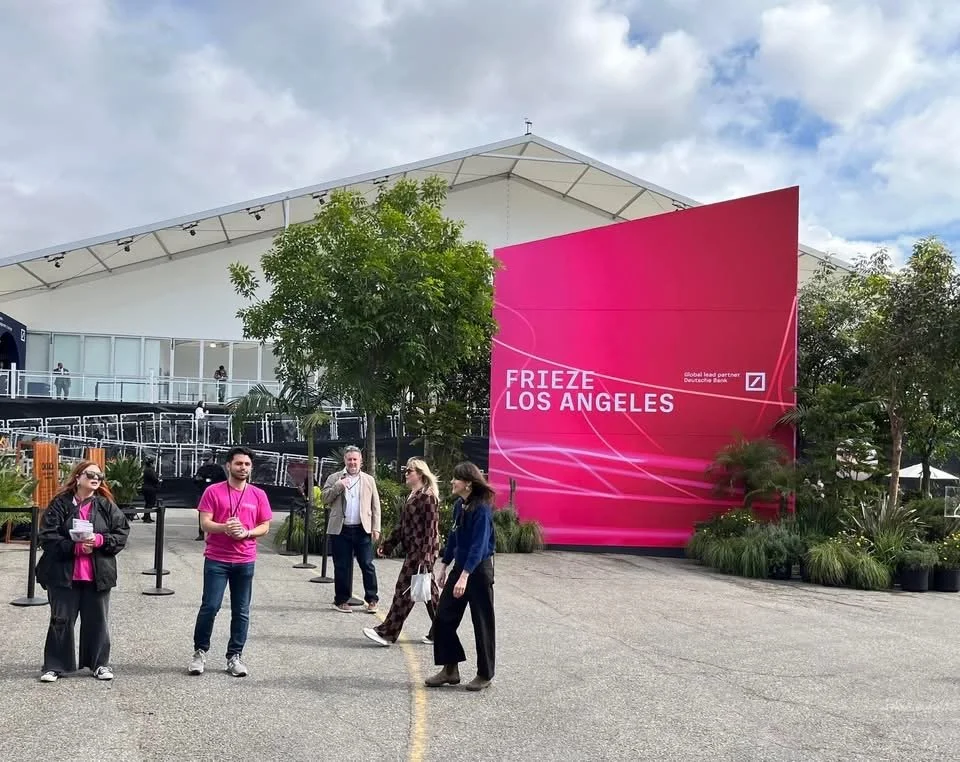
Frieze Los Angeles
Santa Monica Airport
Santa Monica, California
February 29 – March 3, 2024
For more than a decade, I have been surveying glass at the big contemporary art fairs, visiting art expos from Art Basel and Art Miami to the Armory show in New York, the Chicago Art Expo, the Venice Biennale and, this past March, the Frieze Art Fair in Los Angeles. Taking place in a massive purpose-built tent at the Santa Monica Airport, the show included glass work by Larry Bell (C Channel SS Optimum White) at Hauser & Wirth, Jean-Michel Othoniel (Precious Stonewall) at Kukje, Josiah McElheny (From the Library of Future Geometries II) at James Cohan, Lynn Hershman Leeson (Synthia Stock Ticker) at Altman Siegel, Jorge Pardo (Untitled set of 5 lamps) at Petzel, Sean Raspet (Myofbrillar Tissue Scaffold) at VSF, Dominique Moody (Sweat Equity) at François Ghebaly, Fred Wilson (Form Over Function) at Pace, Mildred Howard (Movement II: Sonata for Thomas Green) at Parrasch Heijnen, and Sula Bermúdez-Silverman (Amphisbaena).
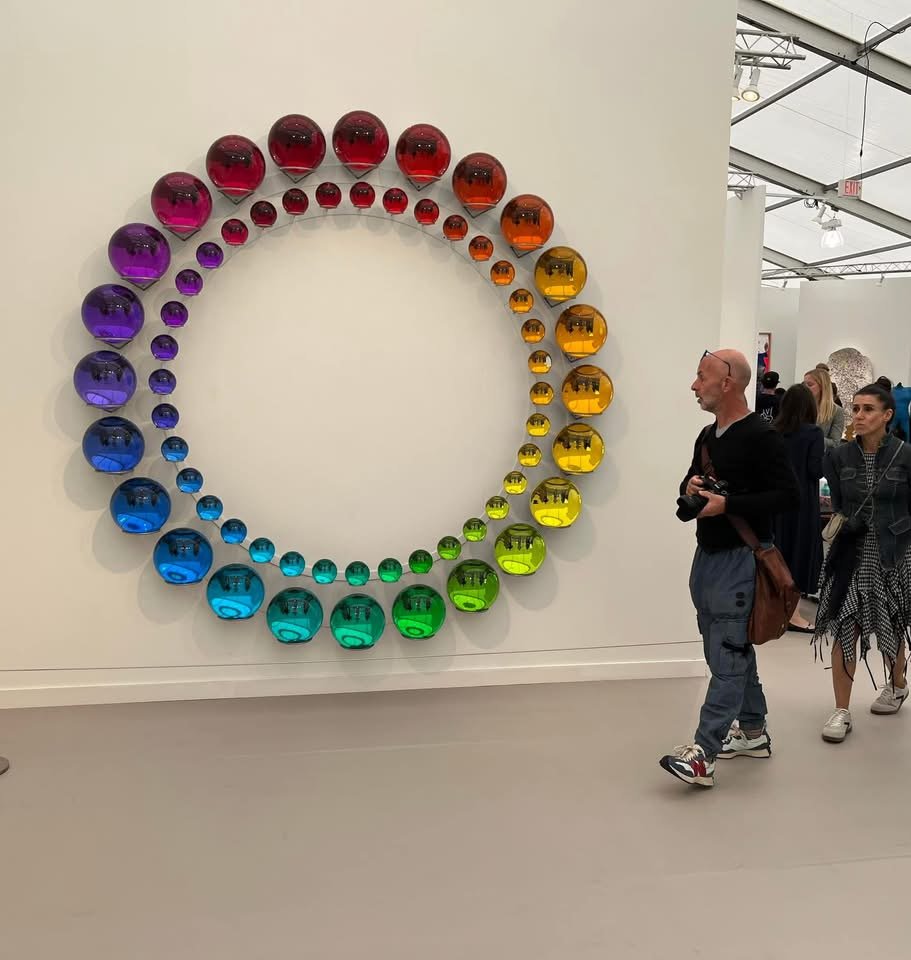
For me, the standout was the sculpture by Olafur Eliasson at Tanya Bonakdar Gallery titled Endlessly happy visible endings (2023), which consists of glass spheres, paint, and stainless steel in a large square structure 98-inches tall. The color of the individual spheres changes as you move around the artwork, and that means the viewer opposite you is seeing something very different. Working from his Berlin studio, Eliasson uses light and color to explore the passage of time. As he said when he exhibited a fragment of an Icelandic glacier in a work he entitled Your waste of time (2006): “It is a challenge to verbalise time itself, even though, paradoxically, talking takes time. Describing time in conversation tends to take away the duration from it, as it is mostly described as an idea or concept.“
At the major art expos like Frieze, sometimes a leading artist is represented by a seemingly minor artwork that can carry a lot of weight in reference to their career. For example, at White Cube gallery, Mona Hatoum exhibited her blown-glass-and-steel Basket (2014), a significant work because it references Hatoum’s national origins and struggles. Glass is the perfect material to evoke fragility. According to the Tate Museum in London, Hatoum was born in Beirut to a Palestinian family in 1952, and makes work which explores the relationship between politics and the individual. She has made a number of works using household objects which are scaled up or changed to make them familiar but uncanny.
Patty Chang exhibited several Glass Urinary Devices, many shaped like plastic water bottles, some blown for her by Amy Lemaire at Urban Glass. The artist explains how the series originated: “Following along the longest aqueduct in the world built in China, I peed every time I came upon it. After returning home, I designed multiple urinary devices with plastic water bottles and had the designs hand blown in borosilicate glass.” This references Chang’s abiding interest in the flux of water and the many ways we recycle, divert and tamper with it. As she says “water has memory” and these devices evoke that memory.
I don’t want to conclude this brief review without mentioning the work of Edgar Arceneaux at Hauser & Wirth. It wasn’t at their booth at Frieze but on display at their LA gallery, a series of interlocking buildings surrounding an inner courtyard with a grand restaurant and garden. There I encountered Arceneaux’s spectacular painting using glass. Of course, paint on glass was used to great effect in the furnishings of Tutankhamen’s tomb, so it’s not a new process. But it’s among the most promising of techniques. Arceneaux’s description of massaging the broken glass and paint with his hands is lovely. I’ll let the artist describe the intent in his own words: “The surfaces look the way they do because of cohesion and friction. When the paint dries to the silver on the mirrors, it has to have some cohesion so that it can take the silver off, but it never does it uniformly … Once the paint is pulled off, it starts to rip. The ripping part of it became meaningful as I was taking care of my mom, nursing her at the end of her life when she had dementia. At a certain point having to bathe your parent; you become completely confronted by your own creation, the place where you came from. The wrinkles that were in her stomach were really beautiful but also a little bit haunting at the same time.”
Reflecting on Frieze LA and a decade plus of related art expos, I recall what got me started. It was a conversation with a prominent ceramics dealer over drinks at the Eden Roc hotel in Miami Beach around 2012. At that time, she argued that fine arts dealers don’t like glass and won’t show it. The only way for me to confirm this was of course to attend a lot of art expos. At the very first one, Art Basel in Miami, I saw spectacular work in glass by Ai Weiwei and Roni Horn. And every year since, glass has played at least a supporting role in making these shows a success. Moreover, it’s a deep pleasure to see glass as simply one medium among others, all working together to produce the aesthetic and intellectual pleasures we expect, a vital art ecosytem with all the various “species” of art living together and interacting.