This is one of my favorite essays, written for the exhibition catalog for “Venice and American Studio Glass.” I curated the exhibition withTina Oldknow and it opened at the Stanze Del Vetro Museum in Venice in 2020.
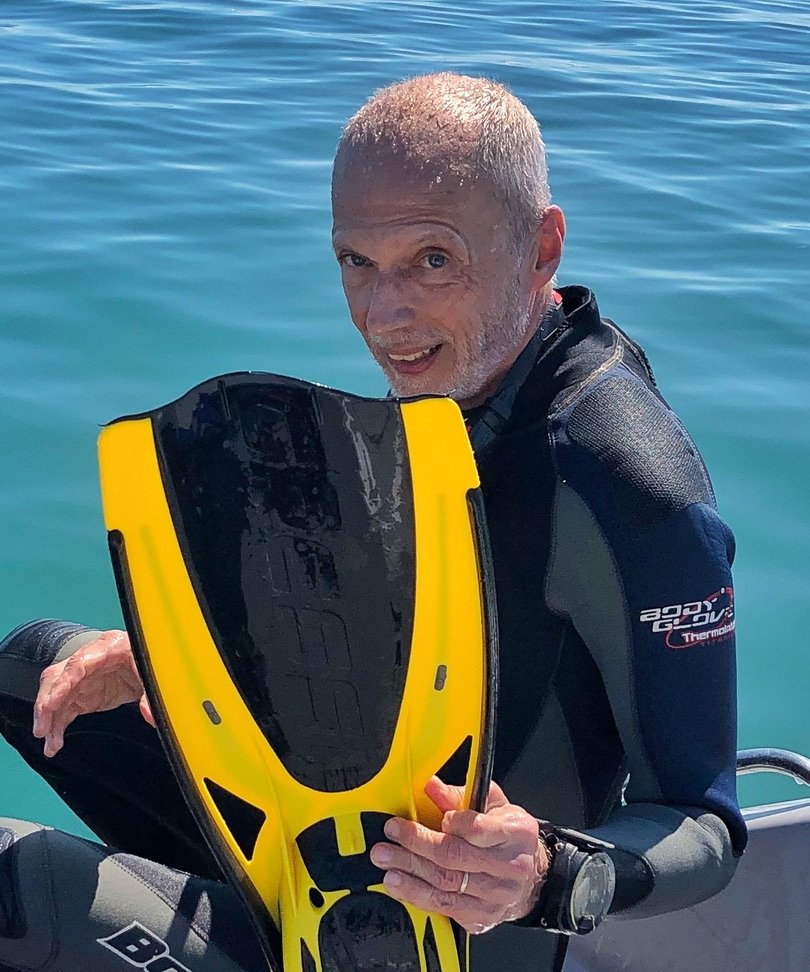
The image is of me diving in the Venetian lagoon as part of my research for the essay.
The Americans: A Venetian Tradition
by William Warmus
“None of us can ever retrieve that innocence before all theory when art knew no need to justify itself, when one did not ask of a work of art what it said because one knew (or thought one knew) what it did. From now to the end of consciousness, we are stuck with the task of defending art. We can only quarrel with one or another means of defense. Indeed, we have an obligation to overthrow any means of defending and justifying art which becomes particularly obtuse or onerous or insensitive to contemporary needs and practice.” — Susan Sontag [1]
Murano’s Influence on Renaissance Art [1]
Medieval Venice was built on the Adriatic Sea, within a coastal lagoon largely free of ancient ruins and the memories they muster. The ghosts of Rome could here be held at arm’s length. A watery landscape dominates the city, with canals that, in some cases, follow the meanderings of the original channels that dissected the tidal flats in the lagoon. Construction is expensive and pedestrian navigation challenging, but from the start the watery walls of the city made it relatively safe from outside attacks, and the spectacular setting increased the beauty of the city by about one million percent. Hard against the sea, Venice would naturally become a great and wealthy mercantile power, and the aesthetic of its arts would be influenced by the aqueous.
The vitreous is also one of the chief glories of the city, whose glassmaking industry matured during the early Renaissance: a glassy aesthetic influenced the leading Venetian painters Giovanni Bellini and Titian, as well as the development of oil paints and the ways in which the natural environment is defined—and yet glass remains largely misunderstood as a vehicle for art during that period. If we are to understand how the Venetian aesthetic was appropriated by American artists, beginning around the middle of the 20th century, we need first to define our terms. Just what is the glassy aesthetic of Venice?
When you see a Jamie Carpenter roundel,[2] that’s Venice. When you see a Dale Chihuly chandelier consisting of hundreds of blown glass components, that’s Venice. When you hold a Dick Marquis fused micromosaic murrine[3] in your hand, that’s Venice, too. All of these owe allegiance to an aesthetic that was developed in Venice and on Murano during the Renaissance and that has had a profound impact on American glassmaking.[4] And it’s a living aesthetic, not a fossil of the 16th century. Carlo Scarpa, the 20th century’s most important Venetian architect, produced designs in glass that owe allegiance to Renaissance painting, but go beyond it: Micaela Martegani Luini wrote for the monumental exhibition “The Italian Metamorphosis, 1943–1968,” presented at the Solomon R. Guggenheim Museum in New York City in 1994, that “Scarpa’s sense of plasticity and color and his inexhaustible urge to innovate definitively transformed the Muranese glassmaking tradition. His forms, which are underscored by their brilliant coloration, achieve such a sublime rarefaction that one can see in them the mellow colorism of Venetian Renaissance painting, the soft, full sensuality of Titian’s Venus, and also the sobriety and reduction of Bauhaus design.”[5]
And yet the English art historian Paul Hills noticed as early as 1999 that “Murano glass, the most celebrated luxury produced in the lagoon, has long been underestimated in art history. . . .” [6] And as recently as 2018, American writers and historians continued to underestimate Murano: the educator Koen Vanderstukken, speaking at the 2018 Glass Art Society Conference on Murano, asked, “Why did it take until the mid 20th century to see glass being used within contemporary or modern art?”[7]Elsewhere, he remarks that, during the Renaissance: “Artistic and philosophical investigation took place not within the craft but rather, to a limited extent, within the art of painting. This changed once again with the arrival of postmodernism. It was then, for the first time, that artistic investigation into glass itself took place. . . .”[8] In 2018, the prominent critic James Yood, who taught at The Art Institute of Chicago, dismissed Murano and favored Venice as the future for Italian glass. “Venice is beginning to recapture the narrative(s) of Venetian glass, . . . reclaiming that from its long exile on Murano.”[9]
A leading American art historian commented to me (off the record) that Venetian glass “killed” American studio glass in terms of its development as a fine art medium because obsession with technique overshadowed conceptual development. It is certainly easy to pick the low-hanging fruit first and to see the Venetian aesthetic as superficially all about opulence and reflection and ultimate skill, crystallized in the mirrors that bring light deep into the dark interiors of the palazzos, the chandeliers that augment the mirrors, and even the vases that are portrayed in Renaissance paintings by artists such as Paolo Veronese. But there are far more profound and interesting ways in which Venetian glass operates from an artistic point of view, and it is my fundamental thesis that the Venetian aesthetic is extraordinary, not based upon the mere refinement of technique, and adaptable to, as Susan Sontag wrote, “contemporary needs and practice.” This is demonstrated most notably by the ways in which American studio glass artists, beginning in the 1960s, blended this refined glassy aesthetic with the raw, edgy aesthetic dominant in the United States.
Paul Hills believes that Renaissance Muranese glassmaking opened up Venetian painters to new ideas in transparency and hue, and that the layering or casing of glass from that era parallels, or even precedes, but surely influenced the ways in which artists were layering, glazing, and blending the recently adopted medium of oil paint.[10] He refers to the celebrated words of Marcantonio Sabellico that glassmaking is “a sweet contest of man and nature” and boldly states that “indeed, it could be argued that it was within this context of highly skilled making that the beauty of nature was defined.”[11] That’s worth emphasizing: Hills argues convincingly, I think, that the highly skilled art of glassmaking was one of the leading pathways by which we defined the beauty of nature.
The idea that culture might precede nature is one that has only recently begun to gain ground among anthropologists, so score one for glassmakers and art historians! In 1992, the anthropologist Peter D. Dwyer argued, in his landmark paper “The Invention of Nature,” that “modern thought treats nature as separate from culture and has assigned ontological priority to the former. This is analogous to the separation of environment and organism that informs much of biology. . . . I shall argue, in the domain of human affairs, culture should be taken as prior, nature as emergent.”[12]
Hills cites an example: a chalcedony glass goblet that “could offer a conceptual microcosm of a landscape in flux, which in turn becomes the arena for Bellini’s drama of the “Agony in the Garden.” It’s a painted landscape that “is strangely molten . . . yet conveys adamantine hardness”—most likely inspired by glass. In the process, “the supernatural, normally invisible to mortals, is rendered glassy.” Keep that in mind the next time you see a glassy ghost. That’s Venice, too! [2]
Among the highest achievements of art and architecture during the Renaissance was the refinement of linear perspective, a point of view highly attractive to Humanism because it placed us, and our pair of eyes, symbolically at the center of the universe. Hills makes the case that the quite different perspective inherent in blown glass vessels was also not without powerful attractions: that glassy space “is alive with curvilinear energy”: “In Bellini and Titian, as in glass vessels, the arcs and scherzi of colour create space, which—far from being plotted and pinned down by linear perspective—is alive with curvilinear energy.” Hills describes “the Venetian dynamic, at once vitreous, marmoreal and aqueous, of . . . space-encircling arcs,”[13] where color “unfurls, reveals itself, conceals itself, through movement, time and space.”[14] That curvilinear space is a crowning achievement of glass in the Renaissance.
To our badges announcing a Venetian aesthetic, including teamwork, roundels, and multiple components arranged together, we can now add liquid landscapes, curvilinear perspective, and, as we will see, subversion of the cynical and ironic. Taken together, all of these “skills” provided, for a young and hungry 1960s-era studio glass artist, a road map that was capable of both locating you in space and propelling you forward to your destination.
Here is an important note about how to read this essay: it explores the Venetian aesthetic, as well as the dramatic changes that took place in that aesthetic when it was influenced by glass as a medium for art during the Renaissance (see above). We then jump forward to the 20th century and the leading theoreticians, especially Carlo Scarpa, Thomas Stearns, and Lino Tagliapietra. After that, we explore the American aesthetic, both before it encountered Venice and after. It seems that nearly every artist developed his or her own point of view, and for reasons of space I have selected a representative group from the exhibition. Yet there is one more point of view: my own methodology. This essay would be incomplete if I concealed my theories about art, so I spend just a little time outlining what I call Reticulate Aesthetics, which is inspired by the aqueous and so indirectly influenced by Venice.
Carlo Scarpa and Modernism [3]
The Venetian architect Carlo Scarpa was instrumental, between the 1920s and 1940s, in establishing the curiously contradictory personality of Muranese glass that dominated the style during most of the 20th century. He was both a procrastinator, endowed with a gardener’s love of solitude and a long-range sense of time and priorities, and an architect-designer, required by trade to work with large teams and to adhere to grueling schedules. This duality manifested itself as “a perverse dialectic between celebration of form and the scattering of its parts, between the will to represent and the evanescence of the represented, between the research of certainties and the awareness of their relativity. . . .”[15] This tug of war is effortlessly resolved in Scarpa’s glasswork—for example, in the murrine (fused mosaic) vessels made for Venini that fuse fragments everlastingly into a whole.[16] Two refined vessels for Cappellin show how Scarpa the modernist was able to meld decoration and form, to bring them into balance. They are austere and yet creative. The noir cone vase is grounded by a red disk-shaped foot and completed with a casually applied red wrap on the lip. The sealing-wax-red bottle has an almost absurdly small neck, making the shoulders monumental by comparison. Fluctuating highlights add visual interest as light strikes the squared-off corners of the red bottle, the slope of the dark cone. But there is a price to be paid in the most elevated, subtle works: the austere colors and shapes and details must be vibrant and well made, because that is all there is to look at, to dwell on. There is no applied dolphin to disguise an ill-made vessel form. These works have the ultra-refined self-assurance of high Modernism, but they owe allegiance to the melted landscapes and curvilinear energies that were first evident in Renaissance Venetian glass.
Venetian glass such as the refined Cappellin vessels of the late 1920s and 1930s must today be seen through the dark clouds of World War II. Within this context, Scarpa’s lattimo (milky glass) bottles seem prescient, their interiors obscured by “infinitely luminous and hazy mists.”[17] But are they like Micol’s antique lattimi in Giorgio Bassani’s The Garden of the Finzi-Continis, which were places where “she could let her gaze wander among the luminous mists of her beloved lattimi: and then sleep, imperceptibly, like a Venetian ‘high tide,’ would return slowly to submerge and ‘annihilate’ her,”[18] or are they harbingers of rebirth, the renaissance of Venetian glassmaking that took place after the war? Probably both. [4]
What appeals to me about Scarpa is that, in his architecture as well as his designs for glass, he produced triumphant works of high Modernism, work that is optimistic, subtle, delicate, gently humorous, and supremely self-confident: all the things I love about Modernism. My impression is that Scarpa was there to calm the waters of Venetian excess, to take the Venini culture and add to it by subtracting from it, if you will, while always honoring the rich Venetian traditions.
Going back for a moment to The Garden of the Finzi-Continis, the narrator dreams that “the lattimi were not at all objects of glass, as she, Micol, had tried to make me believe, but on the contrary, just as I had supposed, cheeses, small dripping forms of a whitish cheese, bottle-shaped.”[19] There is quite definitely a dry, witty side to Scarpa: it can be difficult to figure out how to open a Scarpa door, or even how to walk up a Scarpa staircase. So why can’t a Scarpa vase be a cheese? This is one reason I adore Scarpa: finesse with detail while keeping a steady eye on the look of the whole project, unabashed exhibitionism, dry humor, and even dreaminess.[20] The elegant and austere side of Scarpa influenced contemporary American glassmakers such as Benjamin P. Moore and Dante Marioni, while artists such as Richard Marquis found Scarpa’s exhibitionism and humorous nature attractive.
Thomas Stearns: Abstraction, Asymmetry, and the Aqueous
Since 1989, I have argued that Thomas Stearns forms the crucial pivot linking late Abstract Expressionism to the emerging craft movements of the 1960s. But what he is also remembered for in Venice is his denial of symmetry, and many Americans after him would simultaneously adopt the Venetian style while denying its symmetry:
Upon hearing his report, she went silent and pale, staring at me. I told her I knew what she had to say was not good news, but I wanted her to tell me exactly what she had been told. This is how she explained what the grand master said: ‘For weeks you have stood over us like a bird. We have worked for centuries to create a perfect symmetry in glass. Now you bring your ideas, which have no symmetry, to insult us. You don’t speak our language, either in Italian or in glass. Go away!’”
Thomas Stearns did not go away. As his reflections on [his time in] Venice . . . reveal, he persisted with a vision of what glass can be, won and lost a gold medal at the Venice Biennial, and finally gained the hearts of the glassworkers at Venini.[21]
I thought about another Stearns quote the day I went scuba diving in the Venetian Lagoon: “Mediums become vehicles, and a variety of vehicles make for a variety of realms.”[22] What on earth does that mean? Breaking it down, three words dominate: “mediums,” “vehicles,” and “realms.” Mediums are the vehicles that create realms. Like the medium of water and the vehicle of scuba diving, which open the way to the exploration of the ocean realm. For Stearns, glass was the medium and the glassblowers at Venini were the vehicles that opened the doors for an exploration of Abstract Expressionism in glass, by means of adopting a glassy aesthetic pioneered in the Renaissance and adapted by Stearns.
The glassy aesthetic offered intriguing opportunities. By the 1960s and 1970s, many abstract painters, such as Kenneth Noland, seemed to be stuck. Seeking new ways to control color, Noland began to experiment with shaped canvases. The results were often awkward and contrived. The painter Jules Olitski even spoke of his wish to spray color into the air and coax it into staying in place.[23]
For artists such as Stearns and, later, Dale Chihuly, glass vessels offered a natural way to “shape canvas” using the breath of the artist: for the glassblower, color had coalesced around air. And, as Hills wrote regarding the glassy aesthetic, “The arcs and scherzi of colour create space, which—far from being plotted and pinned down by linear perspective—is alive with curvilinear energy.” Glass advanced the style of Abstract Expressionism and Color Field painting, not the other way around, and Venice was crucial to that success.
Lino Tagliapietra: Reclaiming Lost Innocence [5]
When Susan Sontag mourned the loss of “innocence before all theory,” I really wish she had taken a look at glass as a medium for art, which has managed, to a degree, to be open to direct, unmediated appreciation. This is not true for glass emerging from postmodern- and conceptual theory–influenced academic programs, but for those artists adhering to a Venetian aesthetic, it has been possible, to an extent, to avoid irony and cynicism and to create work that does not require deep interrogation as to what it does, perhaps because it is obvious what it is (a vase, a bowl, a mirror, a chandelier). And that might even be one reason why so many postmodern critics have trouble equating glass with art: they interrogate the vase, and because it is mute (or innocent), they assume it cannot possibly be art.
In this context, and in my estimation, Lino Tagliapietra has been misunderstood. Granted, his technical skills as a glassblower are extraordinary. But in many ways that count, Lino should be viewed primarily as a theoretician who has brought the Renaissance Muranese aesthetic into the 21st century, blending it with his experiences teaching glass in America and elsewhere around the world.
Regarding the lost era of innocence, he had this to say, when I asked him (in 2002) about his early experience teaching in the United States:
People had a very primitive technique, a high rate of loss, maybe three out of four pieces. But I liked the spirit and the fantasy. Now people try to have more technique than fantasy. That is the culture of glass. We need to expand the culture, know more about modern art, for example the aesthetics of using monochrome. Right now we stay too much in technique. In the early days the glassmakers here were naïve but they had good spirit. Now the spirit is a little bit less, a little bit chilly. Curiosity and culture make a difference. That was one thing I observed in the best designers, like Carlo Scarpa and Fulvio Bianconi, who worked in Murano. They were always looking, thinking, traveling, curious about everything.[24]
Tagliapietra considers glass to be almost infinitely significant as an art medium: “Nothing is flexible like glass, nothing has the beauty of glass. The combination of air, fire, water. Even gold has nothing to compare with glass. It is absolutely the most expressive material on the planet.” However, “like anything we do in life—playing the piano—we need vocabulary, attitude, curiosity, in order to give the art poise and energy. Ideas and techniques go together.” He has great insight into how form and color operate in the realm of the glassy: “I begin to feel that too much is a little bit embarrassing in terms of shape. I like the idea of show and don’t show at the same time.” On the other hand, he generally prefers his colors bold: “I like very strong color. For a long time I had a strong feeling about orange. Right now it is about cobalt blue. It is like choosing to eat vegetables or spicy food, very different choices. The same with color, which is tricky and strange. Sometimes, I feel a little bit casual, sometimes more precise and individual, it depends on the moment. I might like brown and yellow together.” So when you see colors tricky and strange, that’s Venice, too.
Typically, Lino makes several objects during a working session at the furnace. So I asked him if one piece suggested a direction for the next. “It depends,” he replied, “on the energy of the piece before. Maybe one story has ended, and then a new story is starting. Maybe you are frustrated or happy: end of the affair. That carries the moment forward. It changes a lot while I work, maybe I need to make another one like the previous one to see what is possible. These are very strange, mixed feelings. But they move the work ahead.” A simple question about his technical working method elicited an extraordinary response about composing narrative structure on the hot-shop floor—and, once again, he commented on the “strangeness” of the feelings during such a process.
So, given all these possibilities, where does a series like “Dinosaurs” come from? This “work is organic,” Lino says. “My relationship to the natural world is very strong and glass is an incredibly natural material. A shape like the dinosaur grows on the blowpipe. And if you lay the dinosaur on its side, you make a fish, which I have done—it is a part of my relationship to nature. When you work in glass, you must have all the elements of nature around you: water in the bucket to cool the tools, fire at the furnace, light, and the sand the glass is made from, that represents earth. This is absolutely important.” I want to put Lino and Paul Hills and the anthropologist Peter Dwyer on a panel to talk about how the culture of glass precedes, and participates in, the definition of nature.
As a scuba diver, I had to ask Lino a question about the role of breath in his work, because of its centrality to both the vitreous art of glassblowing and the aqueous art of diving. He says that it is “the idea of perfect shape. The relationship of front and back in each object, connected by color, is very important. And that is mainly an issue of shaping by breath. And the shape must be connected to the shadow. Sometimes I want to leave a tiny space in the vessel, like a lens, where you can see through, see the light. If you can give the artwork a kind of profundity, it is like seeing deeply through the water of the glass.” Over the years, I have had many conversations like this with Lino, and when he comes out with a perfect phrase like “the shape must be connected to the shadow,” I always cast my eyes downward, to avoid revealing how jealous I am of his perfect grasp of the language of art.
The writer Paul Valéry, meditating on the causes of perfection, wrote that “there are certain special cases where we can compete with nature.”[25] Tagliapietra seems to have been granted such a dispensation. The vessels in his “Dinosaurs” series inhale a big lung full of air with a neck so delicately curved and poised that it seems capable of singing as that air escapes. For me personally, the “Bilbao” series satisfies elemental needs; it evokes the joy and desire that we feel, for example, on a cold night when the aurora borealis is visible in the northern sky, sheets of color flickering and shimmering and sliding over one another as they lock into unexpectedly beautiful patterns. As an artist, Lino monumentalizes the effects of light and color and motion, presenting them to us in a sublime container. As a theoretician, he profoundly understands the language of the glassy aesthetic, and has passed that knowledge along to countless American glass artists.
On the Aqueous
“There are three sorts of people: those who are alive, those who are dead, and those who are at sea.” — Attributed to Anacharsis, sixth century B.C.
You cannot visit Venice without recognizing and honoring its watery side. On May 14, 2018, I made my way, in the midst of a furious downpour, from Venice, where I was staying near the Campo San Samuele (where Titian had a studio), to Murano (whose glass industry influenced him) to watch Dan Dailey work on some designs with a team at the Venini factory. It was raining so hard that water was flushing upward from the juncture in a downspout along a wall that ended in a canal. Even the air seemed tinted blue-green like the water. Despite having an umbrella, I was drenched, but happy to see such a powerful demonstration of the aqueous on my way to view the vitreous. The connections between the two realms have long been noticed by critics and art historians, perhaps by none so poetically as Adrian Stokes: “If in fantasy the stones of Venice appear as the waves’ petrification, then Venetian glass, compost of Venetian sand and water, expresses the taut curvature of the cold under-sea, the slow, oppressed yet brittle curves of dimly translucent water.”[26]
But what might Stokes mean by “curvature” and “curves” in this sentence? I suspect he meant that “the smallest boat leaves a track on the water’s face: even a thrown pebble makes enlarging circles. These liquid movements enhance a thousandfold the solid radiance of the masonry.”[27]
In another place, he talks about Einstein and the curvature of space.[28] But could he also have had in mind the curious feeling that scuba divers have of being encased in a curving glass sphere while diving?
As a diver, I could not resist the opportunity to explore the Adriatic and the Venetian Lagoon, to see if that experience would open up a new realm for me, in Thomas Stearns’s sense of the word. On September 12, 2019, I went diving several miles offshore. All was calm as we left the Lido, but soon the water became rougher and whitecaps appeared. The sea was cold, and at a depth of 55 feet, visibility was one foot. This gave meaning to the idea that Venice reigns serene inside her barrier islands, and that, as Stokes wrote: “The certainty of man-placed stones contracts the ocean’s awfulness.”[29]
I made my second dive the same day just past the MOSE gates inside the benign lagoon, which was still and glassy and inviting. As I was playing beneath and on the gentle waves that day, after the difficult Adriatic dive, the words of Veronica Strang in her important essay “The Social Construction of Water” came to mind, that “water confers elite status” and is a metaphor for change, movement, and mood.[30]
My favorite ocean-realm author, Philippe Diolé, wrote: “One must have the courage to keep the decorative beauty of the sea in the margin. What is important is ourselves in the water, our still unformulated hope of transcending the human condition.”[31] He might also have been talking about the problems facing the arts in an age when theory too often trumps experience. Diving is not an archaeology of the merely decorative but an exploration of the self and our relationship to the ocean realm. Going back again to Susan Sontag, I argue that we need to do the same in the art realm: find a way to merge with the art object and so transcend the purely finite human condition.
This was illustrated on September 10, 2019, when I had dinner with Tina Oldknow and Dan Dailey outdoors at the Ristorante Cantinone Storico in Venice. Tina pointed out that the shimmering reflections of Venetian buildings seen in the canal (next to our table) were what inspired Thomas Stearns to create his extraordinary “Facades of Venice” series. In their aqueous nature and soft-focus colors, his art works bring to mind the aesthetic of Renaissance Muranese glass, and while Stearns transformed stone facades into glassy ones, glass windowpanes were used in Renaissance Venice to transform stone, making it aqueous: “The very translucence of water was fixed to palaces affronting the sea.”[32] On my way home after dinner, I asked myself, to what extent is Venice, and Murano, Mediterranean? Is the Venetian glass aesthetic but one subset of the Mediterranean aesthetic? The scuba diving I enjoyed so much in the lagoon was itself invented in the Mediterranean, off the coast of France. [6]
As I complete this essay, Venice is underwater because of the worst flooding in 50 years. An op-ed[33] in the New York Times by Shaul Bassi, a professor at Ca’ Foscari University of Venice, caught my eye. He cites the cultural historian Salvatore Settis, who “called Venice ‘a thinking machine that allows us to ponder the very idea of the city,’ a place where people have a unique way of interacting to produce unparalleled beauty in a sustainable way.” Murano, too, might be described as a thinking machine, but one that allows us to ponder the very idea of glass and its beauty.
Underwater in the lagoon, my dive guide took me to a spot populated by the eccentrically wonderful Pinna nobilis, or noble pen shell, a large mollusk that anchors its pointed bottom deep in the sand while topside the shell is rounded and opens to feed. I immediately thought, what an inspiration this would have been for Thomas Stearns! And as I rested on the bottom, fixated on the micro-environment of the Pinna nobilis and its associated sea urchins and shells, the words of Diolé rang true: “The gates of the sea are open. . . . The gates are open, the mirror cracked, but we remain on the threshold, gazing down into black gulfs where vision and feeling disperse.”[34] Back home in upstate New York, I woke with a start one night at 3 a.m. I pulled a copy of the 1989 Karasik Gallery exhibition catalog from my bookshelf and paged through it to find the Flavio Poli “Valva” vase designed for Seguso: it must be a pen shell! So I effectively found art in the lagoon: culture does precede nature, and we need it as our guide when exploring impenetrable realms and black gulfs. [7]
On Reticulate Aesthetics
The art critic Donald Kuspit writes that “a failure in theory means a failure in practice.”[35] I agree. Some art critics never develop a methodology, and so their practice of criticism can seem flawed. I am of the opinion that a well-thought-out theory, one that is adaptable and not jargon, can make looking much easier. To revise Kuspit: a success in theory means a success in practice. I did feel at home lying on the bottom of the Venetian Lagoon, “critiquing” the Pinna nobilis as if it were a work of art inspired by Stearns or Flavio Poli, because my diving experiences from Tonga and Fiji to Hawaii and Bonaire led me to develop a theory about how to look at art that is different from many of the classical, hierarchical theories. There is a form of evolution that is different from the Darwinian one. It’s called reticulate evolution, and coral is a prime example of the process. A reticulate process allows for “species blending,” challenging the idea of individual species and unchangeable hierarchies. So I constructed “Reticulate Aesthetics” to go beyond the traditional, hierarchical, and elite art history that is dominant in the West.[36]
Rather than a history of individuals and discrete styles, Reticulate Aesthetics sees a history of collaboration and of blending. This web pattern allows for cross-pollination of ideas and styles even as it recognizes excellence in mediums (e.g., glass, ceramics, metalworking) that, under the old hierarchical structure, never had any chance of ascending—styles that were always pushed to the side, relegated to a lower limb of the great tree of art. Reticulate Aesthetics recognizes the potential value of all art, and our culture’s increasing willingness to look for art at the fringes (outsider art, art from materials such as dirt and fat, art that copies existing art) seems to be an example of this desire for cross-pollination. All of this interconnectedness lends strength and depth to each individual art work.
Perhaps best of all for me in my critical mode, the way we judge art changes, too. We no longer employ criteria in the service of establishing what is “Good, Better, Best” or “Bad, Worse, Terrible.” In Reticulate Aesthetics, we judge by estimating distance and direction and detail. So, for example, I might decide that a specific art work is close to me right now, and write an appreciation of a detail of that object (or concept), in the process establishing its direction in relation to other art works with similar details.
So what does this have to do with Venice, aside from the fact that the theory is aqueous? It influenced how we designed the physical layout of the “Venice and American Studio Glass” exhibition and, to an extent, how we selected objects for inclusion. The “circles” we developed are not traditional hierarchical ones, with a master and his followers. These are reticulate circles: they overlap, and influences can flow in all directions. And I would hope that, as you experience the exhibition, rather than making the old hierarchical judgments of good, better, best, you would look for influences, and work that is close to you now, while maybe giving a little time to the work that seems far away from your personal aesthetic.
Circles of Reticulate Influence [8]
Victoria Newhouse brought to the forefront the criticality of how art works are displayed in her book Art and the Power of Placement.[37] She explored the balance between context and content and how the placement of an object is central to how we understand it. She also noted that “with few exceptions, art books, museum catalogs, and Web sites depict objects in isolation, with no indication of their settings, so it is easy to overlook the extent to which the perception of these objects is influenced by their presentation.”[38]
Because the arrangement and placement of the art works in the exhibition is central to our investigation of influences, we felt a need to show, as well as to tell, the reader something about the layout. The exhibition’s designer, Dan Dailey, prepared a 1:20 scale model, and images of this can serve as our three-dimensional model.
There are seven galleries in the Stanze del Vetro museum, and because of the large scale of the Chihuly Laguna Murano Chandelier, we occupied an eighth space: the Pool Pavilion. We trace circles of Venetian influence through these galleries. The first gallery studies the founding masters of studio glass: Harvey Littleton, Fritz Dreisbach, Marvin Lipofsky, and others, and takes a look at the American edginess in their work “pre-contact.” The second space documents the rise of the “old masters,” including Dale Chihuly, Richard Marquis, and Dan Dailey. These artists proved that studio glass had legs, and they adopted Venetian methods and aesthetics to reach their goals. The next two sections of the show trace the circles of Lino Tagliapietra, the master glassblower, and Pino Signoretto, the master of solid glassworking. Lino had an impact, for example, on the careers of Dante Marioni and Nancy Callan, while Pino influenced William Morris and Raven Skyriver.
It should be stressed that these circles overlap and that influences can flow backward as well as forward, mixing together. For example, the edginess referred to above is a thread that runs through the entire exhibition, even in the elegant work of Dante Marioni, whose vessels get taller and taller and more and more difficult to create. The literal stretching required of the artist in the hot shop is implied by the heights of the art works in the gallery, and isn’t stretch an edge? The long end gallery at the Stanze examines somewhat younger artists who are inventing the 21st century with novel methods adopted from museology (Josiah McElheny) and big data analysis (Norwood Viviano), or who are including video as an essential element of communication (Tina Aufiero and Deborah Czeresko, who uses video in the sense that she achieved fame by winning the 10-episode glassblowing competition in the 2019 Netflix reality television series Blown Away). The work in this gallery is very much Venetian-inspired, but with an American originality and nonconformity of vision. A final room and hallway at the Stanze is a celebration, quite simply, of vessels and goblets, because aren’t these where it all began in the Renaisance, and shouldn’t circles close up on themselves, rather than abruptly end?
Occupying its own pavilion, the Laguna Murano Chandelier is a recollection of the important “Chihuly over Venice” exhibition in 1996. The creation of this complex object was the last “event” that took place: it was formed in the studio of Pino Signoretto, who made it with Lino Tagliapietra, but it was never exhibited in Venice, and so we thought it fitting to bring it back for a sort of “Chihuly over Venice” encore. Accompanying Chihuly in the pool space is his prominent student, James Carpenter, whose architectural models reveal how Venice continues its influence, on the largest of urban scales. Chihuly and Carpenter collaborated early in their careers—as, for example, on The Corning Wall, which they made to commemorate a flood that devastated the community and The Corning Museum of Glass in 1972. The wall, made of three-dimensional roundels, has an indicator that refers to the high-water mark in the museum’s original galleries. Chihuly so much liked the way it turned out that he made one for himself. [9]
Expanding the circle beyond the exhibition and the urban environment, the artist Josh Simpson makes science-fiction worlds using Venetian murrine and hot-working techniques—worlds inspired by the planets in our solar system. Some have been taken aboard the International Space Station, where they float free of gravity as their topographies merge with the geography of our own globe, visible just outside the windows. Differences of scale evaporate, as the astronaut Alan Bean observed: “After my walk on the moon during Apollo 12, I could look out the spacecraft windows and, in one direction, I could see the Earth, in the other direction, the moon. I suddenly realized that I could stretch out my arm and, in a sense, hold each unique world in the palm of my hand . . . yet-to-be discovered places may be reflected in Simpson’s intricately landscaped Planets that we can, today, hold in our hands.”[39] That is the wonder of the murrinetechnique: it can be used as a tool to capture and sculpt the microscopic or the cosmic. [10]
Back on Earth, let’s take a deeper look at the aesthetics of some of the artists in the exhibition, beginning with the first gallery and moving forward.
Harvey Littleton: The Great Circle [11]
Italian glass has roots in Venice, but American studio glass begins with Harvey Littleton. He is the founder of the American Studio Glass movement. The first object we can associate with the founding is female: a nude torso cast by the artist from Vycor multiform glass in Corning, New York, in 1942—this at a time during World War II when the Venini factory on Murano was making light bulbs. If you will, the roles of the United States and Italy in the realm of glass had been symbolically exchanged, if only momentarily: Venini producing tech, Corning contributing to the founding of a new art movement.[40]
From the beginning, Littleton was aware of the importance of Venice to glass, and in 1957–1958, during a trip to Europe, he even blew glass (for about an hour) as part of a team at the Fratelli Toso Glassworks on Murano before being escorted out as a non-employee. Littleton spent time at Venini studying the extensive archive and “before leaving Murano, Harvey bought blowpipes and other tools for a hot glass studio.”[41] Although most collectors and curators associate Littleton with glassblowing, he was from the start open to the use of flat glass as an artistic medium. In the summer of 1966, Littleton and the German glass artist Erwin Eisch traveled around Europe in a Mercedes-Benz borrowed from Erwin’s brother, eventually arriving in Venice to meet with the abstract painter Emilio Vedova, who was preparing his work for the Italian pavilion at Expo 67 in Montreal: a grand mural made from light rather than paint. Vedova had, however, encountered seemingly insurmountable difficulties in finding a medium that worked with the projectors for the imagery. “In Harvey’s mind, glass offered the obvious solution, and he advised Vedova to work with the Venini factory in achieving his vision,” wrote the Littleton biographer Joan Falconer Byrd.[42] The result was considered a success.
The gestation process of studio glass was long, interrupted as Littleton went off to soldier in World War II and later began a career as a successful potter and educator. He was back at it again in 1958–1961, melting glass in a crude furnace he had constructed himself, carving simple shapes from small cast glass forms, blowing his first glass into objects he describes as “phallic bubbles,” and using a blowpipe given him by Jean Sala in France. Finally, studio glass was born: in the Midwest, in Ohio, in 1962, at the Toledo Museum of Art workshops (widely cited as the founding event of studio glass) led by Littleton. This time, the participants used blowpipes without historical association: honest black American iron pipe purchased from a local hardware store, suitable for gathering at one end, blowing from the other. Something new and innocent had entered the world.
A striking feature of the founding of studio glass is that Littleton had, by the time of the publication of his book, Glassblowing: A Search for Form, in 1971, cut the template for so much of what followed, beginning with technique. A large section of the book is technical, including photographs showing a glory hole and illustrating how glass is blown; but when he writes that “glass in the molten state is able to take into solution almost any material; platinum is the major exception,”[43] it might be a metaphorical plea for the artist to go beyond technique and to think about dissolving art styles as well. Littleton goes on to link glass as material to glass as expressive of artistic style by exploring Abstract Expressionism, Minimalism, and the Arts and Crafts movement in his work.
Littleton sought to recapitulate the history of 20th-century glass, writing in 1971 that “my book is both a guide and a revivalist manifesto,” and citing a link with “Tiffany and Carder and Gallé [who] were trained as artists and had chosen glass, but [who] chose to work within the framework of factories that they founded, factories that were totally under their control so that they made very exciting things. . . .”[44] It might even be argued that Littleton sought long-term to put the artist back in control of the factory, even as he sought to put the furnace into the artist’s studio. From this point of view, studio glass did not seek to avoid the factory; rather, it sought to return artists to control of the furnace—a goal that has been achieved.
From our relatively comfortable 21st-century perspective, it is easy to overlook a profound aspect of Littleton’s persona: he was a risk-taker and adventurer who sailed two boats across the Atlantic (once in 1973 with one other person, and again in 1986, aboard his sailboat Tamara, with two others). The founding of studio glass may today seem obvious, even conservative, but almost everything about glassmaking is risky and difficult, and in 1962 the outcome was far from assured. To a large extent, Littleton led by force of will. Marvin Lipofsky reports about the period from 1962 to 1964: “As students we didn’t know how to do anything. All we could do was emulate what Harvey was doing. We learned how to put the pipe in the glass. It was dip and blow. But what shape should you make? The first time we opened the annealer and looked at our finished pieces, there was an argument over who made what because they all looked alike. But Harvey had the inspiration that artists could use glass as an art material. His thoughts went beyond making vases. It was wide open for Harvey.”[45] It was this wide-openness that Littleton sought to convey to his students. Despite a tendency to minimize the strength of his will, as when he says that he sought to put glass into the studio because “no one else was willing to take it on,” Littleton was well aware that studio glass might dead-end: “In glassblowing, if the necessary risk is taken, the outcome must always be in doubt. Artistic creation must occur in crisis.”[46] This is the thrill and challenge of the glassmaker’s art, forcefully described by Littleton in a language tinted with sexual overtones, driven along as if hunting a wild animal:
When the artist lifts his blowpipe, he must be prepared to intervene with all his aptitude, training, form-sense, as well as physical and mental energy. Everything he knows converges at once on this curious scene reenacted millions of times in human history: a man breathing his desire into the molten glass. Each time it recurs it is only as different as the men are different from one another; the dance with the blowpipe, the sudden grasping of tools and the hissing of steam as they are applied, the form completed—these things remain the same. A man cannot educe forms from hot glass by conceiving it as a cold, finished material. He must see it hot on the end of his pipe as it emerges glowing from the furnace; he must have a sense of wonder! His perceptions are ever new; his reactions must be swift and decisive! He must immerse himself in immediate experimentation and study, for the glass will not wait.[47]
I have heard glassmakers described as the truck drivers of the art world. Glassmaking is sweaty, gritty, dependent upon solid (but very fragile) objects made with 19th-century industrial tools. The presence of a furnace in the artist’s studio seems anachronistic at a time when fine art has become post-conceptual, pre-postmodern, disappearingly visual and mordantly intellectual. Norman Mailer might have been writing about this relationship in 1969 when describing the first launch for the moon: “Saturn V was a furnace, a chariot of fire. One could witness some incandescent entrance to the heavens. But Apollo 11 was Command Module and therefore not to be seen. It spoke out of a crackling of static, or rolled like a soup can, a commercial in a sea of television. . . .”[48]Harvey Littleton lit a fire in the artist’s studio at a time when the artist’s studio was becoming a command module for conceptual art and its academic outposts. Molten hot and computer cool never cohabit in the world of technology, but since Littleton they have had to make an accommodation in the world of art.[49]
Littleton is frequently in his Venetian mode, making elegant and energetic “Loops” or calm, centered “Crowns” that derive from cane and murrine techniques, but are put in the service of a Color Field aesthetic. A cross section of one of these looks like a Ken Noland Target painting. From time to time, however, Littleton felt compelled to draw attention to the raw power of glass and its edginess. In Blue Projectile Impact (1984), he obtained some laminated bulletproof glass and supervised Gary Beecham as he shot the glass with a .30-06 Springfield bolt-action rifle with armor-piercing rounds.
The result is the first art work you see when you approach the exhibition. Littleton’s Blue Projectile Impact is aggressive but calculated. American edginess is not so much indicative of looseness or sloppiness, but rather has an agenda. Littleton believed that “art is a strange business because we distill emotions into a form” and strove to make his art work “intense, personal, direct.”[50] Blue Projectile Impact fulfills all three. The influence of Venice on American artists is also a “strange business.” We have sought, in the layout of the exhibition, to demonstrate how influences swing back and forth. Venetian elegance is one pole, American edginess the other. But more often than not, there is common ground in-between. After all, as Hills showed us, Renaissance glass was itself full of curvilinear energy. It too had an edge.
Fritz Dreisbach: Sowing Circles as Johnny Appleseed[51] [12]
The Farm was designed and blown by Fritz Dreisbach and Robert Levin at Ohio University in Athens in 1974–1975. It is a monochromatic white made from Fenton “Milk” glass cullet, which was supplied by O. J. “Giggs” Gabbert. As Fritz says: “The Farm was blown from the furnace without a glory hole or without any torches of any kind—NO Lamp work!! That’s how we worked back then! Almost all American glass artists working in the 60s and 70s used the glass furnace to both gather and reheat glass.”[52] It is included in the exhibition as an example of the “pre-contact” era of studio glass, before Venetian techniques took hold. Unlike Littleton’s aggressive Blue Projectile Impact, The Farm is what it is, which in itself is a strain of pure Americana. Not unlike the Lord’s Prayer Murrina, made a couple of years earlier by Richard Marquis.
The project originated when Dreisbach was invited to enter work for a children’s fantasy exhibition in Louisville, Kentucky. He “mentioned the Louisville invitation to Rob and his wife, Wanda Levin, who was teaching pre-school children. We asked her to help select an appropriate project for young children. She suggested that since we were living and working in a rural area, we should consider making an Appalachian farm scene out of glass. It could be something kids might get under the Christmas tree to play with. Rob said to me: ‘Well I know how to make a chicken and you know how to make a pickup truck. I think a farm-yard is great idea!’ It became a true team effort as students from the University of Louisville helped to make the farm. Most of the parts were “free blown” without molds, but Levin constructed wooden blow-molds to shape the two largest structures: the house and the barn. Hot-bit décor was added to define the windows and doors. The Farm soon included dozens and dozens of components, eventually covering a 4X8 foot plywood sheet.”
Dreisbach recalls a favorite story that involved the Ohio University campus police. “They were warehoused across the street from the glass studio—too close! We were hippies and they were cops. There was tension, resulting in the occasional conflicts concerning the parking of their police cars right where we were trying to unload our glass cullet. After the campus policemen saw our farm set up, they were much nicer to us. They even made suggestions for additional farm implements, since many of them grew up and lived on nearby farms.”
Despite the rustic techniques used to create The Farm, Dreisbach went on to become a highly capable Venetian-style glassblower, frequently called the Johnny Appleseed of studio glass for the widespread influence he has had as a teacher. He estimates that 90 percent of the glassmaking styles and techniques taught in the United States are Italian-influenced. But The Farm was not: it’s a rare document of an era before Venice.
Symmetrical Visions [13]
It is a fundamental thesis of this essay that Venetian glass of the 20th century balanced what I have called the pungent with the pure, offering pathways in either direction, but also allowing artists to find an edge somewhere in-between. Richard Marquis is an example of the pungent, Carlo Scarpa balanced on the edge between the two visions, and Benjamin P. Moore chose purity. As Dante Marioni recalls: “In 1980, no one other than Benny was skilled at making symmetrical objects. I was watching Benny.” Moore was also instrumental in shepherding Venetian skills from Murano to America via Pilchuck Glass School: “As far as a Venetian glass master for Pilchuck ’79, I have another dandy lined up. His name is Lino Tagliapietra. . . . [He] speaks no English, but will be great with the students. . . . [He is] a very unique and rare Venetian glass master.”[53]
Marioni asserts that “Venetian glassmaking has become global glassmaking. Swedish methods no longer compare.” And “It’s gone from spinning things open à la Chihuly, to working [tight] like Lino.”[54] Moore adds that, in America, artists blend techniques and aesthetics from many cultures.
Marioni has known Lino since he was 19. Tagliapietra suggested that if you can make the small things, like a goblet, you can make almost anything.[55] Marioni watched Lino work for a long time and eventually found his own edge, in my opinion, by pushing perfection to the limit and nearly beyond. A side effect of this aesthetic was that some of his vessels were getting taller and taller, requiring more intense acrobatics in the hot shop. But that is good; it’s a sign of his edge. The finished objects balance on small bases and bring to mind the fragility of perfection, always one small step away from disappearing.
William Gudenrath [14]
William Gudenrath has built a career around the interpretation of historical glassmaking techniques, as is evidenced by the mini-survey of Venetian methods in this exhibition. Gudenrath is not merely slavishly imitating the best and most complex works, however. He makes them to better understand how they were originally made, to gain insight into the minds of the original artists working hundreds of years ago. In that sense, he and I have parallel projects, because I write this essay to gain better insight into the minds of the artists and their aesthetic visions.
Proximity to The Corning Museum of Glass has been instrumental in his research. He has observed that “Venice really won the war. . . . With the Venetian technique, you can make almost anything blown. That is not true with Swedish or Czech glassmaking. But the problem is, if you can make a Venetian goblet, “you get pulled in by technique, like me.”[56] Not everything was positively influenced by Murano. The Venini factory today is a somewhat gloomy, gritty place. When Bill designed the first studio for teaching at The Corning Museum of Glass, he wanted something neutral, clean, welcoming. Male swagger, so common in Muranese factories, was discouraged in the new Corning environment. So we see, yet again, Muranese attitudes adopted but also adapted to American conditions, including interpretations of what is politically appropriate to American culture.
Richard Marquis: Revolutionary Glass [15, 16]
Are Dale Chihuly and Richard Marquis the alpha and omega of 20th-century American glassblowing? Chihuly is out there in the public eye, always active, while Marquis is isolated on an island, but very capable of causing controversy. What is the essence of Marquis? He stays rustic while moving comfortably in the realm of highly refined techniques, as can be seen in the “Marquiscarpas,” which were inspired by refined murrine vessels designed for Venini by Carlo Scarpa. Marquis upgraded them by adding realistic murrine—for example, ones with maps or dollar signs or images of animals—and in the cover object for this catalog, he depicted the American flag, but take a closer look at the 50 “stars.” Tina Oldknow writes that “a nutshell definition of his artistic philosophy” is that it unites “a master’s keen interest in objects and artistic process with the rebel’s defiant need to declare ‘I object’ to provoke and promote new perspectives.”[57]
I asked Dick about Venetian influences: What did you bring back? “I knew how it was all done,” he said.[58] But knowing how it was all done was, for Dick, just the starting point for a lifetime of doing it all his own way. He knew that you have choices: a large studio with a big team signals Venetian drama, or a one-person shop with an assistant. Guess which way he went, and then quiz him about his “Whole Elk” theory. Dante Marioni says that “he is the king of all this, for me.”[59]
It is not possible to write about Marquis and not discuss the famous Lord’s Prayer Murrina, which was part of his master’s thesis at the University of California, Berkeley, in 1972.[60] This was simultaneously a reference to American folk art (the Lord’s Prayer inscribed on the head of a pin, etc.) and a work of conceptual or word art, bringing to my mind the 1980s “Truisms” of Jenny Holzer, described as “short statements with a strong impact but an ambiguous meaning. . . .”[61] My favorite folk art use for the Lord’s Prayer is the recipe that suggests you “simmer the broth for three Lord’s prayers.”[62] After Marquis opened the door for the hypercreative interpretation of murrine, others added to the broth. The artist Kait Rhoads talks about the “Texas size” murrineof Stephen Rolfe Powell,[63] for example, included in the exhibition as the opposite of the precious and intricate Marquis murrine, and yet sharing with him the American spirit of rebellion.
William Morris: Nature and Narratives [17]
William Morris’s roots are in Venice, in the circle of Pino Signoretto. Bill went to Murano many times to learn. He disliked the shiny surfaces of glass, so he liked the way scavo took the shine away and gave the glass a sense of age (scavo means “excavation” and refers to various corrosive treatments of the surface of glass that give it a weathered, archaeological character). He wants his artifacts to take on a story and tell its narrative. For example, the Canopic Jars refer to ancient Egyptian funerary equipment, yet relate to Morris’s life as a hunter: he longed for a way to recognize the animal with some kind of ceremony. So the jars became the “containers” of the animal essence. The heads representing the animals’ heads were seemingly impossible to sculpt, but Bill learned how to accomplish this from Pino. “We had never seen anyone sculpt from the inside,” he says.[64] Pino inserted tools into the hollow opening in the glass: long, hooked tools. When you press something from inside, it can look like a bone beneath skin from the outside. As the ambitions of Bill and his team expanded, Jon Ormbrek designed special sculpting tools.
Dale Chihuly had the least direct influence on Bill’s aesthetics, but a huge influence on exploration, in the sense of “let’s see where this might take us,” rather than beginning something new by trying to envision where it will end. Dale is courageous and playful, and in his own way, Morris has emulated that.
Yet Morris is controversial. The critic Janet Koplos thinks that he is telling empty stories: “The crux is that I don’t believe these works, and that’s what it comes down to for any viewer: whether the work convinces you.” Over against this, the Metropolitan Museum of Art curator Jane Adlin believes and is convinced that “Morris’s Suspended Artifacts and Canopic Jars produce a magical connection in viewers’ minds between today’s reality and the prehistoric past. The works are relevant and contemporary yet provocatively ancient.”[65]
Morris sparked another controversy when he retired from glassblowing, at the peak of his skill, in 2007 and moved to the Big Island of Hawaii. One reason he stopped blowing glass was because it is consumptive and not yet sustainable. He asked: What is the purpose? Why not leave some resources for young people? However, he is still an artist, only now he carves volcanic rock.
Sitting on a porch overlooking the Pacific, Bill said, “My whole life is the ocean.” He paddles a one-person outrigger canoe, and frequently spearfishes alone. I thought of Venice and the huge impact water has had on the aesthetics of the city. We discussed parallels between the ocean waters and glass. The resistance of water and the resistance of glass. Out on the water, every day is different. Wind swells, tides, and currents affect energy as you are moving through the water. You need to be in a position to use this most efficiently and creatively. That is like working with glass. The powers of observation and concentration that are required, and the physicality of it, are like working with glass. You decide to make a power move, or a tap of the paddle, or a weight shift. In the ocean, wind creates energy in swells, and in canoes we use that energy to propel ourselves. But the energy out there is always colliding, diffusing; it is different in a down run. You feel it. Sometimes the ocean is sticky, the boat won’t release; it is not as responsive, slows down. In that situation, you need to move out of that water. I say, “sticky, like glass,” and Bill agrees. Ultimately, you have no control over the environment, only over how to react to it.
Raven Skyriver [18]
Morris had a major impact on Raven Skyriver, whose mastery of technique is a sign of his artistic maturity: he creates effortlessly graceful animals by sculpting hot glass. There are no real bones in his sea creatures, yet bones define their proportions, so Raven sculpts in the exterior planes that are defined by internal bones. He heats and pushes down on a nose to make a brow. He pulls out the eye sockets to imitate the bone structure just beneath the skin. He works on the mouth, heating and “carving” and pulling out the corners, until a calm or a serious look emerges. In a white whale, a tiny piece of black cane finishes the eye. If the eyes are too round, he might heat them one last time and pull the corners with a dental tool to give them an almond shape. External ears are one of the features that identify a sea lion as different from a true seal, so if this is to be a sea lion, Raven carves the ears out of the body, and then pulls the points with a small piece of cane to give them a sharp, taut look. Fins can be a problem: you have to make them as thin as possible or they look wrong, but if they are too thin they will melt in the glory hole when being reheated. When all of these aspects are sculpted with finesse, the creature comes to life with an appealing spirit.
Skyriver wants his creatures to gaze at us and seem to return our gaze, to have a soul rather than the clinical accuracy and emptiness of, for instance, the lampworked glass of Blaschka marine models. He has moved away from the monumental and timeless style of his mentor, William Morris, for example, that of his Canopic Jars. Skyriver’s creations are almost always on the move. While Morris probed ever more deeply into the dark and opaque corners of the world, forsaking transparent glass, Skyriver is a master of the subtle use of transparency to convey character, especially in the projecting parts of faces: the ears and noses and parts of the orbit of the eyes. The light gathers there, and my thoughts gather around the light as I break through the gaze: Is that the soul I see within?
Skyriver is situated near this vast history of glass masterpieces, horrible kitsch, and nature in decline. He walks a tightrope: fall one way and you make kitsch, fall the other way and you make cynical trophies. So far, in my opinion, he has kept his balance. The work is good, both aesthetically and morally. We see Skyriver developing his own grammar of facial features, gestures, and positions, using that incredible skill not to make trophies but to create gazes that communicate. The big white whale with a pinpoint coal-black eye gazing outward is one of my favorites. It is stripped down, bare, minimalist, contrasting an overabundance of white with a speck of black whose placement is critical to the composition. This is not the whale as you would experience it in nature; it is something closer to the idea of a white whale, or the impression you might take away after diving with one.
From the point of view of reticulate aesthetics, I admit that I am frankly judging Skyriver by locating him close to me and in the direction in which I, too, am heading: I want to travel alongside him for a time as he creates these sea creatures that are our equals. Yet judging by location and direction also creates a social obligation: I need to recognize that some of you will place Skyriver at a distance and in a direction you have no interest in heading. What is close to me may be over the horizon for you. You are free to resist the thought that nature may be the equal of humanity.
What I find so phenomenal about Raven’s sculptures is that, in their gazes, they decenter humanity, knocking it ever so gently off its pedestal, leveling the playing field. Sea lion equality? Nature shared, not dominated. I gaze at the sea lion, which gazes back, and the artist too is present, having created the animal’s gaze and attracted mine: an intricate web of mutuality rather than a domineering hierarchy that demands the priority of humanity. This art is not conceptual, but tentatively narrative. Skyriver, because of his age, has plenty of time and space to experiment, survive failures, refine masterworks, and break through the coal to break into fire.[66]
Inventing the 21st Century
Adriano Berengo
One way to invent the 21st century is to bring cutting-edge artists into the community of glassblowers and casters and see what happens. Wouldn’t you think such an idea would be obvious and commonplace, at least in a center like New York City, which has a public-access hot-glass studio, UrbanGlass?[67] Seemingly alone, Adriano Berengo, following on the tradition of Egidio Constantini, has pursued collaborations with major non-glass artists with passion, reinvigorating glassmaking on Murano in the process. If art is all about placement, Berengo is the master. He placed the world-famous artist in the Muranese studio. And he has worked with approximately 27 American artists, including Petah Coyne, Dan Graham, Joseph Kosuth, Paul McCarthy, Tony Oursler, Robert Rauschenberg, Kiki Smith, Sarah Sze, and Fred Wilson. Contemporary American artists who work primarily in glass have included Jeffrey Sarmiento, Richard Jolley, Karen LaMonte, Beth Lipman, Judith Schaechter, Joyce Scott, Zak Timan, and Dustin Yellin.
As Adriano described it in the “Glasstress” catalog of 2009: “The theme of the 53rd Venice Biennale is ‘the construction of new worlds,’ which seemed to me the perfect occasion to present an exhibition in which to try to imagine another world, a context where glass—thanks to the inspiration of great international artists—has the possibility of showing the best of itself.”[68] In just 10 years, Berengo has managed to remake the canon of contemporary glass, adding artists such as Ai Weiwei, Fred Wilson, and Louise Bourgeois to this other world.
Nancy Callan [19]
Now widely considered to be one of the best glassblowers of her generation, Nancy Callan is especially “grateful to the first generation of female glassblowers and artists including Flora Mace, Joey Kirkpatrick, Sonja Blomdahl, and Ginny Ruffner who worked so hard to break down barriers. I want to inspire women and men to see that you don’t have to be a big guy to work in glass.”[69] Her own team consists of David Walters, Alix Cannon, and Isaac Feuerman.
Regarding Lino Tagliapietra, Nancy says simply, “He is glass.” Lino was her direct link to the history of Venetian glass. Working on Lino’s team “has been a huge influence on my life, my work, and the scope of my ambition.” He taught her to find her own voice. She never wanted her work to look like Lino’s, and was even worried about using cane out of a concern to respect the maestro, to respect his respect for the sacredness of glass. When first working with Lino, she saw him pick up a fragment of cane from the hot-shop floor, kiss it, and put it on the bench.
She set out to “take these Venetian traditions and translate them into my own imagination, to bring them into the 21st century. A defining moment was when I started doing things I did not think possible.” Like what? She loves rolling up cane, and she found a way to do it without trapping air bubbles in the design of her “Anemone” pieces.
As with all her work, the panels benefit from close looking. The eye naturally traces the path of the canes on the black ground. Some are like topographical maps. Others, the ones with wide bands of white, are as if milk and heavy cream were poured out, mingled, blurred, shaded to grays—but always with real depth, not illusion, because the canes are rounded, not flat like the line drawn by a pencil. While painters can surely build up dimensionality by applying paint thickly, canework begins life as a solid structure melted into a surface, and that makes all the difference. Look for that difference in her work. And these panels make me think of Hills’s description of “the Venetian dynamic, at once vitreous, marmoreal and aqueous, of . . . space-encircling arcs,” where color “unfurls, reveals itself, conceals itself, through movement, time and space.”[70]
In 1989, I curated “The Venetians: Modern Glass 1919–1990” for the Muriel Karasik Gallery in New York City. It explored the evolution of high-style Venetian glass from Carlo Scarpa and Napoleone Martinuzzi forward. The show was, at heart, an exploration of what the poet Edmund Spenser wrote about in The House of Busyrane: the ever-changing balance between lust and love, and the necessity in life of being bold, and ever more bold, tempered by knowing when to “be not too bold.”
I concluded: “That in essence is the artistic legacy of the Venetians, now passed along to America: achieve symmetry, fear symmetry. Deny craft, never stray far from the love of craft. Delight in balancing the pungent with the pure.”[71] When I wrote that, Nancy Callan was a freshman at the Massachusetts College of Art and Design in Boston. It might be argued that the boldest gesture Callan represents is that she is a female glassblower, something truly new in the 3,500-year history of glassmaking, and one of the very best glassblowers by any standard, male or female. But many aspects of her art—from her use of color to broad, sweeping gestures—are also bold.
Yet her boldness is anchored in the noble and pure traditions of Venetian glassmaking. She seeks to challenge those traditions to create fresh, new work, and she finds inspiration in popular American culture, bringing to mind the way in which Richard Marquis created new work from old traditions while at Venini in 1969. But while Marquis is a realist, Callan gives greater weight to abstraction in her work, which skillfully blends geometric and Color Field tendencies. And in her concern to pack as much structure as possible into the thin wall of the blown glass form, I would say that she reminds me of the French Art Nouveau artist Emile Gallé.
In a final e-mail exchange, I asked Callan if she thought that the web or net of intricate canework she creates is a way of capturing the object, of making the object her own. She answered, “I wouldn’t say I ‘cast the net’ to possess the object. It’s an embedded part of the form and not overlaid on top, in my thinking. I use the cane more as a lure, to draw the viewers in to look closely, to intrigue them.” Lure, of course, can mean “to seduce or to lead astray.” To make bold—and ever more bold. In an era seemingly unmoored, Venetian traditions are noble because they are not too bold. Adhering to them is a way forward without going over a cliff, a way to seduce without leading astray, a way to live a life and create an art.[72]
Kait Rhoads [20]
Kait Rhoads works with “room-temperature” murrine. “My method of construction mirrors how my life has formed me, with individual elements woven together to create a strong whole,” she says. “I consider the individual units, conical hexagonal forms known as hollow murrine, as architectural elements that fit together to create a fluid or floating object.”[73] The innovative aspect of the work is the way in which she joins the murrine components together. Rather than fusing them hot into a single, rigid art work, she uses copper wire to bind together each and every element. This makes the work flexible, like fabric.
She likes the idea that murrine are versatile enough to make jewelry, or public art, or art of any scale in-between. Rhoads enjoys the flexibility of fabric, and yet she likes the strong hexagonal shapes of the glass she makes. So she creates mechanically flexible murrine constructions out of brittle glass components by wiring them together—which, by the way, is extremely time-consuming. A completed work is flexible like a fabric but can hang on a wall and look like a solid: the idea of frozen motion has great appeal for Rhoads. She considers this organic architecture. It is also perfect for portraying undersea creatures, which appeals to Rhoads because she is a scuba diver.
It is interesting to me that some studio glass artists began their careers with experiments in textile design, including Dale Chihuly, as well as Thomas Stearns, who was primarily a textile artist. Before Venice, Dale had a Fulbright Fellowship to go to Finland to study weaving, but it was turned down by the host country because there was no host company available. It also occurs to me that the Rhoads wired murrine relate to the wire cylinder drawings that Flora C. Mace and Joey Kirkpatrick made from 1979 to 1984. Once they started to fill in the wire frames with color, they became like miniature leaded or stained glass windows. Kait symbolically lifted the drawings off the brittle cylinder, allowing them to stay flexible. And she introduced Venice into the technique, in the form of the murrine components. [21]
Norwood Viviano [22]
In his Cities Underwater of 2018–2019 (and ongoing), Viviano merges the simplest of blown glass cylinder forms with the results of intense data analysis to project the estimated loss of land in each city over a 500-year period as sea levels rise. Quite a few cities disappear entirely, such as Norfolk, Virginia, and New Orleans, Louisiana (which will be mostly underwater by the end of this century).
I find the individual shapes of the nested cylinders very elegant and appealing, despite the heartache they predict. After five centuries of glassblowing since the Renaissance, you would think that all of the interesting shapes would have been explored, and yet along comes Norwood, who creates something fresh and new. And it relates to research into organic forms. Stephen Wainwright, in his Axis and Circumference, quotes the artist Frank Smullin (1984): “I have found an intriguing duality: contrast between axis and circumference can be exploited for expressive purposes.”[74] This inspired Wainwright to write a book exploring the duality of a cylindrical body’s length and diameter, a contrast that has been used to such dramatic effect by Viviano in tracking the rise of sea levels, as well as the growth of cities. Viviano’s work makes an argument that we need elegant structure in the service of a well-defined function: “Structure without function is a corpse and function without structure is a ghost.”[75]
“Chihuly over Venice” [23, 24]
Dale Chihuly is the most prominent artist to emerge from within the Studio Glass movement, and that may be why his work, too, is generally misunderstood. Some critics see it as decorative and dismiss it as sentimental. I argue that he should be viewed as a Color Field sculptor with Pop Art influences. He is not cynical or ironic, and in an art world still dominated by the pursuit of those two adjectives, his ability to capture lost innocence is highly suspect. The art critic Donald Kuspit writes: “Irony and cynicism have become de rigueur, as though to defend against the fact that standards and values have become unclear and contradictory to the point of chaos. . . . Chihuly’s sublime, ripe, precious art restores the balance between craft and concept, seamlessly integrating them, subverting cynical irony with its beauty. It stands apart from modernist decadence and infantilism like a beacon in the black sky.” [76]
“What Venetian art did for Venice, elevating the city’s atmosphere until it seemed sublimely concrete and ineffable, Chihuly’s art does for Seattle. . . .” — Donald Kuspit[77]
When almost anyone thinks of glassmaking, Venice and Murano come to mind. And yet, if you visit the city, there is almost no public art made from glass, and aside from many spectacular windows made from roundels, there is almost no private art on display. Dale Chihuly changed all of that, if only briefly, in 1996, when he mounted a series of grand sculptures outdoors (and indoors) around the city. It became possible to walk around Venice, or to take a gondola (or, more likely, a vaporetto), along the Grand Canal at night and see a series of glowing totem-like sculptures in courtyards or floating over small side canals. Each seemed more elaborate than the one before, and many consisted of hundreds of blown glass forms bunched together like grapes or like chandeliers intended for the homes of giants.[78] Many of the art works were, in fact, derived from the chandelier-inspired sculptures the artist had been making since 1992, when he created one for a solo show at the Seattle Art Museum. But these might more correctly be described as mock chandeliers, for they are not intended as sources of light and do not contain bulbs or LED devices.
Stars in their own right, the chandeliers are meant to be in the spotlight. For Chihuly, the Color Field artist, they provided amazing ways to paint in three dimensions with globes of intense color, full of curvilinear energy—the curvilinear massed a hundredfold, the glassy massed a thousandfold—and all floating above the city that gave Chihuly his start in glass as a young student on a Fulbright Fellowship. Beyond art, it was a grand thank-you to Venice and a recognition of its enduring importance to glass as a medium for fine art.
“Chihuly over Venice” became a template for the artist’s future working methods, so that by 1999, when he mounted “Chihuly in the Light of Jerusalem,”[79] the systems had been streamlined, the team was working more fluidly, and the scale of the glass installations had increased. The two projects opened the way for Chihuly installations in botanical gardens and other locations worldwide, and led to sales of large-scale works, including to private collectors, corporations, and hotels. It could be argued that “Chihuly over Venice” cemented his reputation as the leading American studio glass artist and propelled him solidly into the fine art arena.
The aqueous Laguna Murano Chandelier (1996) was conceived by Chihuly especially for Venice, made under his direction on Murano by Lino Tagliapietra and Pino Signoretto and their teams, and then shipped to the Chihuly Studio for completion. You might call it a hybrid. Yet although it was part of the “Chihuly over Venice” project, it has never been shown in Venice. Until now. It is displayed in the Pool Pavilion on the island of San Giorgio Maggiore, resting on a specially designed platform in the (empty) swimming pool with a view beyond to the Lagoon. So both literally and metaphorically, this aqueous creation is surrounded by water; it lives because of water.
By the end of the 20th century, Donald Kuspit was questioning art’s ability to address issues of mental health and well-being, and in his search for a medium that could heal (at least metaphorically), he found Dale Chihuly. Kuspit wrote that “glass has the power to alter consciousness,” while recognizing that an “oceanic experience is necessary for psychosomatic health.”[80] Yet even if art heals, powerful forces in society are always undermining the individual’s sense of self-worth: think of the current political situation in the United States. Against this state of tension, Kuspit saw that “Chihuly’s paradisiacal environments” can rejuvenate us. He continues: “One of the tasks of art . . . is to express and restore the individual’s primordial sense of intrinsic value. It does this by facilitating . . . an in-depth oceanic experience, that is, a return, in spirit, to the . . . womb, . . . to childlike innocence, and to an unself-conscious feeling of well-being. Such innocence and well-being, with their implication of psychosomatic health and their sense of responsive delight, radiate from Chihuly’s forest-and-sea environmental installations.”[81] Dale Chihuly’s “childlike innocence” is Kuspit’s response to Susan Sontag’s observation that opened my essay: “None of us can ever retrieve that innocence before all theory. . . .” [Something is wrong with the formatting of this paragraph. We cannot determine how to correct this. Can the designer do so?]
James Carpenter: Inhabited Depth[82] [25]
Sharing space in the Pool Pavilion with Chihuly are the architectural models of James Carpenter, Dale Chihuly’s prominent student. The two worked on collaborations together, such as The Corning Wall, and so we thought we would bring them back together in this space.
For the most part, Chihuly stayed true to his Venetian roots, with art works made by glassblowing or hot working. Carpenter largely abandoned glassblowing to focus on how flat or cast glass can be used in architecture, and how the aesthetics of glass can influence the development of other mediums. His Sky Reflector-Net dome at the Fulton Center subway station in Lower Manhattan was described this way in the New York Times: “Most subway artwork sits in a station. Now comes a subway station that sits in an artwork.” It consists of a 79-foot-high net of reflective metal diamonds, “supplemented by prismatic glass blades suspended at the top of the dome that will scatter light rays through the interior.” The opening to the sky from below is intended to help orient subterranean passengers to the surface above them. From a glassy point of view, it also has the effect of putting them inside a giant vessel, one that works magic: “that gets to things the Sky Reflector-Net may provide that transportation officials cannot measure: delight, astonishment, perhaps even awe”—the “Wow” factor. Carpenter described how the dome works on a bright, sunny day: “It’s almost like you’ve taken the whole sky and folded it in,” he said.[83] Folded the sky into a giant vessel, like flowers in a vase. Of Fulton Street, Carpenter writes:
I would say that the Fulton Street project, although not directly influenced by but seeking a parallel transformative spatial effect, would be a connection to the gold glass mosaics of San Marco. In this example, the dematerialization of the architecture is accomplished with the “golden” background which both metaphorically and optically establishes (or blurs the ability to establish) a “depth” to the observed surface, thereby allowing this upper volume of the architecture to “float.” Fulton deploys a very different way of cinematically “folding the image of the sky” into the building you are occupying which of course has numerous predecessors from the renaissance—an example in Venice being the ceiling of Santa Maria dei Gesuati fresco by Giovanni Ba[t]tista Tiepolo. This idea of architecture becoming a symbolic vaulted “heaven” has linkages back to Greek theater performed directly under the evening sky and Fulton is perhaps the truest embodiment of this original concept—the sky is an active, real time participant in the space with the viewer. So a vessel, yes, but a heavenly vessel within which we all dwell, the celestial sphere.[84]
The clarity of focus and self-assurance of Venice that has inspired Carpenter’s bold aesthetic also led him to design one of the largest glass sculptures. Installed in Lower Manhattan, it stands 741 feet tall and is known as 7 World Trade Center. Its facade was designed by the artist and completed in 2006. [Note to designer: This is a continuation of the preceding paragraph.]
Conclusions
“Poets thought like painters, sculptors saw with the eyes of novelists, sociologists spoke the language of images, artists thought with their hands.” — Umberto Eco, 1964[85]
By 1943, the old European canons were breaking down under the stress of war, and by 1994, when the Solomon R. Guggenheim Museum in New York City mounted the landmark exhibition “The Italian Metamorphosis, 1943–1968,” those canons had been transformed into new ones, and that was true of glass as well. One focus of the Guggenheim show was “the exchanges of ideas about art between the United States and Italy in the twenty years after World War II. . . .”[86] Harvey Littleton became a part of that when he traveled to Europe in 1957–1958, visiting Murano to conduct archival research and even to briefly blow glass. Recall that Littleton conducted the first true studio glass workshop in Toledo in 1962, and Umberto Eco worked with both Carlo Scarpa and Emilio Vedova on the Italian pavilion for Expo 67 in Montreal. In that pavilion, Vedova employed custom-made glass panels by Venini, panels suggested by Harvey Littleton, closing the circle of Italian-American cross-pollination by an early date. Artists were indeed thinking “with their hands” when they took up a blowpipe in that pop-up glass studio in Toledo, and it might be argued that Littleton acted like a sociologist “who spoke the language of images” when he suggested that Vedova use Venini to resolve his problems for an installation at Expo 67.
During a trip to Venice to work on this essay and exhibition, I stayed with friends in the palazzo where Lord Byron lived while he was in Venice. One day, a stepladder appeared in the living room because the chandelier needed adjusting. I asked what that might mean, and learned that, while almost everything else in the building was slightly tilted or off-center, the chandeliers act like plumb lines or plumb bobs and want to hang absolutely vertical and perpendicular to the horizon. With everything else askew, the chandelier would look slightly off. So, in Venice, they place weights in chandeliers to make them tilt and align, as best they can, with the inclining surfaces of the room. Or maybe harmonize is a better word. I thought, isn’t Venetian glass like that glass chandelier, a material that is by nature perfect but must be doctored a little so that it does not make everything else look imperfect? I argue that it was that perfection, hard-won and requiring a code of rules to be rigorously followed, that appealed to glass artists in the 1960s and 1970s. Flora Mace and Joey Kirkpatrick recalled that studio artists of that early era were looking for a road map to follow, and Venice provided one. Just mix Venetian perfection with American edginess (equal to the lead weight) to make art. But in what proportions? That is a crucial question. It seems that each artist arrived at his or her own special blend.
We have explored how the narrative of American studio glass became entangled with the story of Venetian glass, and, concretely in the design for our exhibition, we show that there are overlapping circles of influence—for example, Pino Signoretto and his circle, which includes William Morris and Raven Skyriver, and Lino Tagliapietra and his circle, which includes Dante Marioni and Nancy Callan. This is not a one-way street: within and between the circles, influences flow back and forth like tides and currents in the Lagoon.
In 1989, I wrote: “By the 1970s Murano was faced with a decline in skilled glassblowers . . . and the rise of a new historical revivalism: the post-modern. Excesses of the post-modern form the background noise from which the best Venetian-style, although frequently not Murano-made, glass of the period must be isolated: the works of Chihuly, Dailey, Marquis and Tagliapietra, made sometimes in America, sometimes in Venice, always owing allegiance to the best Venetian traditions and ideals: Integrity of craftwork coupled with the comradery of teamwork redeems these objects.”[87]
When I wrote that, I was not aware of the deeper glassy aesthetic of Venice, the one so thoughtfully explored by Paul Hills, full of curvilinear energy and liquid landscapes. Not consciously aware, but I was anchored to it via artists such as Thomas Stearns and his liquid “Facades of Venice.” During the final two decades of the 20th century, American artists (Dale Chihuly, William Morris, Richard Marquis, Flora Mace, Joey Kirkpatrick, and on and on) captured and ran with the Venetian glassy, expanding its meaning to fit the edginess of our American aesthetic. But we never abandoned the chain linking us to the past, and among the artists who are inventing the 21st century, including Nancy Callan, Norwood Viviano, and Kim Harty, the Venetian glassy continues to inspire a fresh approach while simultaneously providing a road map that keeps them from getting too far out and too lost. They balance on an edge between tradition and innovation, and that’s the sweet spot where the best art wants to be.[88]
[1]. www.susansontag.com (accessed October 30, 2019).
[2]. A roundel is a round glass disk made by blowing glass into a bubble, eventually opening that bubble (while it is still hot) at one end and then spinning it so that it flattens into a disk, a little like a bud opens into a flower. The earliest known medieval glass windows were probably made from roundels, including those in Venice.
[3]. In this essay, what the studio glass community calls murrine may also be referred to, a little more colloquially, as fused micromosaic or fused mosaic, depending upon the relative scale of the individual fused components.
[4]. The American artists and designers discussed or mentioned in this essay are (alphabetically) Tina Aufiero (b. 1959), Gary Beecham (b. 1955), Sonja Blomdahl (b. 1952), Nancy Callan (b. 1964), James Carpenter (b. 1949), Dale Chihuly (b. 1941), Deborah Czeresko (b. 1961), Dan Dailey (b. 1947), Fritz Dreisbach (b. 1941), William Gudenrath (b. 1950), Kim Harty (b. 1983), Joey Kirkpatrick (b. 1952), Robert Levin (b. 1948), Marvin Lipofsky (1938–2016), Harvey Littleton (1922–2013), Flora C. Mace (b. 1949), Dante Marioni (b. 1964), Richard Marquis (b. 1945), Josiah McElheny (b. 1966), Benjamin P. Moore (b. 1952), William Morris (b. 1957), Jon Ormbrek (b. 0000), Kait Rhoads (b. 1968), Ginny Ruffner (b. 1952), Josh Simpson (b. 1949), Raven Skyriver (b. 1982), Thomas Stearns (1936–2006), Norwood Viviano (b. 1972), David Walters (b. 1968), and Fred Wilson (b. 1954). Other American artists who worked in mediums other than glass are Jenny Holzer (b. 1950), Kenneth Noland (1924–2010), and Jules Olitski (1922–2007).
The Italian artists and designers discussed or mentioned herein are Fulvio Bianconi (1915–1996), Egidio Costantini (1912–2007), Napoleone Martinuzzi (1892–1977), Flavio Poli (1900–1984), Carlo Scarpa (1906–1978), Archimede Seguso (1909–1999), Pino Signoretto (1944–2017), and Lino Tagliapietra (b. 1934).
Other artists who worked in glass are Erwin Eisch (German, b. 1927), Emile Gallé (French, 1846–1904), and Jean Sala (French, b. Spain, 1895–1976). Those specializing in other mediums are Louise Bourgeois (American, b. France, 1911–2010), Emilio Vedova (Italian, 1919–2006), and Ai Weiwei (Chinese, b. 1957).
Also mentioned in this essay are three Renaissance painters: Giovanni Bellini (Venetian, about 1430–1516), Titian (Venetian, about 1485–1576), and Paolo Veronese (Veronese, 1528–1588).
[5]. Micaela Martegani Luini, “The Revival of Glass and Ceramics,” in The Italian Metamorphosis, 1943–1968 (catalog for exhibition at the Solomon R. Guggenheim Museum in New York City, October 6, 1994–January 22, 1995), ed. Germano Celant, New York: Guggenheim Museum Publications, 1984, pp. 222–228, esp. p. 223.
[6]. Paul Hills, Venetian Colour: Marble, Mosaic, Painting and Glass 1250–1550, New Haven, Connecticut, and London: Yale University Press, 1999, p. ix.
[7]. Koen Vanderstukken, “GLASS: Virtual, Real,” The Glass Art Society Journal, 2018, pp. 51–52, esp. p. 51.
[8]. Koen Vanderstukken, GLASS: Virtual, Real, London: Black Dog Publishing, 2016, p. 163.
[9]. James Yood, “Venice in the Vanguard,” Glass, no. 150, Spring 2018, pp. 34–41, esp. p. 35.
[10]. The early history of the invention and development of oil paints is still incomplete, but for the purposes of this essay, I refer to the 15th century’s widespread adoption of oil paints as an artistic medium.
[11]. The Venetian scholar and historian Marcantonio Coccio Sabellico wrote, in his De situ Venetae Urbis (published about 1495), “There is no kind of precious stone which cannot be imitated by the industry of the glassworkers, a sweet contest of man and nature.”
[12]. Peter D. Dwyer, “The Invention of Nature,” in Redefining Nature: Ecology, Culture, and Domestication, ed. R. F. Ellen and Katsuyoshi Fukui, Oxford, U.K.: Berg, 1996, pp. 157–186, esp. p. 157.
[13]. Hills [note 6], p. 122. Hills also discusses the Renaissance attitude toward colors, which at times adopted the ancient argument that florid colors were “morally suspect” (p. 91), with influential philosophers such as Aristotle preferring austere colors. The “essentially colourless or monochrome” nude human body was set up as the “highest form of visual truth.” Perhaps this attitude, and its persistence into the modern era, is among the reasons why colorful glass is so often overlooked as an art medium. See ibid., p. 92.
[14]. Ibid., p. 198.
[15]. Manfredo Tafuri, cited in Fumihiko Maki, “The Art of Suki,” in Carlo Scarpa. ed.Toshio Nakamura, Tokyo: A&U Publishing, 1985, p. 207.
[16]. William Warmus, The Venetians: Modern Glass 1919–1990, New York: Muriel Karasik Gallery, 1989, pp. 64–65.
[17]. Ibid., p. 6.
[18]. Giorgio Bassani, The Garden of the Finzi-Continis, New York: Harcourt Brace Jovanovich, 1977, p. 86.
[19]. Giorgio Bassani, The Garden of the Finzi-Continis, trans. William Weaver, New York: Everyman’s Library, 2005, p. 111. The original Italian edition was published in 1962.
[20]. A portion of this section on Scarpa was excerpted, in edited form, from William Warmus, “Infusion,” Glass, no. 134, Spring 2014, pp. 30–37.
[21]. Warmus [note 16], p. 5.
[22]. Ibid., p. 68.
[23]. William Warmus, Fire and Form: The Art of Contemporary Glass, West Palm Beach, Florida: Norton Museum of Art, 2003, p. 41.
[24]. All of the quotations from Tagliapietra in this section are taken from Lino Tagliapietra, interview with the author, August 27 and September 11, 2002, for Incanto di Bilbao, Cleveland: Thomas R. Riley Galleries, 2002 (31 pp.). The text here is taken from the interviewer’s original transcript.
[25]. Paul Valery, Paul Valery: An Anthology, ed. James R. Lawler, Princeton, New Jersey: Princeton University Press, 1977, p. 124.
[26]. Adrian Stokes, The Quattro Cento and Stones of Rimini: A Different Conception of the Italian Renaissance, Routledge Revivals, Abingdon, U.K.: Routledge, 2002 (new edn., 2018), Kindle edn.
[27]. Ibid.
[28]. Ibid.
[29]. Ibid.
[30]. Veronica Strang, “The Social Construction of Water,” in Handbook of Landscape Archaeology, ed. Julian Thomas and Bruno David, Abingdon, U.K., and New York: Routledge, 2016, pp. 123–130.
[31]. Philippe Diolé, The Seas of Sicily, trans. Alan Ross, London: Sidgwick & Jackson, [1955], p. 136.
[32]. Stokes [note 26], p. 96.
[33]. Shaul Bassi, “Waters Close over Venice,” New York Times, November 16, 2019, section A, p. 23.
[34]. Diolé [note 31], p. 5. As a diver and an art historian, I find these words by Diolé inspiring: “In the sea I found my own country” (p. 81). Deep in the ocean realm, I found the method that binds together all my work as a curator and an art historian.
[35]. Donald Burton Kuspit, Clement Greenberg: Art Critic, Madison: University of Wisconsin Press, 1979, p. 173.
[36]. Portions of this section of my essay are excerpted, in a mildly edited form, from William Warmus, From a Tree to a Web, American Craft, v. 75, no. 2, April/May 2015, pp. 104–107.
[37]. Victoria Newhouse, Art and the Power of Placement, New York: Monacelli Press, 2005, pp. 282–283.
[38]. Ibid., p. 8. In defense of museum catalogs, they are usually published before the exhibition opens.
[39]. Andrew Chaikin, Josh Simpson: Glass Artist, Madison, Wisconsin: Guild Publishing, 2001, p. 127.
[40]. “Although Harvey dismisses his Torso . . . as immature, glass historian William Warmus considers its creation to have been ‘the founding event of contemporary glass.’” See Joan Falconer Byrd, Harvey K. Littleton: A Life in Glass. Founder of America’s Studio Glass Movement, New York: Skira Rizzoli Publications, 2011, p. 11.
[41]. Ibid., p. 34.
[42]. Ibid., p. 68.
[43]. Harvey K. Littleton, Glassblowing: A Search for Form, New York: Van Nostrand Reinhold, 1971, p. 43.
[44]. Harvey Littleton, letter to the author, August 26, 1993.
[45]. Marvin Lipofsky, telephone conversation with the author, June 22, 1998.
[46]. Littleton [note 43], p. 16 in the 1980 paperback edition.
[47]. Ibid., p. 17.
[48]. Norman Mailer, “Of a Fire on the Moon,” in The Time of Our Time, New York: Random House, 1998, pp. 721–722.
[49]. William Warmus, “Harvey Littleton: Glass Master,” Glass, no. 72, Fall 1998, pp. 26–35. The material presented here is excerpted from this essay, but has been revised.
[50]. The two quotations are from Harvey Littleton in Artseen! (video), Grasberg/Littleton, 1997, 8:45 running time.
[51]. “Fritz Dreisbach: The ‘Johnny Appleseed’ of Studio Glass,” The Gather (The Corning Museum of Glass), Fall 2005/Winter 2006, cover and p. 6.
[52]. All of the quotations from Dreisbach in this section are taken from Fritz Dreisbach, e-mail to the author, August 31, 2019.
[53]. Benjamin P. Moore to Thomas Bosworth, cited in Tina Oldknow, Pilchuck: A Glass School, Seattle: Pilchuck Glass School in association with the University of Washington Press, 1996, p. 160.
[54]. Quotations from Marioni are excerpted from an interview with Tina Oldknow and the author in Seattle in July 2018.
[55]. Lino Tagliapietra, interview with Tina Oldknow and the author, December 2, 2017.
[56]. William Gudenrath, interview with the author, Summer 2018.
[57]. Tina Oldknow, Richard Marquis: Objects, Seattle: Seattle Art Museum, 1997, p. 37.
[58]. Richard Marquis, interview with the author, Summer 2018.
[59]. Dante Marioni, interview with the author, Summer 2018.
[60]. Proofreading the Lord’s Prayer Murrina, I noticed that two words are transposed: “On earth as it in is heaven,” rather than “as it is in heaven.” Perfection is elusive.
[61]. Michael Archer, Art since 1960, New York: Thames and Hudson, 2002, p. 177.
[62]. Bee Wilson, Consider the Fork: A History of How We Cook and Eat, accessed online at books.google.com (accessed November 12, 2019), n.p.
[63]. Kait Rhoads, interview with the author and Tina Oldknow, Summer 2018.
[64]. Quotations and paraphrases in this section are from an interview by the author with Morris at his home near the Captain James Cook Monument in Hawaii on January 25, 2019.
[65]. Gary Blonston, William Morris: Artifacts—Glass, New York: Abbeville Press, 1996, foreword by Jane Adlin, p. 7.
[66]. See William Warmus, “Animal Grace,” Glass, no. 143, Summer 2016, pp. 46–53. A section of the material presented here is excerpted from this essay, but has been revised.
[67] UrbanGlass has worked with what I describe as “Art Basel”–level artists, including Robert Rauschenberg, but has no formal program like Berengo’s to introduce artists at that level of professional success to glass.
[68]. Glasstress, ed. Adriano Berengo, Milan and New York: Charta, 2009, p. 23.
[69]. All of the quotations from Callan in this section are taken from Nancy Callan, interviews with and e-mails to the author, November 2018.
[70]. Hills [note 6], p. 198.
[71]. Warmus [note 16], p. 9.
[72]. See William Warmus, “Behaving Boldly,” Glass, no. 154, Spring 2019, pp. 48–54. A section of the material presented here is excerpted from this essay, but has been revised.
[73]. Bioresonance: The Sculptural Work of Kait Rhoads, Kait Rhoads LLC, 2019, p. [5].
[74]. Stephen A. Wainwright, Axis and Circumference: The Cylindrical Shape of Plants and Animals,” Cambridge, Massachusetts: Harvard University Press, 1988, p. v.
[75]. Ibid., p. ix.
[76]. Donald Kuspit, “Chihuly and Stroemple: A Meeting of Imaginations,” in Chihuly: The George R. Stroemple Collection,Portland: Portland Art Museum, 1997, pp. 14–15.
[77]. Donald B. Kuspit, Chihuly, New York: H. N. Abrams, and Seattle: Portland Press, 1997, p. 35.
[78]. My three-volume diary about the project is in the Warmus Collection of the Rakow Research Library at The Corning Museum of Glass.
[79]. In 1999, I accompanied Chihuly to Jerusalem, where I kept a diary (also in the collection of the Rakow Research Library) and maintained an early social-media Internet site about the project while it was being assembled.
[80]. Kuspit [note 77].
[81]. Ibid.
[82]. “The appearance of James Carpenter’s work is serene. . . . The work produces an inhabited depth. . . . Carpenter addresses the object of perception not only by positioning it within cultural and economic contexts, but also by inscribing it into biological and ecological systems.” See Sandro Marpillero, James Carpenter: Environmental Refractions, New York: Princeton Architectural Press, 2006, p. 11.
[83]. The quotations in this paragraph are taken from David W. Dunlap, “Reflective Artwork Fills Subway Hub with Sunlight,” New York Times, June 14, 2013, p. A20.
[84]. James Carpenter, e-mail to the author, October 8, 2019. Regarding Venetian influences on the proposed Penn Station project in this catalog, Carpenter wrote: “The roof structures which we designed along with all the other interior and exterior elements do have a direct connection back to any number of structural vaulting systems. The brick vaulting in the Church of Santa Maria dei Carmini, in [its] rational exuberance, speaks to spanning large spaces with ambitious interconnecting vaults. Being built of brick and painted with a simple white wash, the structure visually reads as a remarkable engineering feat, yet in its simplicity radically separates itself from the heavily ornate gold arches below and the surrounding series of paintings by [Giovanni Battista] Cima and [Lorenzo] Lotto. The structure maintains its visual integrity and in this way shares a sense of honesty and clarity with the glass shell structures we have done for Penn Station with Hans Schober of Schl[ai]ch Bergermann Engineers.”
[85]. Umberto Eco, “You Must Remember This . . . ,” in The Italian Metamorphosis [note 5], pp. xii–xv.
[86]. Ibid.
[87]. Warmus [note 16], p. 9.
[88]. I hope I have convinced you that the relationship between Venice and American studio glass was and continues to be fruitful. I think the two cultures will forever be linked, even as the tradition endures a stormy reception among postmodern artists and academics. This on-again, off-again tough love of Venetian perfection led me to meditate, as I worked on this essay, on some lyrics from a pop song that was widely played in the late 1970s, around the time when Venice began to transform American studio glass. With these popular words of wisdom, I make my ending.
And if you don’t love me now
You will never love me again
I can still hear you saying
You would never break the chain.
Fleetwood Mac, “The Chain,” from the album Rumours, released February 4, 1977, on the Warner Brothers label.
FIGURE CAPTIONS
[1] Venice and the Venetian Lagoon. Photo: Tony Hisgett.
[2]. Giovanni Bellini, Agony in the Garden, about 1458–1460. Egg tempera on panel. H. 80.4, W. 127 cm (H. 33.07, W. 50 in). The National Gallery, London (Bought in 1863, NG726). Photo: Courtesy of The National Gallery.
[3]. Carlo Scarpa, vase and bottle, about 1928–1930. Made by M.V.M. Cappellin & Co., Murano. Blown glass. Vase: H. 21, Diam. 15.2 cm (H. 8.25, Diam. 6 in); bottle: H. 17.8, Diam. 8.3 cm (H. 7, Diam. 3.25 in). Photo: George Erml.
[4]. (Left): Carlo Scarpa, lattimo vase, about 1928. Made by M.V.M. Cappellin & Co., Murano. Blown glass. (Center): Tomaso Buzzi, black vase with filigree collar, about 1930. Made by Venini & C., Murano. Blown glass. (Right): Napoleone Martinuzzi, potted plant, about 1928. Made by Venini & C., Murano. Blown and hot-worked glass. H. 35.6 cm (H. 14 in). Photo: George Erml.
[5]. Lino Tagliapietra, Samba do Brasil, 2000, detail. Blown glass vessels on fabricated metal table. Dimensions vary, but for this version, the full size, including the table, is H. 210.8, W. 177.8, D. 55.9 cm (H. 83, W. 70, D. 22 in). Photo: Courtesy of Lino Tagliapietra, Inc.
[6]. Thomas Stearns, Facades of Venice and Sentinel of Venice, 1962. Made by Venini & C., Murano. Blown glass. Sentinel: H. 52.1 cm (H. 20.5 in). Photo: George Erml.
[7]. Flavio Poli, Valva vase, about 1954. Made by Seguso Vetri d’Arte, Murano. Blown glass. H. 42.5, Diam. 14 cm (H. 16.75, Diam. 5.5 in). Photo: George Erml.
[8]. Image of Dan Dailey with exhibition model in Pool Pavilion on San Giorgio Maggiore, and several detail images of the model. Photos: Enrico Fiorese, courtesy of Le Stanze del Vetro.
[9]. James Carpenter and Dale Chihuly, The Corning Wall, 1974. Blown glass, fabricated, assembled. H. 199.4, W. 125.8 cm (H. 78.5, W. 49.5 in). The Corning Museum of Glass (74.4.186). Photo: Courtesy of The Corning Museum of Glass.
[10]. Josh Simpson, Megaplanet, 2005. Hot-worked glass. Diam. 29.5 cm (Diam. 11.63 in). Smithsonian American Art Museum (2018.13). Gift of Stewart Gordon Rosenblum in memory of his parents, Elmer M. and Harriet G. Rosenblum.Photo: Courtesy of Renwick Gallery, Smithsonian American Art Museum.
[11a]. Harvey K. Littleton, female torso, 1942. Slip-cast Vycor glass on base. H. 28.6, W. 12.8 cm (H. 11.3, W. 5 in). The Corning Museum of Glass (78.4.38). Gift of Dr. and Mrs. Fred A. Bickford. Photo: Courtesy of The Corning Museum of Glass.
[11b]. Harvey K. Littleton, Four Seasons, 1977. Blown glass, cut, assembled, bonded. H. 13.7, W. 26.1, D. 25.8 cm (H. 5.38, W. 10.25, D. 10.13 in). Renwick Gallery, Smithsonian American Art Museum (1991.172A–P). Gift of Paul and Elmerina Parkman. Photo: Gene Young, Renwick Gallery, Smithsonian American Art Museum.
[11c]. Harvey K. Littleton, Opalescent Red Crown, 1983. Hot-worked and cased glass, cut, assembled. H. 70.5, W. 74.9, D. 62.9 cm (H. 27.75, W. 29.5, D. 24.75 in). Renwick Gallery, Smithsonian American Art Museum (1985.70). Museum purchase made possible in part by Mr. and Mrs. R. Philip Hanes Jr., Victor Gross, Joseph Davenport Jr., John Hauberg, Mr. and Mrs. Robert Judelson, Mr. Samuel Johnson, and Edward Elson. Photo: Gene Young, Renwick Gallery, Smithsonian American Art Museum.
[11d]. Harvey K. Littleton, Blue Projectile Impact, 1984. Bulletproof glass shot with a .30-06 Springfield bolt-action rifle with armor-piercing rounds, hot-worked glass, wood base. H. 61.6, W. 55.2, D. 31.1 cm (H. 24.25, W. 21.75, D. 12.25 in). Collection of the artist’s estate. Photo: Courtesy of Maurine Littleton Gallery.
[12]. Fritz Dreisbach, The Farm, 1974–1975. Made in collaboration with Rob Levin. Blown and hot-worked Fenton “Milk” glass cullet, assembled. H. 33, W. 229.7, D. 111.4 cm (H. 13, W. 90.5, D. 45 in). The Corning Museum of Glass (83.4.143), © Fritz Dreisbach. Photo: Courtesy of The Corning Museum of Glass.
[13]. Dante Marioni, Red Parquet Mosaic Vase, 2007. Blown glass, murrine technique. H. 85.1, Diam. 17.7 cm (H. 33.5, Diam. 7 in). Collection of the artist. Photo: Russell Johnson.
[14]. William Gudenrath, flared wineglass, 2019. Blown glass. H. 22.8, Diam. 10.2 cm (H. 9, Diam. 4 in). Collection of the artist. Photo: Jeremy Unterman.
[15]. Richard Marquis, Lord’s Prayer Murrina, 1972. Made with Rafaella del Burgo, Brian Rea, Robert Naess, and Dave Brock. Fused mosaic (murrine) glass, drawn, cut, assembled. H. 1.7, W. 2.2, D. 0.5 cm (H. 0.63, W. 0.75, D. 0.25 in). The Corning Museum of Glass (94.4.111A). Gift of the artist, © Richard Marquis. Photo: Courtesy of The Corning Museum of Glass.
[16]. Richard Marquis, Silhouettes and Stripes Marquiscarpa, 1999, detail. Fused, slumped, and blown glass, murrineand cane techniques, wheel-carved. H. 44.5, W. 55, D. 21.5 cm (H. 17.5, W. 21.75, D. 8.5 in). Collection of the artist and Caterina Tognon Arte. Contemporanea. Photo: Enrico Fiorese.
[17]. William Morris, Canopic Jar: Raven, 1993, detail. Blown and hot-sculpted glass, applied scavo. H. 67.3, Diam. 23 cm (H. 26.5, Diam. 9 in). Collection of the artist. Photo: Duncan Price.
[18 a,b]. Raven Skyriver, Essex, 2014. Sculpted hot glass. W. 109.2 cm (W. 43 in).
[19]. Nancy Callan, Dusky Plum Droplet, 2017, detail. Blown glass, cane technique, sanded. H. 45.7, W. 45.7, D. 50.8 cm (H. 18, W. 18, D. 20 in). Collection of Kineret S. Jaffe and Morton M. Silverman. Photo: Russell Johnson.
[20]. Kait Rhoads, Alaria, 2016, detail. Blown glass; golden, brown, and white hollow murrine woven onto steel support structures with copper wire. H. 94, W. 122, D. 25.5 cm (H. 37, W. 48, D. 10 in). Collection of the artist. Photo: Rozarii Lynch.
[21]. Flora C. Mace and Joey Kirkpatrick, Doll, 1981, detail. Blown glass, hot-applied wire and glass thread drawing. H. 30.5, Diam. 18.4 cm. (H. 12, Diam. 7.25 in). Tacoma Art Museum (2013.14.55). Gift of Anne Gould Hauberg. Photo: Tacoma Art Museum.
[22]. Norwood Viviano, Cities Underwater: Thirteen Sites, 2018–2019, detail of Venice. Blown glass, vinyl cut drawings, digital projection. Installed: L. 4.5 m (L. 15 ft). Collection of the artist and Heller Gallery, New York. Photo: Cathy Carver.
[23]. Dale Chihuly, Campo della Salute Chandelier, 1996. Photographed in location during “Chihuly over Venice,” Venice, Italy. Blown and hot-worked glass, steel, assembled. Installed: H. 4.3, Diam. 1.8 m (H. 14, Diam. 6 ft). © Chihuly Studio. Photo: Courtesy of Chihuly Studio.
[24a]. Dale Chihuly, Laguna Murano Chandelier, 1996, detail. Made with Pino Signoretto and Lino Tagliapietra. Blown and hot-worked glass, steel, assembled. Installed: W. 9.1, D. 9.1 m (W. 30, D. 30 ft). The George R. Stroemple Collection (DC.407). Photo: Shaun Chappell.
[24b]. Pino Signoretto, Lino Tagliapietra, Dale Chihuly and team making Laguna Murano Chandelier, 1996. Photo: Courtesy Chihuly Studio and Lino Tagliapietra, Inc.
[25]. James Carpenter, model for Sky Reflector-Net, Fulton Center, New York, New York, 2014. Made by James Carpenter Design Associates. Perforated optical aluminum. Model: H. 33, W. 38.1, D. 38.1 cm (H. 13, W. 15, D. 15 in); project’s final dimensions: H. 24, Diam. 22.5 m (H. 79, Diam. 74 ft). Collection of James Carpenter Design Associates.Photo: © Patrick Cashin, MTA, © David Sundberg.