THE VENETIANS 1919-1990
by William Warmus
This essay first appeared in 1989 in my book The Venetians: Modern Glass 1919-1990 (ISBN 0-9624585-0-3) published by Muriel Karasik Gallery as the catalog for the exhibition I curated at the gallery in New York City. It included 231 artworks, including major objects by Carlo Scarpa, Napoleone Martinuzzi, Thomas Stearns, Dale Chihuly, Lino Tagliapietra and Richard Marquis.
Using a formula I have found successful in curating exhibitions, I brought in experts to review the artworks in order to verify authenticity and help enrich the curatorial program, including Franco de Boni and Lino Tagliapietra. The artist Thomas Stearns provided assistance with his works in the show, and when I discovered he had written a little memoir about his time in Venice, I included that in our catalog.
Muriel Karasik was a complex person and fascinating to work with. Her gallery was popular with artists like Warhol and Mapplethorpe, and during the setup of the show one evening the dealer Bruno Bischofbeger stopped by, we had the door open for fresh air, and Larry Gagosian (who was out jogging) saw Bruno and joined us. That was NYC in the 1980s.
Il Giornale Dell’Arte called the show “The most important exhibition of Italian glass ever organized in the United States” and The New Yorker said that “The American Dale Chihuly’ s are the wildest by far.”
Jim Oliveira, writing for an auction sale at Wright in 2022, noted that:
“Of all these catalogs, one in particular stands out: The Venetians: Modern Glass 1919-1990. Staged in the fall of 1989 at the Muriel Karasik Gallery in New York City, this exhibition and sale contained at least a dozen of the rarest and most valuable pieces of 20th century Murano glass in existence. A number of these were by the American artist Thomas Stearns, who at the time was relatively unknown, including The Sentinel of Venice and the five Facades of Venice which have collectively gone on to sell for millions of dollars…..
Above all, the Karasik catalogue and sale are important to Italian glass scholars and collectors because of the people involved and the exacting standards which they imposed on the presentation of the objects. By 1989 a great deal of scholarly research had been done on the history of 20th century Murano glass. The fact that Franco Deboni, a pioneer in the field, was deeply involved in every aspect of the Karasik sale is significant. As a scholar, author and critic, the efforts of William Warmus were also crucial to the success of the exhibition, and his introductory essay established a clear context for 20th century Murano glass in terms of world art.”
The story of the exhibition I curated has a lovely ending, as much of the Karasik collection is now housed in the collection of Nancy Olnick and Giorgio Spanu in upstate New York. According to an interview published in the Observer ( Elisa Carollo published 11/08/25):
“They began collecting in earnest between 1993 and 1994, when they gained access to an important trove that would become the heart of their collection….Through a chance phone call with a friend, she learned that a warehouse in the Hamptons held an entire collection of Murano glass that had just become available. She and Spanu, guided by friends from the Barovier family, visited and found themselves “like kids in a candy store,” discovering what turned out to be the collection of Muriel Karasik.
With her New York gallery, Karasik had introduced Murano glass to American collectors and artists alike. “Warhol used to go to her store. She was also a photographer and had started a great collection of Mapplethorpe. In fact, Mapplethorpe started collecting Murano glass thanks to Muriel, who showed it to him for the first time,” Olnick explains. Acquiring that group of works marked the true beginning of their deep engagement with glass.”
The Venetians: Modern Glass 1919-1990
By William Warmus
“Upon hearing his report, she went silent and pale, staring at me. I told her I knew
what she had to say was not good news, but I wanted her to tell me exactly what
she had been told. This is how she explained what the grand master said: "For
weeks you have stood over us like a bird. We have worked for centuries to create
a perfect symmetry in glass. Now you bring your ideas, which have no symmetry,
to insult us. You don't speak our language, either in Italian or in glass. Go
away!"
Thomas Stearns, the first American to design for Venini, did not go away. As his
reflections on his time in Venice reveal, he persisted with a vision of what
glass can be, won and lost a gold medal at the Venice Biennial, and finally
gained the hearts of the glassworkers at Venini.
The history of Venetian glass in the twentieth century is many things: a story
of recalcitrance in the face of innovation, fabulous skills wasted on baubles
for tourists, a flirtation with dark melancholy in the aftermath of World War
II. The story of Venetian glass in our century is equally a tale of pioneering
individuals: the designer-artists Paolo Venini, Napoleone Martinuzzi, Ercole
Barovier, Carlo Scarpa, Fulvio Bianconi, Thomas Stearns, and Dale Chihuly, and
the grand master glassmakers Arturo Biasiutto ("Boboli"), "Checco" Ongaro, Lino
Tagliapietra. The brilliance of their collaboration is evident in the fabulous
objects they produced, some of perfect symmetry, others (like Thomas Stearns')
achieved through symmetry denied.
The story of the Venetians begins around 1921, with simply shaped vases and urns
inspired by depictions of blown glass in the Renaissance paintings of Titian,
Veronese and others, and made by Vetri Soffiati Muranesi Cappellin-Venini &
Compagnia, a four year alliance between the young attorney Paolo Venini
(1895-1959) and the antiques dealer Giacomo Cappellin (1887-1968), with Vittorio
Zecchin (1878-1947) as artistic director. (1) This brief period now seems like
an intermezzo, a pause for breath between the excesses of previous Italian
historical revivals --dragonstem goblets tinted in garish colors and destined
for the tourist trade-- and a new, refreshed, exuberant modernism.
In 1925 the alliance split into Cappellin and Venini, each company profoundly
influenced by the presence of a new breed of designer-artists: architect Carlo
Scarpa (1906-1978) at Cappellin until its shutdown in 1931 and at Venini from
1932 through 1947 (2), and at Venini architects Tommaso Buzzi and Gio Ponti
together with sculptor Napoleone Martinuzzi (1892-1977).
Scarpa was to emerge in postwar Italy as a major architect, designer of the
Brion Tomb, and was instrumental in establishing the curiously contradictory
flavor and ambitions of Muranese glass--Murano is the island in the Venetian
lagoon that became the setting during the Renaissance for the Venetian glass
industry. Scarpa was at once a procrastinator, a gazer endowed with the
gardener's sense of time and priorities, and an architect-designer, required by
trade to work with others and adhere to complex schedules. This duality
manifested itself as "a perverse dialectic between celebration of form and the
scattering of its parts, between the will to represent and the evanescence of
the represented, between the research of certainties and the awareness of their
relativity..."(3). The tug of war is effortlessly resolved in Scarpa's
glasswork, most emphatically in the murrine plates made for Venini (plate 32)
that fuse fragments everlastingly into a whole, a whole that carries forever
within itself, because of the precious fragility of glass, the possibility of
further fragmentation.
By 1925 the work of Venini had become more daring, more experimental in
character. If Scarpa's work is characterized by extraordinary refinement of
sensibility and a crystalline awareness of the contradictions that drive
contemporary culture, then Napoleone Martinuzzi's work at Venini from 1925 to
1932 represents the equally Venetian tendency toward exuberance of form and
masterly playfulness--in Ruskin's words from The Stones of Venice: "such
fantastic and fickle grace as the mind of the workman can conceive and execute
on the instant. The more wild, extravagant, and grotesque in their gracefulness
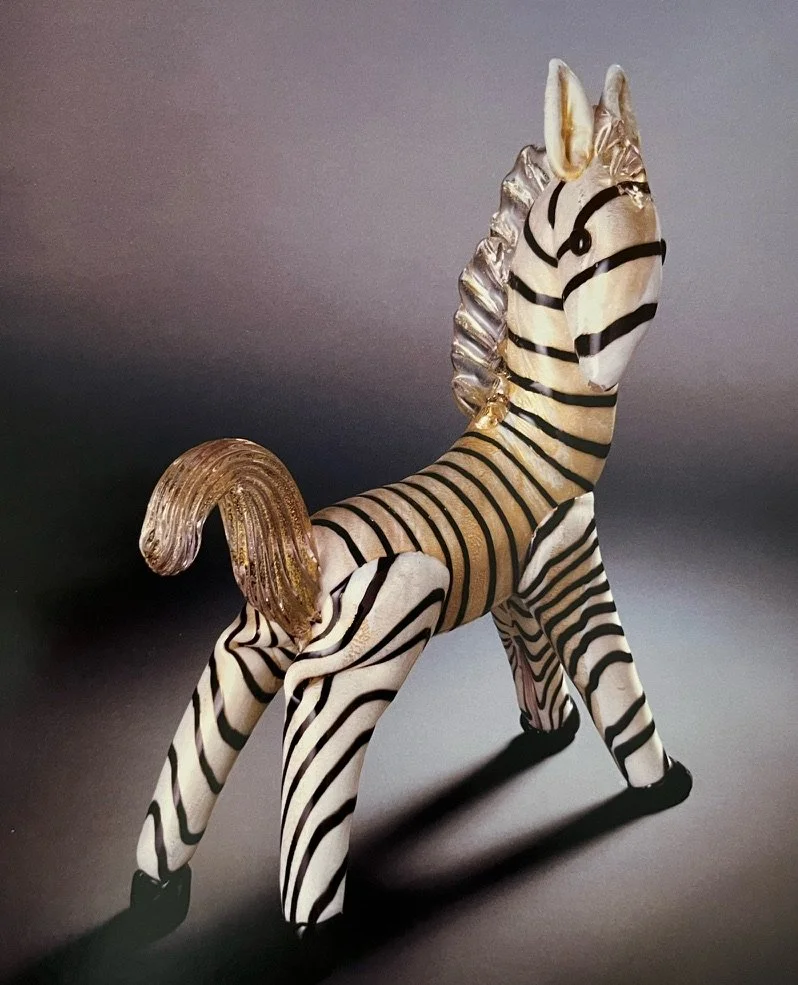
the forms are, the better." We need only witness his potted plants and animal
figures to confirm that this is not tourist glass. Here is hot glass manipulated
with sure skill and effortless finesse into living, almost surreal forms.
Ercole Barovier (1889-1974) of Artisti Barovier, later Barovier and Toso, was
the other major force in Italian glassmaking between the world wars. Vases such
as the one I call the Atomic Vase are both daring-- heavy glass was at the time
something new in Murano--and exhibit a love of unforced, fluid form; one design
won a prize at the Paris International Exhibition in 1937. Barovier's unusual
murrine vases reveal him as an innovator: individual rods of glass have been
sliced, arranged like a mosaic, and blown out into a bubble while in a molten
state. The cross-sections of rod, shimmering with a dusting of aventurine,
compose a grid that dissects the hollow space within the vase and maps the
expansion of the air bubble as it presses outward.
Detail of murrine vase by Barovier, c.1930 (Photo: George Erml)
Venetian glass of the late twenties and thirties must today be seen through the
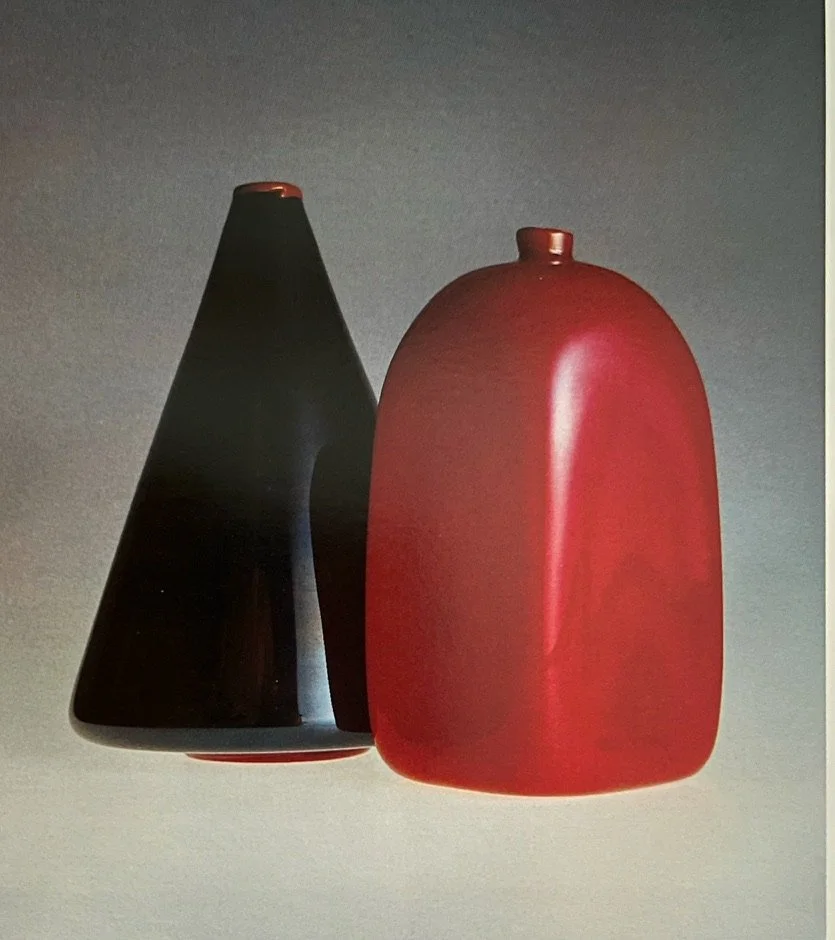
dark clouds of World War II. Within this context, Scarpa's little lattimo (milky
glass) bottles seem inspired, almost prescient, their surfaces clotted with
"infinitely luminous and hazy mists." Like Micol's antique lattimi in Bassani's
Garden of the Finzi-Contini's, they are harbingers of the future, places where
"she could let her gaze wander among the luminous mists of her beloved lattimi:
and then sleep, imperceptibly, like a Venetian high tide, would return slowly to
submerge and annihilate her. (4)
World War II failed to annihilate the functionalist style that predominated in
the decorative arts in the twenties and thirties. Nevertheless, that great
upheaval profoundly changed the rules of society and culture. Postwar Europe was
left to brood over its excesses; no longer the central arena for political
action, it was free to work out what a post-political society might look like.
Italy reveled in this unexpected freedom, release, and open-endedness, and the
fifties and sixties became something of a high-water mark for Venetian glass.
The duality represented by Scarpa and Martinuzzi was reworked, yielding to a
"clear-obscure" state that emerges in the engraved glasswork of Venini as well
as Thomas Stearns' The Facades of Venice . Such a state was not incompatible
with, indeed favored the development of, Fulvio Bianconi's (1915- ) singular
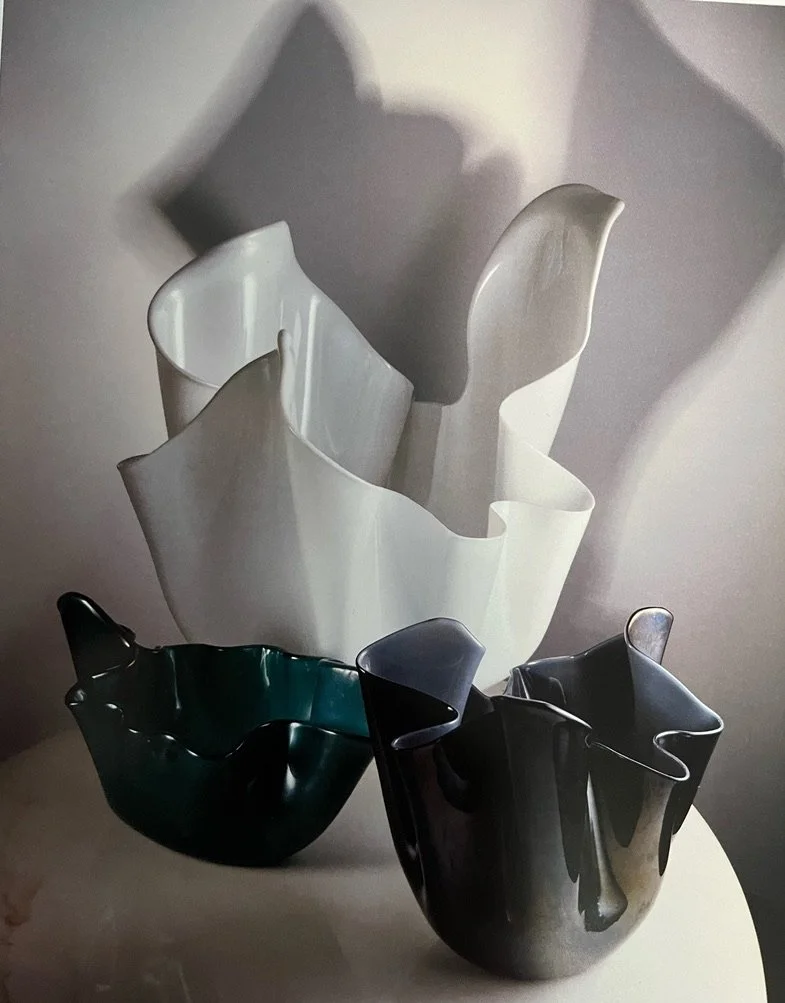
creations in a sometimes darkly humorous, Pop art style. Handkerchief vases
became at once the badge of Muranese elegance and a caricature of past glories.
Venetian glass of the postwar period was built upon ancient techniques, and much
of its vitality came from adapting these processes to contemporary ends. It is
difficult to believe now, but as late as the 1960s major factories on Murano
were still operating with wood-fired furnaces, laboriously stoked by apprentice
glassmakers who had to keep the temperature exactly right or risk ruining the
glass and filling the blowing room with acrid smoke. While oil and gas furnaces
slowly replaced the wood fired ones, the basic steps in glassworking have
remained essentially unchanged since the time of the Roman empire. Molten glass
is still extracted from the furnace on the end of a hollow metal rod, the
blowpipe. Anyone who has ever removed honey from a jar with a wooden stick will
be familiar with this process, although he will lack an appreciation of the
intense heat that pervades the glass factory. The blowpipe is continually
rotated to keep the gather of glass centered--as with our glob of honey.
Eventually, the gaffer or master breathes air into the pipe, forming a bubble
within the molten mass of glass at the opposite end. By shaping this bubble on a
metal table, the marver, and with simple wooden or metal tools at the
glassmaker's bench, the gaffer and his team of assistants can coax an amorphous
mass of glass into an infinity of shapes and sizes. Once the glass becomes
something--a vase, for example--a solid metal pontil rod is fused to its base
and the blowpipe is removed from the opposite end. The gaffer is then able to
open up the bubble and form the neck. If handles, a foot, or some form of three
dimensional decoration is required, an assistant can bring a specially shaped
solid bit of hot glass to the gaffer at the bench, where it is fused to the
object being made and cut off with scissors. One gains an appreciation for the
short working range of glass as a leftover portion of the bit, red hot and soft
enough to cut like butter, solidifies in mid-air and crashes into fragments upon
hitting the factory floor.
To prevent the vase from crashing apart, the gaffer will often hand his blowpipe
to an assistant who takes it to a furnace for reheating, where the rapidly
cooling glass is softened and made ready for reworking. When the entire process
is judged complete, the finished vase is cracked off from its pontil and goes
into another kind of furnace, the annealer, where gentle high heat slowly gives
way, over a period of hours or days, to room temperature, and the stresses that
have built up in the glass from all the reworking are relieved and diminished.
A majority of the pieces in this catalog were made following these ancient
processes, but with astonishingly different results. Compare Carlo Scarpa's
corroded relief vases with Dale Chihuly's Venetian vases and the work of Abimo,
Bianconi and Barovier. In Scarpa's 1936 work, hot bits of applied glass meld
into and become part of the structure of the simply blown vase: the old
unity-amid-diversity theme. The handles of the 1950s Corbusier vase by Abimo and
Bianconi's vase for Venini are blown hollow, connecting effortlessly into the
body of the vase itself and confusing the handle with the handled; in Barovier's
single hole Barbarico vase, handle and vase are one, the hollow blown space that
is usually within the vase turned inside out in a maneuver worthy of a
topologist. By 1989, Chihuly's exuberant solid bits become overwhelming handles
that threaten to replace the hollow vessel they adorn.
If the glassblower takes time in preparing a bit of molten glass, it is possible
to stretch that bit out like taffy to many times its length so that it reaches
from one end of the factory to another. The result is a slender thread, rod, or
cane of glass that may be cut up into short segments. If canes of different
colors and shapes are bundled together, reheated, and the stretching process
repeated, the resulting cane will reveal an intricate cross section when sliced
into thin tablets or murrina. Murrine vessels result from the fusion of many
such murrina. The Facades of Venice of Thomas Stearns, and certain details of
The Sentinel of Venice, likewise result from an arrangement of lengths of glass
rod that is fused to the molten glass bubble as it is pressed into the rods and
rotated. Filigree bottles and bowls are the result of an intricate multi-layer
pick-up process, working with extremely slim threads or rods of glass. Thus this
one process, exquisite in its simplicity, maddening in the difficulty of its
execution, has offered generations of artists the basis for highly personalized
interpretations. It could even be argued that the lovely Venini inciso
(engraved) vases, with surfaces the texture of old phonograph records, were
inspired by filigree vases, the hollowed out grooves but a memory of the
colorful and intricate threads of glass.
Space does not allow a full exploration of the variety and endless combinations
of techniques employed by the Muranese masters. Their creativity inevitably led
them to introduce parallel tendencies in the fine arts, for example abstract
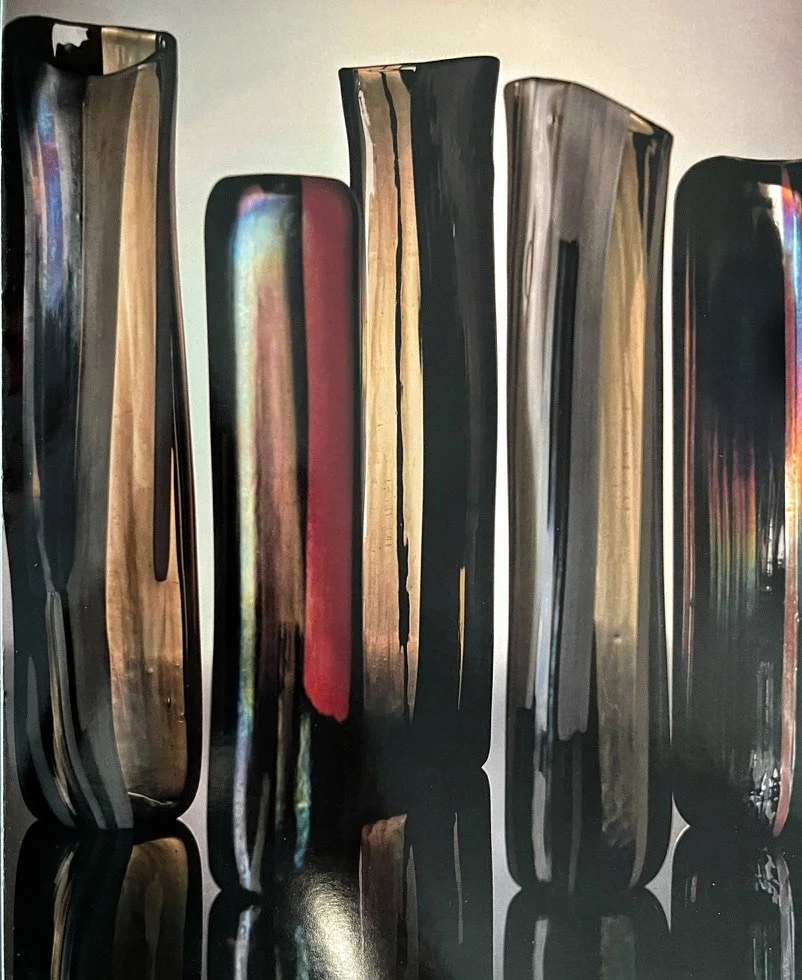
painting, to the glassmaker's stylistic vocabulary--Thomas Stearn's brooding
cylinder vases and certain highly colorful Venini vases come to mind.
Stearns forms the crucial pivot linking late abstract expressionism to the
emerging craft movements of the 1960s. It is a testimony to the continuing power
of these postwar works that many anticipate the styles of glassmakers working
today: one 1950s bubbly glass urn might be mistaken for a spun glass bowl by
Toots Zynsky if not for its conventional shape; the best of the inciso vases
have a subtlety that might not go unappreciated in the work of the Czech
glassmaker Frantisek Vizner; Handkerchief vases surely share a kindred spirit
with Dale Chihuly's baskets and seaforms of the late seventies and eighties, and
the murrine dishes of Venini might have inspired the work of Klaus Moje. Indeed,
many artists have worked in Murano and been influenced by what they experienced,
including Chihuly, Marquis, Zynsky, Marvin Lipofsky, Robert Willson, and Raoul
Goldoni.
The democratization of objects that was at the heart of functionalism--the idea
that anyone might own something beautiful--was expanded from the 1950s onwards:
Venini under the direction of Ludovico de Santillana opened its doors to foreign
artists while pioneers like Harvey Littleton in America devised ways to recreate
small factory furnaces suitable for artists' studios; and a mass audience, long
attuned to such common craft activities as cooking or gardening, began to make
"craft-art" at home. Craft, since the industrial revolutions more a product of
the technologically advanced factory than the studio, now also appeared in the
art school and shopping mall craft fair.
As the democratic horizons of functionalism expanded in the 60s and 70s, the
utilitarian functions inherent in the style were increasingly subverted. Craft
became, or rather its practitioners wanted it to become, art. The Stars and
Stripes Cup with four letter word murrine by Richard Marquis is a poignant
reminder that the democratic right to free speech was at last at large in the
craft world.
By the 1970s Murano was faced with a decline in skilled glassblowers (office
workers made more money more easily) and the rise of a new historical
revivalism: the post-modern. Excesses of the postmodern form the background
noise from which the best Venetian-style, although frequently not Murano-made,
glass of the period must be isolated: the works of Chihuly, Dailey, Marquis and
Tagliapietra, made sometimes in America, sometimes in Venice, always owing
allegiance to the best Venetian traditions and ideals: Integrity of craftwork
coupled with the comradery of teamwork redeems these objects. Their work stands
in relation to the postmodern as the work of Cappellin and Venini stood in
relation to the excesses of Salviati's ornate goblets.
Emerson writes about the inscriptions on the gates of Busyrane: "Be bold". On
the second gate: "Be bold, be bold, and ever more bold". On the final gate: "Be
not too bold." That in essence is the artistic legacy of the Venetians, now
passed along to America: achieve symmetry, fear symmetry. Deny craft, never
stray far from the love of craft. Delight in balancing the pungent with the
pure.
William Warmus
Endnotes:
1. Ada Polak. Modern Glass. London: Faber and Faber, 1962. Pages 54-69.
2. Francesco Dal Co and Giuseppe Mazzariol. Carlo Scarpa: The Complete Works.
New York: Rizzoli, 1985. Page 183.
3. Fumihiko Maki in Carlo Scarpa. Tokyo: a + u Publishing Company, 1985. Page
207.
4. Giorgio Bassani. The Garden of the Finzi-Contini's. New York: Harcourt Brace
Jovanovich, 1977. Page 86.