Tom Patti: Illuminating the Invisible
William Warmus
This is my essay from the book ILLUMINATING THE INVISIBLE by William Warmus and Donald Kuspit. Museum of Glass: International Center for Contemporary Art/ Tacoma, Washington, 2005. ISBN 0295984732.
Tom Patti creates small, intense sculptures from flat sheets of glass. He has adopted as his medium the common type of glass used in homes, skyscrapers, and automobiles—glass that is present practically everywhere human habitations exist.
It is difficult to think of an ordinary material that is less visible than window glass. But for Patti flat glass is a highly charged substance: “It’s the thing we see all the time but never recognize.”[1] By compacting and condensing and subtly manipulating individual panes stacked into blocks, Patti highlights the compelling texture, weight, color, and shape of the glass. His sculptures, all of which can be held in the hand, celebrate this ubiquitous material and make its hitherto invisible aesthetic tangible.
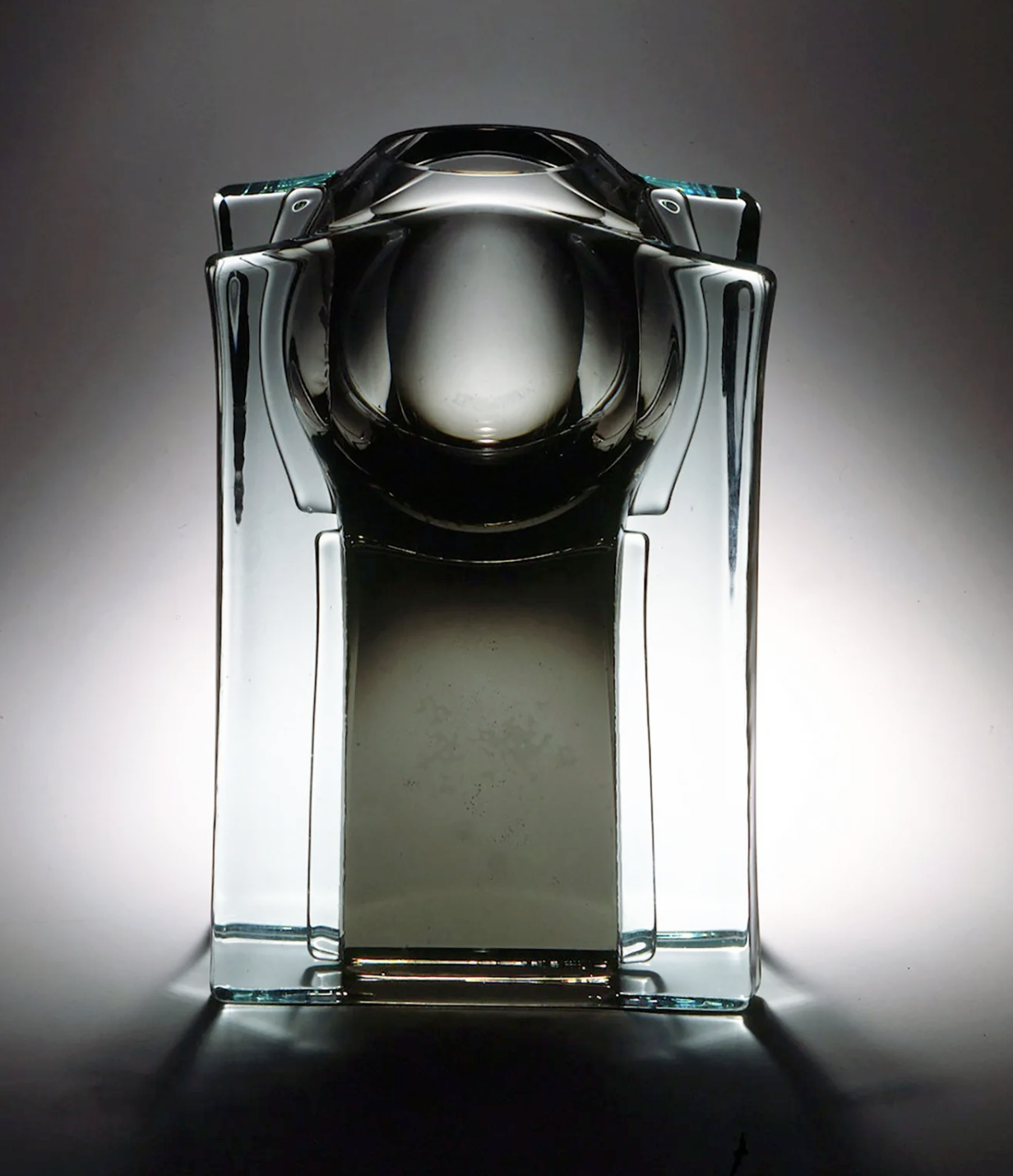
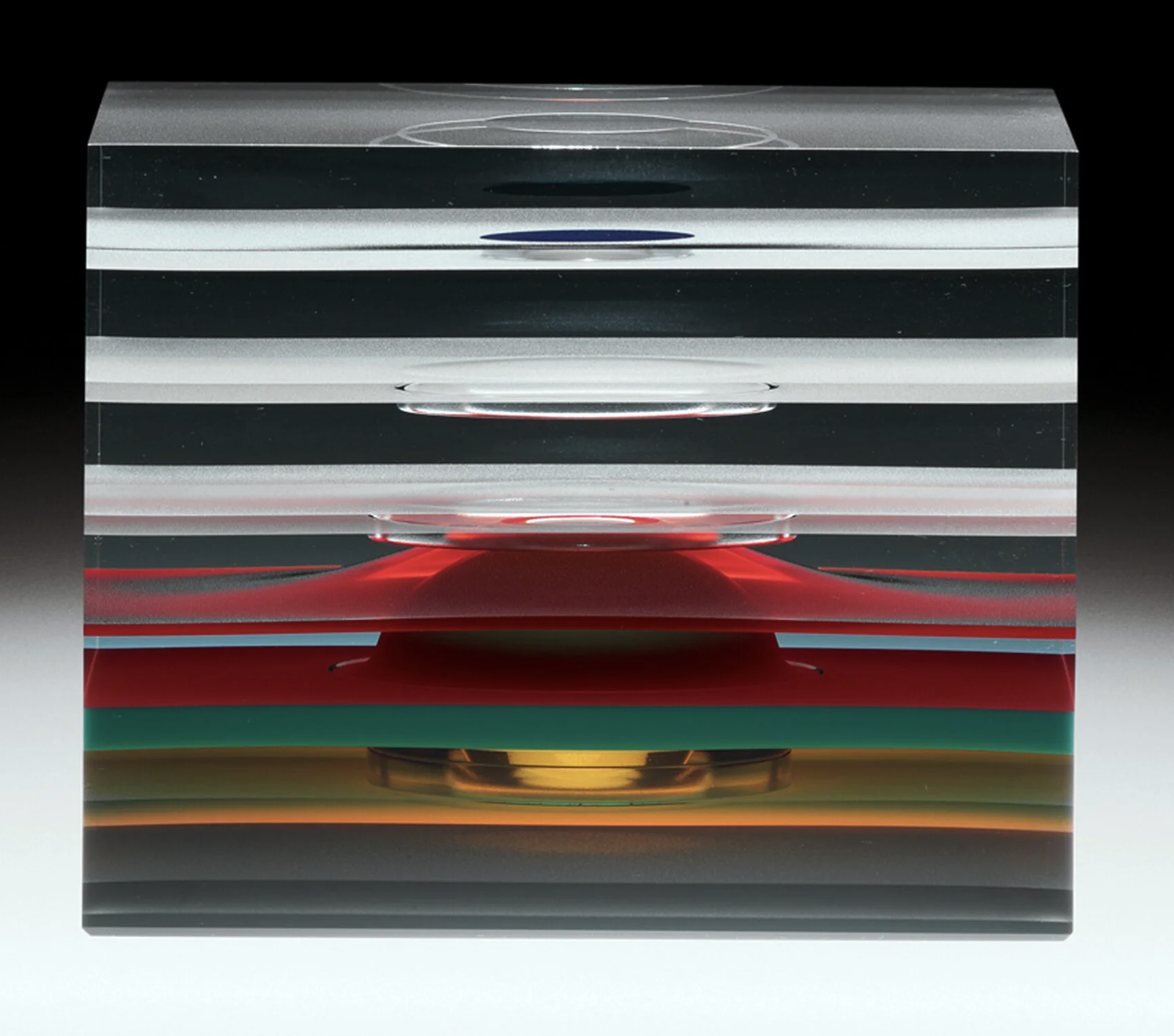
In a characteristic sculpture, more than a dozen sheets of flat glass of varying colors and thicknesses are stacked together and heated in a high-temperature oven. The intense heat causes the panes of glass to fuse together, as if they have been welded, creating a structurally unified mass. While the glass is in its molten state, Patti introduces air at the top of the stack, forming a hollow bubble that expands down into the interior of the artwork and leaves a subtle dome on the top.
Chances are good that you have looked through thousands of panes of glass of the type Patti uses without thinking about any of them. Glass is meant to let light through, and the thinness of each pane contributes to its invisibility: usually it’s only when the window is dirty that we pay attention to the glass itself, and then only in order to get out the squeegee and wash it. By stacking many thin panes together, Patti amplifies the hidden aesthetic quality of each pane of glass while creating works that possess a rich optical depth (see fig. X [illustration TP 282][OR reference by Title (year) and plate no.). He has created an aesthetic of flat glass where none existed before.
But if all Patti did was draw our attention to the hitherto underappreciated aesthetic aspects of industrial flat glass, this achievement would be a narrow one. His broader artistic accomplishment lies in his creation of a series of sculptures that work both abstractly and metaphorically.
Sublime Abstraction
Exploring the world and our place in the world is a traditional project of the artist. Patti, however, conducts his explorations by engaging with the “high art” traditions of western art rather than the mass culture preoccupations of Pop Art, which was dominant when he began his artistic career. While he uses a mass-market material in his art, Patti falls into the sublime tradition of art making represented by the Abstract Expressionists Mark Rothko and Barnett Newman, and more recently by James Turrell, especially Turrell’s Sky Windows series from the 1970s, architectural constructions that frame the sky and draw attention to its subtly shifting colors. Patti has less in common with the Pop Art of Andy Warhol or Jeff Koons.
Instructively, a sculpture series by Koons resembles Patti’s work in structure but is its conceptual opposite. Works in the Tanks series, created around 1985 (more than a decade after Patti started his flat glass sculptures), consist of basketballs suspended in aquariums filled with liquid: like Patti’s sculptures, they contrast sheets of flat glass with an inflated hollow sphere (the basketball) in the center. But Koons has said that his goal was to take an everyday object with mass recognition, isolate it, and use the new context to transform it into another type of thing (here the basketball becomes a womblike or cellular object). Unlike Koons, whose appropriated preexisting objects retain their identity in the finished sculpture, Patti relishes the process of transforming his commonplace material (flat glass) into something both tangibly and conceptually new by heating and fusing and distorting it.
From the start, Patti set very demanding standards and goals for his work in glass, determined to see his artwork take its place beside painting and sculpture as an equal, appearing neither trivial nor decorative in comparison. Patti brings a level of seriousness to his work that sets him apart from many working in this medium. He is among the most contemplative, the most introspective, of artists. The quality of much art making can seem uncomfortably loose, even careless, when compared to Patti’s soul-searching sensitivity.
For example, Patti (who is fond of making apparently cryptic remarks) once said, “I have all this stuff around my bench, including three kinds of clear glass. Three months later I’ll notice they are all different colors.” The glass didn’t change, but it took him three months to notice that the three panes of supposedly clear glass were in fact subtly different colors. Much of Patti’s work seeks to slow things down and urges us to observe the world with greater care. This level of subtle awareness contrasts again with the project of Pop Art and the mass media, where images are often selected so that the viewer can speedily see the difference and get the point at a distance and with minimal contemplation: the language of advertising is not Patti’s idiom.
On a very basic level, Patti’s sculptures work abstractly. They isolate the specific properties of flat glass and emphasize them: the sculptures abstract or tease out thickness, color, pliancy. Some works make us appreciate the edges of the panes of glass and their varying thicknesses, and others are studies in a particular color or in several subtly contrasting colors. In many works, the interior bubble deforms the sheets of glass as if to reveal their particular strength and resiliency. Occasionally Patti will seek to remove properties, like the reflective shine we encounter when a pane of glass, seen in broad sunlight, turns a window into a glaring surface.
The Language of Glass
But Patti also came to see flat glass as a raw material that he could use to create a rich language. Patti’s sculptures are metaphorical expressions of architectural structures, the landscape, and life forms. Many of the sculptures are constructed like buildings, visible in cross-section floor upon floor; these eventually will inspire Patti’s large-scale works, glass structures that are fully integrated into buildings. For other sculptures, the artist takes the gaze conventionally directed at a landscape seen through a window and angles it inward. Panes of glass, usually mounted vertically in window frames, appear in Patti’s sculptures in a horizontal position: the only way we can “look through” these windows is to look through their edges. In doing so, we find that the artist has directed us, not outward toward the landscape, but inward to the private structure of the object. Finally, the organic way that Patti manipulates glass parallels the way living forms grow in nature, most apparent in the vessel sculptures: in the exoskeleton works, certain panes of plate glass project beyond the edge of the bubble to form a configuration reminiscent of the exterior skeletons of insects.
As a college student, Patti read D’Arcy Thompson’s great work On Growth and Form, first published in 1917, and avidly noted the sections about the glassblower:
It was Oliver Wendell Holmes who first showed this curious parallel between the operations of the glass-blower and those of Nature, when she starts, as she so often does, with a simple tube. The alimentary canal, the arterial system including the heart, the central nervous system . . ., all begin as simple tubular structures. And with them Nature does just what the glass-blower does, and, we might even say, no more than he. For she can expand the tube here and narrow it there; thicken its walls or thin them; . . . bend the tube, or twist and coil it . . . the human stomach . . . is simply an ill-blown bubble, a bubble that has been rendered lopsided by a trammel or restraint along one side.[2]
Patti’s work reflects the creations of Nature as each handheld sculpture becomes a world unto itself, whether an interlocking architecture, an inward-directed landscape with the horizon adjusted to meet our eye at close range, or a blown biomorphic form.
The Studio Glass Movement
By the time of World War II, glassmaking had become a highly industrialized process. The sixties saw the emergence of the studio glass movement, defined by its ambivalent relationship to industry and spearheaded by the artist Harvey Littleton. Studio glass artists, dedicated to an at times radical aesthetic of experimentation, adapted industrial equipment such as furnaces to the more intimate setting of the artist’s studio and worked to integrate glassmaking as a program of study into studio art courses at universities worldwide. During its most radical stage, studio glass artists adhered to the romantic ideal of the artist working alone in the studio without assistance, and the dictum ”technique is cheap,” attributed to Littleton, came to signify that ideas trumped glassblowing skill or conventional materials.
Patti also began to adapt industrial machines and materials to the needs and scale of the artist’s studio. But in comparison to other studio glass artists, he steered a more moderate course. He has always respected the products of industry and is not averse to resorting to the factory if it can provide him with the tools and materials he needs to make his art. This difference in attitude is evident in his work. While much studio glass, especially from the 1960s and 1970s, has a rough, homemade, even folk art quality, Patti’s work of the same era shows an allegiance to an industrial design aesthetic in its crispness and elegance.
While Littleton, the acknowledged founder of studio glass, traveled extensively in Europe to research the history of glass and forged links with university and museum administrators in this country, Patti drew on his personal experiences. During his studies at the Pratt Institute in Brooklyn, New York, he pursued a degree in industrial design, exploring prototype membranes either for the human body (where the membrane would activate switches as a part of the body moved) or for housing. He developed a material that, once inflated, became rigid, then investigated novel means of pressurizing such a system. After college, he began a series of playful experiments, from casting ice to turning plastic straws into self-contained blowpipes (the material blown being the material of the straw itself). Given his exploratory nature, once he turned to glass, he became interested in experiments combining the two classic methods of working with glass.
From ancient Egypt through the Middle Ages and into the twentieth century, glass has been worked in two very different ways: formed as a hollow shape around a core, which might be something as substantial as earth or as ephemeral as air, or formed as a flat, thin sheet, like the inlays on Pharaoh Tutankhamen’s golden mask or the stained-glass windows of Chartres cathedral. These are the two great traditions of glass, represented in modern times by the light bulb and the skyscraper.
It has long been common to blow a glass cylinder and, by cutting it apart, create panes of window glass that give no obvious clue to their origin in a blown hollow; you might say that their flatness denies their origin. Patti, however, was perhaps the first to combine blown and flat traditions in glass when he formed a hollow object by introducing a bubble of air down through a stack of plate glass sheets that had been heated to a molten state. Patti says that he needed a way to get inside the stacked sheets of glass so that he could manipulate the interior: the bubble of air became his tool. The result was a melding of two great art traditions—the two-dimensional realm traditionally represented by painting and the three-dimensional realm of sculpture—into a single artwork.
Where Littleton’s studio glass movement extended the ongoing evolution of the history of glass, simply moving the traditional glassblower from the floor of the factory to the artist’s studio, Patti ruptured the evolutionary continuum by adopting a wholly different practice. He avoided, for example, any link to traditional glassblowing. Patti himself admits, “I was inept. I’m not a glassblower.” He adds, “Littleton invented the studio furnace; I eliminated it from the studio.” His methods of working glass, which are concentrated and considered, run counter to the frenetic activity of the traditional glassblower, who must constantly move on the floor of the studio from the bench, to the furnace, to the glory hole (where the glass is reheated), all the while rotating the blowpipe so that the honeylike molten glass does not drip off onto the floor. Rejecting this approach, Patti developed a slower technical process that allowed him time for contemplation: “When you feel you’ve got to get up, don’t get up; stay at the bench.” Patti became a true original by staying put.
Chaos and Stability
Behind Patti’s childhood home in Pittsfield, Massachusetts, is a field of burdocks and densely tangled vines that is the remnant of one of General Electric’s junkyards. According to the artist, “The landscape behind the house was the GE factory.” He speaks fondly of the discarded oddities he found there, disposed of in less environmentally careful times, having learned that the child will find treasure in the least likely of spots: “Invention is an art. You make a discovery, you stay with it, you make it meaningful, you make it human.” In a sense, that has been his project these past six decades: to humanize the industrial junk that mesmerized him as a child.
In a 1981 interview, Patti observed, “The child will take the ball and tend to roll it; the adult will take the same ball and try to stop it. It’s a certain thing that I can’t explain but that I can accept. The child in me loves the spinning and the rolling and the chaos of glass, and the other part of me tries to stabilize it, to logically deal with it, to hold things in time and space.” Patti enjoyed the innocent, experimental, forgiving nature that studio glass exhibited in the sixties and seventies. But how do you stabilize chaos and make an enduring contribution? His work since the sixties is an answer to those questions.
In the 1960s, Patti left western Massachusetts long enough to earn B.I.D. and M.I.D. degrees from the Pratt Institute, but he soon returned to his native Berkshire Mountains, close to family and friends and factory junkyards. Leaving the center of the art world to pursue an art career was perhaps the first sign that Patti was something of an anti-rebel. While the style of dress in the sixties art community veered toward worn blue jeans with patches, Patti—although struggling like many of his contemporaries to make a living as an artist —could at times be seen wearing a suit. He knew that some artists, even relatively affluent ones, played the role of the impoverished artist because society expected such behavior, but he saw that as a frivolous affectation at a time when the country was in turmoil, struggling with the war in Vietnam, the relentless assaults on the environment by big industry, and the growth of a contentious counterculture. Patti wanted to present himself as someone serious because he wanted his art to be taken seriously. Of course, as studio glass gained the respect of museums and galleries and collectors in the 1990s (and as prices for studio glass escalated dramatically), sightings of artists in suits became far more common.
In the early 1970s, Patti’s wife, Marilyn, ran a truck stop and diner in Adams, Massachusetts, where he often helped out by washing dishes. He had a dirt-floor studio in Savoy, full of scavenged equipment, where his experiments with glass included playing with an absurdly long 20-foot blowpipe—he thought at the time that the pipe itself was the interesting part of the work. One day he surprised some visitors to the studio, who walked in to see glass being worked at the end of this long pipe that seemed to have a life of its own as Patti controlled it from around a corner. Other times he would gather glass with three pipes, just to see if he could do it and because he was curious about the kinds of objects that would result from such an awkward process.
By the mid seventies, Patti’s work was attracting more attention within the art community, and in 1975 he lectured at the Rhode Island School of Design in Providence, where Dale Chihuly had founded a studio glass program. Both Patti and Chihuly are limited to the use of one eye because of injuries sustained early in their careers, but Patti notes that this constraint set them on widely divergent paths in their art. Chihuly, who found that the lack of depth perception made it increasingly difficult for him to blow the intricate glass objects that he designed, embraced the team system that has come to define his style. Patti, on the other hand, curious about his limited depth awareness, began to design objects that were studies in perception. He created objects that could be held in the hand at arm’s length, easily moved and rotated before his eye as he investigated ever more subtle optical effects. The scale fit the project: his intent was not to make a massive telescope for studying the universe, but to devise an intricate microscope for exploring inner space.
Patti appears to relish limiting circumstances, treating them as an opportunity for insight. During a two-week course at the Penland School of Crafts in North Carolina that he attended in the 1970s, many of the glassblowing demonstrations took place after lunch when Patti was in the kitchen washing dishes as part of his work-study program. Though he missed seeing how things were done, examining the objects only after the fact, he feels that he learned more this way: “Invention starts by trying to think about how something was made,” he says.
Some of Patti’s earliest surviving works are culletlike chunks of white glass. Made at his Savoy studio, they owe more to Patti’s earlier research into inflatable latex structures than to the history of glass. These works share a common theme: they are diagrammatic and information generated. One (non-glass) piece, Title (year), consists of coordinates in space marked on a card, instructions for generating a house built by a machine. In Title (year), a solid chunk of glass is fused against the edge of another chunk that has been blown open roughly; air is the tool that has shaped (or diagrammed) the sculpture, although the control of the process is crude at this stage. A later work, Title (year), shows two sheets of opaque white glass stacked and fused together with a bubble of air sandwiched in between. Patti has started to use air to shape his “canvas,” with the sheets of glass acting to “program” the progression of the air. The bubble is no longer crude, but fresh and spontaneous.
Soon the first vessels appeared. Title (year) is flesh toned with a clear band running vertically down the center: an opaque vessel hollowed out by air and split by light. Another vessel, Title (year), alternates bands of green and white, the green being the color of plate glass seen edge on (most window glass seems clear but in fact has a slightly green tint due to iron impurities in the sand that is a raw material of glass). Color will become increasingly important as a means for expressing mood. While Patti’s early gray works owe an allegiance to the industrial design aesthetic so evident in 1950s and 1960s glass, they also seem to convey the gray-hearted mood of industrial life. By the early 1980s, the works have become darker, more brooding, almost black. Then, just as it seems that Patti has squeezed all the color out of the work (or perhaps, like a black hole, absorbed all the light), he will begin a fresh series that uses shades of intense red, evoking sunrises and sunsets.
Cubing the Sphere or Sphering the Cube
Patti’s first important one-person exhibition was held in 1977 at the Contemporary Art Glass Group Gallery in New York (later Heller Gallery). Preparation for the show and the need to title each work sent Patti in search of a name for the innovative technique he had developed. Laminating? Fusing? Layering? He finally settled on the phrase “blown laminated glass.” For individual titles, he grouped together words that describe aspects of each object. Compacted refers to the technique or character of certain fused works, Solar is the trade name of one type of sheet glass, and Gray is the color: hence, the title Compacted Solar Gray.
From the beginning, Patti made a conscious effort not to name things within what he sees as a romantic tradition, which was in keeping with his project to de-emotionalize glass. This effort went against the prevailing fashion. In the seventies and into the late eighties, when others were making Art Nouveau, Venetian-style, or even Pop Art-inspired glass, a sculpture by Patti formed a distinct contrast: it had all the drama and expressiveness and tactile interest of these other works, but these qualities existed inside and around the work rather than on its surface. “Romanticism,” Patti says, “is a curtain in front of empty space. My work should make the viewer search.”
In keeping with this evolving philosophy, at a time when craftspeople regarded a “handmade” quality as a part of the essence of their art, Patti sought to “take the fingerprints off the work.” His work looked machine made, although in fact it was more laboriously handmade than most “handcrafted” objects. In this respect, Patti’s art participated in the project of Minimalism, which also sought to remove the “hand,” or the brushstroke, from the work in a reaction against the emotive excess of Abstract Expressionism. The idea was that a “minimal” surface would allow viewers a purer and more powerful experience of form, color, and space.
As glassmakers began to gain the attention of the art world in the late seventies and early eighties, Patti’s career took off. In 1979, New Glass, a worldwide survey of glass organized by the Corning Museum of Glass in Corning, New York, featured Patti’s work on the cover of the catalogue as well as in the poster for the show. The survey traveled to the Metropolitan Museum of Art in New York, the first studio glass exhibition to be shown at the museum, which had just acquired one of Patti’s works.
Many glass artists reacted to the increasing public enthusiasm for their work in predictable ways: they made the work bigger and more “difficult,” reflecting the prevailing trends in other arts. At the same time, as workshops and technical manuals proliferated, showing the novice how to make glass without any need for the trial and error experimentation of the earlier period, a stylistic homogenization grew. Patti saw what was happening but steered steadily along his own course. Noting the changes overtaking glass in the 1970s, Patti observed, “Glass was hard and that attracted certain types. Now it’s easier, and that has opened the way to a change in tolerance.” Patti saw his own hard-won success as a similar challenge, a “change in tolerance” that could affect the integrity of his work. He responded by keeping some of the parameters rigorously the same: for example, he kept his work at the same hand-held scale rather than pumping things up to play to the expanding commercial market for the new medium.
Banded Bronze (year) [plate?], which appeared on the cover of the catalogue for the New Glass exhibition, looked like a traditional vessel but wasn’t. In fact, it was interesting because it was a hybrid, making reference to both of the traditional forms in glass: vessels and sculptures. It pointed simultaneously backward to the triumphant, industrially designed glass that the Corning Museum had featured in 1959 in its first world survey of contemporary glass, Glass 1959, and forward to a time in the 1980s when the aesthetic of glass sculpture would supersede functional vessels among glassmakers.
In Banded Bronze and its immediate successors, the cube (an artifact from the square panes of plate glass, which when stacked formed a solid rectangular mass prior to their fusing in the oven) asserts its presence forcefully against the vessel-defining bubble. Is Patti “cubing the sphere,” as writer Paul Hollister has suggested, isolating the blown shape of glass and so opening the way for a more abstract sculpture? Or is he “sphering the cube,” seeking to deconstruct the mechanical rigidity of industrially produced plate glass? One recalls what happened in abstract painting when artists began to modify the traditional, and confining, rectangular shapes and wooden frames of their paintings. As painters like Kenneth Noland devised canvases that were diamond shaped or even curvilinear, they found the process liberating.
Patti shared that exhilaration as he melded the two contradictory traditions of glassmaking, blowing “glass into a cube, creating straight edges when all the time its molten nature is saying round.” In effect, he introduced the edge into the (blown) glass world. By merging the two practices, he created something entirely new: “You get so far out that you lose touch with the past.”
Indeed, the past traditions in glass were under increasing challenge. As the 1980s progressed and Patti moved with Marilyn to Plainfield, Massachusetts, the glass community found itself divided between those who would make glass a medium for sculpture, and thus felt compelled to jettison glassblowing as tainted with the tradition of the vessel, and those who continued to create vessels, but more as an athletic contest of glassblowing skills without regard to the artistic possibilities of the vessel. Patti was in a unique situation to bring both traditions together.
The air that makes the hollow bubble is, of course, always of a perfect transparency and purity. Air became Patti’s armature, his blank canvas, “fixing” the painterly medium of glass. Postwar painters struggled to free color from structure, an effort that reached its apogee in the stained canvases of Morris Louis and other Color Field painters, but no matter how gossamer their infusions, color was always restrained by the canvas and its wooden or metal supporting structure. Jules Olitski once spoke of his wish to discover a means of spraying color into the air and coaxing it into staying in place. Patti in a sense has realized Olitski’s vision as the hollow bubble of air invisibly defines and shapes the diaphanous masses of color within the glass blocks.
The bubble of air also introduces light, which simply and powerfully evokes the spiritual. Patti was raised close to the Catholic Church: he almost became, like his brother, an altar boy. Patti has said that the Solar Risers series he began in 198?? [Marilyn to provide] represents the entry of a spiritual element into his work. One senses that new element in the soaring dynamic created as the bubble, lifted on its plate glass wings, gathers and radiates light. The edges of the plate glass, which seemed in the vessel works to act more as decoration, now begin to act like fields of color. For a moment, the forces of the cube and the bubble move in concert.
As the eighties progressed, Patti’s work became denser, more compact, and more compressed. It was as if the radiant spirit of the Solar Riser works were being embedded in a frozen fog of gray or black glass. In sculptures like Title (year) [Corning piece c. 1982-4], sheets of very dark, almost opaque glass dominate the stacks that form the sculpture, interspersed with a few transparent sheets. The dark sheets appear to absorb most of the light, acting like a vise to squeeze the light out through the thinner transparent ones. These highly introspective works, while supremely self-assured, seemed out of place amidst the glitz and frenzy of the decade, both in glass and in other art media.
An Architectural Art
The late eighties and early nineties marked the end of Patti’s use of the vessel form as a vehicle for the investigation of light and space. What has followed is concerned purely with light, color, and structure, as interpreted though a series of virtual horizons. Patti has observed about this more recent work, “Vertical work struggles upward against gravity. In a horizontal plane, everything appears at rest. It’s easier to travel through a horizontal. I took the object and made the viewer move through the planes that are within the object, instead of around the object itself. I made them do things they don’t necessarily do when they look at sculpture.”
Drilling through the horizons of Patti’s work from the 1990s are interior structures, some of which look like hollow rings or bands. Sometimes they sparkle with a silvery sheen or, like Title (year) [Illus TP 267D],evoke the rippling of water in a pond when a stone is tossed onto the surface. Other structures, including Title (year) [Illus TP256 D, which is a detail], resemble dissected technological forms or exploded architectural drawings. Patti says that he was “trying to give the core a greater physical presence than the glass that it was embedded within.” He has moved from his original Minimalist preoccupation with the fusion of industrial glass. The hollow core is now achieving ascendancy over the sculptural block.
In 1980, General Electric commissioned Patti to create a large sculpture for its plastics research facility in Pittsfield. GE gave him access to some of its high-technology fabrication facilities, and Patti incorporated these new processes into the sculpture, which he made largely of laminated plastics. Patti views the central oculus of the work (see fig. X [or identify as Title (year) and plate no.?]) as symbolic of the eye of GE—or the eye of the CEO of GE. More importantly for the artist, though, the change in materials and scale, and the access to new technological possibilities, encouraged him to begin pursuing architectural-scale projects.
From 1993 to 1996, Patti was engaged in a project to incorporate his work directly into the structure of a building at the Owens-Corning corporate headquarters in City, State?? [Marilyn to provide]. To that end, he created a wall that was twenty-eight feet long and twelve feet tall (see fig. X [or identify as Title (year) and plate no.?]): “I was interested in work that was integrated rather than hung on the wall like a painting or set on a pedestal. This wall is a physical, interlocking element of the building.” As in the GE project, Patti received access to Owens-Corning’s facilities and machinery, allowing him to investigate new manufacturing processes for use in creating the installation.
Other projects followed, including windows for a synagogue in City (year) [Marilyn to provide], the entrance to the upstairs main gallery of the Museum of Fine Arts, Boston (2000), a wall for the Mint Museum of Craft and Design in Charlotte, North Carolina (year), and two projects scheduled for installation in 2004 in New York, one at Morton Square, a residential structure in Greenwich Village, and another at the Roosevelt and 74th Street subway station in Queens.
Patti’s architectural work, made primarily from flat sheets of laminated glass, seems to have evolved from his sculptural blocks, if now on a massive scale. It’s as if he took a steamroller and flattened the dense blocks of his eighties work into thin sheets that contain within them an ephemeral, ghostlike embodiment of all the inner structures of the sculptures. After two decades of creating sculptures that were in some ways like miniature buildings that viewers could hold in one hand and peer into, Patti effectively decided to explode those forms wide open so that he could literally walk inside his own work and take a look around.
One of the most elegant and magical of the architectural works Patti created is a simple front window for a gallery that sells art jewelry in Lenox, Massachusetts. From a certain distance, the window appears to be steamed up or perhaps covered with a thin layer of frost. As you move closer to the glass panel, the murkiness gradually disappears, but not over the entire window—visibility sharpens only within a narrow circle closest to where you are standing. If you move to either side, the area of clarity moves with you. It is as if a tangible atmosphere inhabits this pane of glass. What’s more, this is an intelligent atmosphere that responds to the person looking through the glass by modifying its density and opacity.
Aside from its unusual optics, the window addresses another of Patti’s concerns in his architectural work: safety and security. The laminated panel is safety glass, providing an extra degree of protection for the gallery, even as the hazy atmosphere the window projects adds an aura of intrigue and mystery to the space.
Transformations of Light
Patti has said that he is “not interested in producing illusion,” and yet a work like the Lenox gallery window seems to be an engine for creating fantasies. But of course what he means is that he wants the real thing, the actual substance of light, and not its representation. “The history of painting,” he says, “is applying the illusion of light to canvas. Painting represents light with paint.” In contrast, he continues, “Glass captures light and seems to be the light.” In the window in the Lenox gallery, Patti goes further, using the glass—through a trick of layering and lamination—to transform light into a distinct atmosphere.
This concern with fluid transformation informs his treatment of edges and the transitions between parts that seem to be a key to his work: “I think that there is something interesting about my need to eliminate joints and connections, and glass let me do that.” Before Patti, if artists wanted to layer glass, they glued it. But Patti was drawn to that mundane edge between materials and the subtle exchange made possible there: as he says, “I eliminated the glue.” In the process, the element between surfaces became a pure, unencumbered space. For Patti, the planes of interface in glass—for example, where two colors meet—are more interesting than the “mud,” or the traditional amorphous gather of glass. And so he came to emphasize the horizon lines in his work, the places where different colors, or sheets of glass, meet and are fused.
Given Patti’s attention to the transformative possibilities of light, viewing his work edge-wise makes sense: we can see how the glass “captures” and channels light. Contemplating one of his block sculptures, we seem to be within the canvas rather than perpendicular to it, as with traditional easel painting. After creating this three-dimensional canvas, one that channels the light (and channels us into it), Patti “marked” it, not with a paintbrush, but with an expanding bubble of air. Unlike paint, this transparent mark transforms the material work, dramatically reshaping the plates of glass even as it is shaped itself by the strength of the plates that it seeks to deform. Painting and sculpture have become one.
This transformation has to do with implied motion as well. Many artists such as Marcel Duchamp and Noland experimented with colored disks and circles as vehicles for conveying motion or evoking a spinning movement suggestive of unlimited space. These experiments, however, were always within the confines of the picture plane. Patti takes this concept a step further in his most recent work, creating a gyroscopic form of concentric circles and spheres that probes the center of his fused glass blocks and measures their static inertia even as it energizes the space, which is structured by horizontal planes of transparent color. The inferred motion of the drilled concentric and stacked circles inside Patti’s works locates the work in space, centers it, and establishes the horizons. One thinks of the mechanical gyroscopes that serve to stabilize structures like the Hubble space telescope or the “artificial horizons” found in aircraft instrumentation.
Patti’s innovation is in finding a new means to center an object, and he can do that because—unlike monolithic stone or bronze sculpture, or the hollow container forms of ceramics—his materials, glass and air, are transparent. By using a transparent medium, Patti can build from within knowing that all of the inner layers and structures will remain on display. We see the spinning forms at the center. The horizontal planes of color “see” them, too, and are energized as they channel the sparkling beams of light reflected by the gyroscopic interior structure.
Just as the gyroscopic interiors symbolically free these sculptures from gravity, the use of artificial light in some of the works make them symbolically independent of the sun. Title (year) is a work arranged to be lit from beneath. During the day, sunlight illuminates the sculpture, while at night the underlighting takes over. At dusk the two sources of illumination are in a shifting contest for dominance. In a sense, the work is never “on or off”—it is consistently changing, although, as Patti says, “you can’t remember the subtle changes from minute to minute.” With the “sun” under the object as well as above, Patti evokes a pre-Copernican world where the work is at the center, circled by the sun, though he sees it as a more universalizing gesture: “Now my piece is one with the sun.”
The World in Your Hands
The argument can be made that art in the twenty-first century divides into two camps: the narrative and the formal. One school seeks through narrative means to present to its audience an opinion about the great political, social, and moral issues of our era. The other school exists somewhere above the horizon of current history. It considers the ultimate goal to be the creation of a world where the individual is free to pursue truth and beauty, and it seeks to express the spirit of such a utopian world by creating beautiful work.
The scholar Eric Auerbach makes this distinction in contrasting the works of Homer with the Bible:
The Homeric poems conceal nothing, they contain no teaching and no secret second meaning. . . . [I]nterpretations are forced and foreign, they do not crystallize into a unified doctrine. . . . It is all very different in the Biblical stories. . . . [If they] produce lively sensory effects, it is only because the moral, religious, and psychological phenomena which are their sole concern are made concrete in the sensible matter of life. . . . These two styles, in their opposition, represent basic types: on the one hand fully externalized description, uniform illumination, uninterrupted connection, free expression, all events in the foreground. . . . On the other hand, certain parts brought into high relief, others left obscure, abruptness, suggestive influence of the unexpressed, ‘background’ quality, multiplicity of meaning and the need for interpretation. . . . [3]
Patti’s sculptures aspire to encompass both styles. Despite their sublime elegance, his work is never purely formal. It suggests a narrative, or Homeric, dimension by inviting the active participation of the audience. These are not works to be passively admired. Ideally, you should hold them in your hand, draw them close to your eyes, and read them as you would a book, scanning the horizontal planes. And yet these sculptures also possess the mystery and multiplicity of Biblical literature. This is a world of brilliant transparency darkened in many places by multicolored shadows.
Patti is intensely concerned with reconciling opposites. Almost any sculpture by this artist reveals a fusion of opposites: uniform illumination and obscurity, uninterrupted connection and abruptness, foreground events and background quality. While it is true that Patti has succeeded in fusing the two distinct traditions of flat glass and glassblowing, it seems his greater accomplishment has been to create a body of work this is both narrative and formal.
In that sense, Patti’s art continues an agenda older than the Greek and Biblical narratives. I see it as reaching back to late prehistoric Egyptian art of around 3500 B.C., in particular to a series of decorated stone palettes (slate slabs often decorated with low-relief sculpture). The Egyptians of that era were exploring a very special type of narrative art. These are not traditional western images, nor are they meant to be “read” in the way we read most images or stories in western art. They differ from later Egyptian art where stories, as in the Bible and Homer’s epics, are for the most part linear, scanned in a particular order with a consistent flow to the narrative structure.
The Hunters Palette from the late fourth millennium, now in the British Museum, London, is a carved stone cosmetic palette shaped like a smooth arrowhead but much larger (see fig. X [it might be useful to have a reproduction of this palette here]). In the center is a circular depression that would probably have held a cosmetic substance. The decoration consists of three rows of figures running the length of the palette: the two outer rows are hunters whose feet press against the row of animals sandwiched between. Having presented the opposition between civilization and nature, the narrative registers a confrontation between the two when the hunters surprise a lion and attack it with arrows.
For some scholars, the scene is a pure chaos of people and animals. But Whitney Davis makes a convincing argument that these works are a type of abstract narrative where the plot unfolds in the motion of the work.[4] He suggests that the palettes were intended to be rotated and (in the case of objects with decorations on both sides) flipped over for the viewer to construct a story line. Rotating the Hunters Palette dissolves the “chaotic” distribution of figures and reveals a stratification of zones, with the animal realm of nature compressed between the hunters’ zone. In one palette position, the figure at the top fires an arrow, but only by rotating the palette can we see that that arrow flies off the object itself, into the space of the viewer (metaphorically, of course!), before it returns to the surface of the palette to find its target: the attacking lion. The viewer is invited to literally chase after a possible narration and try to capture an interpretation by moving the object in space. Because the narrative is not strictly linear, it is possible to make several different and equally valid interpretations from the same object.
Patti’s sculptures work in an analogous fashion, but instead of realistically depicting hunters and lions, they employ an abstract vocabulary. Perhaps Patti’s most profound achievement has been to restore a type of open-ended narrative in motion to the world of sculpture, one that had been, for the most part, ignored since prehistoric times. The initially inscrutable silence of his works and their ambiguity (they can seem like cast-off industrial parts when first encountered) suggest the same apparent “chaos” of the stone palette. And they require a similar effort to construct a narrative, by either moving the object itself or (more likely) by moving around the artwork, craning our necks, crouching down to its level, and standing on tiptoe to look in from above.
As we begin to build up a narration and uncover a story line, we realize that these works are not pointless. Yet we must adapt ourselves to a new type of ambiguity: the story we see in any work might be told a little differently each time we “read” it. The metaphoric zones can shift. For example, one reading might focus on how the flat glass is arranged and another on the way the bubble within mirrors the laminated glass. Or layers of alternating opaque and transparent glass might be read as stripes of color one time and later as a vise where the dark glass squeezes the light out of the clear glass (much as the hunters squeezed nature on the Egyptian palette). And sometimes trajectories extend off the surface of the work—in fact, the truncated glass planes of each sculptural block imply the possibility of an infinite extension into space: the landscape not only in your hand, but also in your mind’s eye.
Patti gives you the entire universe. What you do with that gift is your call.
[1]All quotes by Tom Patti are from interviews conducted by the author from 1984 to 2004.
[2]D’Arcy Thompson, On Growth and Form (1917; reprint, Cambridge, England: Cambridge University Press, 1961), p. 287.
[3]Eric Auerbach, Mimesis: The Representation of Reality in Western Literature (Princeton, N.J.: Princeton University Press, 1968), pp. 13–14 and 23.
[4]Whitney Davis, Masking the Blow: The Scene of Representation in Late Prehistoric Egyptian Art (Berkeley, Calif.: University of California Press, 1992), pp. 93–118.