Raoul Goldoni
by William Warmus
My essay about Raoul Goldoni, among my favorite artists working in glass, was published in Glass Quarterly, Fall 2012, Number 128 as the Reflection column on p.64.
Luminous Vessel
By William Warmus
A glass sculptor who could just as accurately be termed an architect of light, Raoul Goldoni (1919-1983) was the subject of a recent retrospective exhibition at the Museum of Ancient Glass in Zadar, Croatia, which turned its attention from the archaic to the work of an important 20th-century artist. The exhibition surveyed Goldoni's career and included masterful abstract sculptures such as Jezgra (meaning nucleus or heart) (1967), the human and animal forms in his "Lubanja" (meaning cranium) series, as well as Vepar (1968), which looks like a kind of postmodern wild boar. His granddaughter, Martina Goldoni, says that he knew the great value "of patient working and slow construction," and that he "was as clear about this as the air inside his glass archipelago was clear."
New York City's Heller Gallery featured Goldoni's work in a 1980 exhibition entitled "Harvey Littleton and Raoul Goldoni: Masters of Light, Volume and Space." I was a curator at The Corning Museum of Glass at that time. I met Goldoni, bought one of his sculptures for the museum, and became a fan for life. Goldoni died too young, his work has become difficult to find, and yet see it you must, at least a few examples, in order to appreciate its subtlety and profundity.
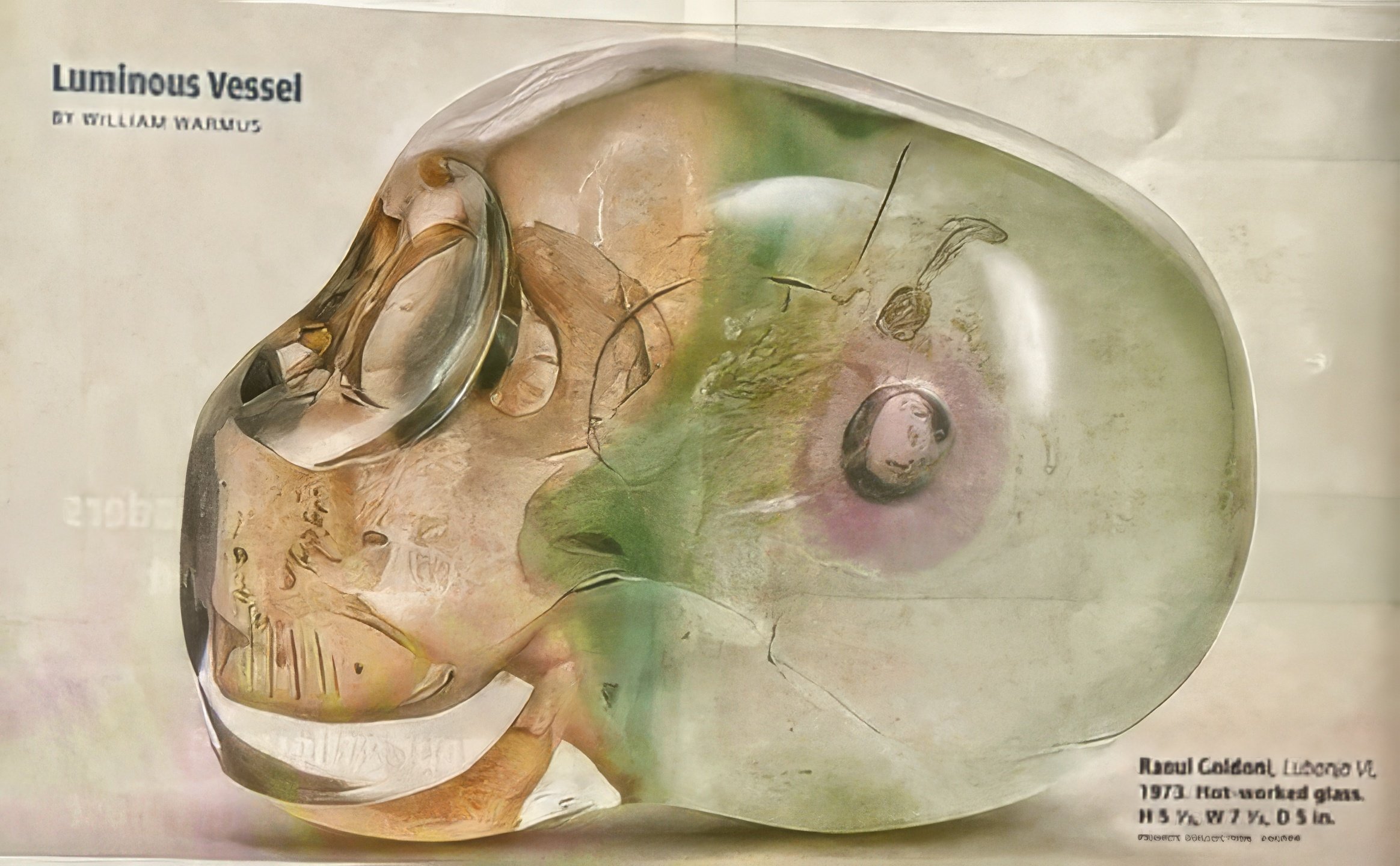
Lubanja VI (1973) reminds me of some of the best characteristics of a Goldoni. It is a human skull, built of layers of solid glass, which
beckons you to look inside. The more you look, the less human it seems. A clear air bubble for a brain? Then you see it is a brain, encased in a purple glow. Greenish veils drift toward the front of the head. The teeth are silvery, elongated bubbles of air. The proportions seem off-the skull too elongated, too bulbous.
Far from an X-ray perfect skull, it says things about skulls, or humans, that are not well known. Earlier this month l visited the Neues Museum in Berlin, which contains a series of sculptor's model heads from ancient Egypt, made about 1350 B.C., during the time of the Pharaoh Akhenaten, who took Egypt toward monotheism with his worship of the sun god Aten. Some of these stone heads (possibly missing the glass inlays for eyes) are characterized by bulbous crania, including high foreheads, not unlike some Goldoni sculptures. Why?
A catalogue for the Neues Museum theorizes that "the artist seems to have created a pictorial code through the exaggerated skull shape, in which Aten as the god of creation manifests himself in the birth of the child." Maybe the search for a way to capture the ideal quality of light led both the ancient artists and Goldoni to distort the human head, to expand the skull so that it represents not just the physical but also the deeply spiritual.
Writing in Zagreb on April 6, 1978, Goldoni observed: "Surely the most acceptable solution of the creative process would be if we were able to create a work of art in no time, in one breath, without seeking and examining what the form should look like.... However, the creative process does not develop exclusively in this way ... often a whole life of continuous work is necessary for this task." Part of that task, he argued, involves "entering deeply into the past, discovering something for the first time while it had already been discovered long before in accordance with the true tradition of art, with the origin of form."
Both the ancient Egyptian artist Thutmose, in whose studio the Berlin sculptures were uncovered, and the modern artist Goldoni, working in Zagreb, discovered the spiritual properties of light. One depended upon light reflected from stone, and so made his heads big and bulbous so more light might reflect from them. The other had available a multi-layered, transparent medium. He made his heads bulbous too, so that more light could be trapped momentarily within, bounced around, and exhaled. Both are superior monotheists of light. And, I might add, both are known from only a few examples of their work.
WILLIAM WARMUS, a contributing editor to
GLASS, wishes to thank Martina Goldoni for images and inspiration.
Image used to illustrate this essay:
Raoul Goldoni, Lubanja VI,
1973. Hot-worked glass.
H 5½, W 7 ½, D 5 in.
PRIVATE COLLECTION, ZAGREB