Page Hazlegrove
by William Warmus
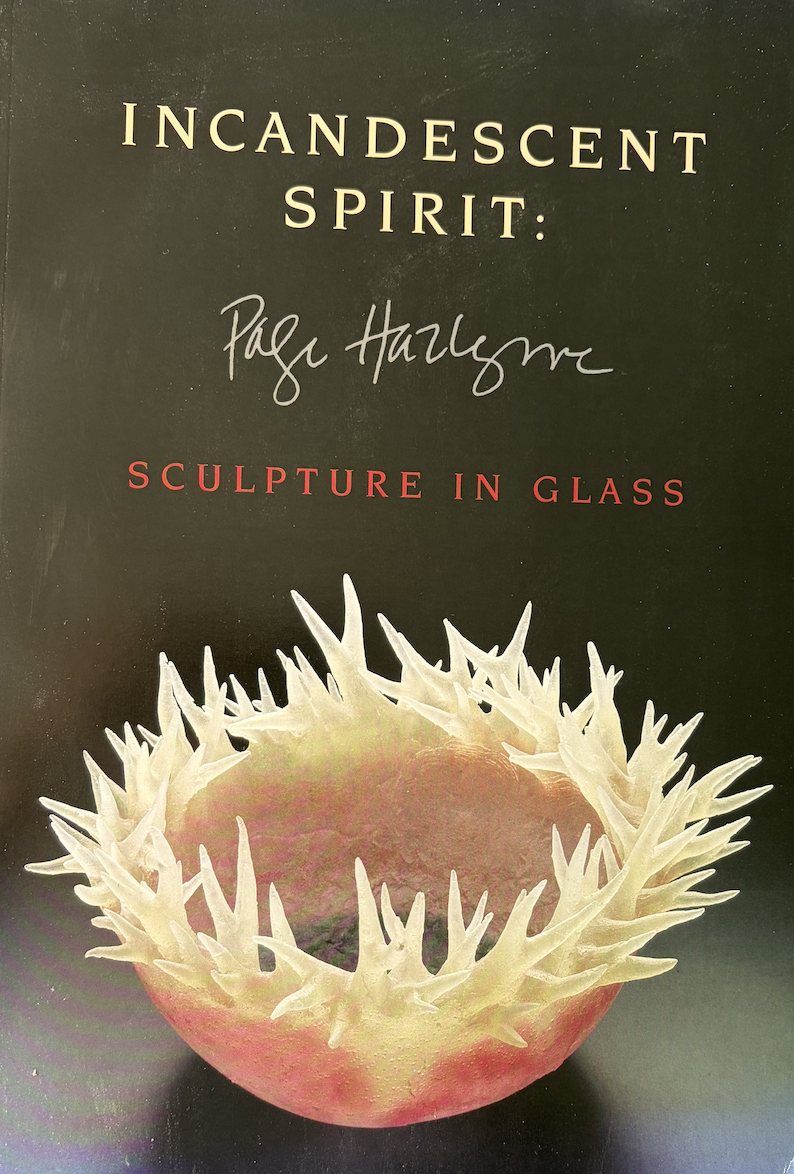
This essay was for the catalog of an exhibition of Hazlegrove’s work held at the Art Museum of Western Virginia, May12 -September 24, 2000. Published by the museum in 2000, ISBN 0-9701240-0-7. Cover image: Branching Bowl, 1996 Pǎte-de-verre, 7x 15. Collection of the Museum of Fine Arts, Boston.
Page died in 1997. She was among the most promising artists of her generation, and I miss her.
I visited RISD when Page was a student there, and as the editor of Glass: New Work magazine, I published her work in two issues. Niche was illustrated in an article Bruce Chao wrote about the RISD program (spring 1987) and Two Bottles was included in an essay about pâte de verre (a type of cast glass) by Anna Boothe (fall 1987).
In 1992, I included Contained Flight in an exhibition curated for Cone-Solow Gallery in Mendocino, California. As we unpacked the work and began to set it up for the show, one component was a delicate cast glass wing that needed to be inserted into a covered jar. I remember the scary, scratchy sound of glass scraping against glass as I lowered the wing ever so carefully into its container, and then a different pleasing, plunking sound of glass against glass as I placed the lid onto the jar.
Closing the top was curiously satisfying. The jar and the clipped wing spoke of science parsing out and containing, learning the secrets of flight while disabling the object of its investigation. The experience--the sights, the sounds--all conspired to establish the presence of something beyond science.
Page Hazlegrove: Birds of Passage
by William Warmus
A Brief History of Glass
Every artist begins with too much and too little. On the one hand, we find the formidable overhanging world art history and on the other, a blank slate. As an artist, Page Hazlegrove chose the creative medium of glass. With this choice, Page faced a history of glassmaking dating back 3500 years and a material rich in venerable traditions.
The sculptor Tuthmosis may have made glass in his studio-compound in the ancient Egyptian city of Amarna around 1350 B.C. Glassblowing was as yet undiscovered; instead, artisans ingeniously formed hollow glass vessels around a core, which later needed to be dug out. The core-formed vessels produced at that time imitated rare stones and were feathered with colorful bands of decoration. Glass was costly, and these valuable vessels were reserved for precious contents like the cosmetic kohl, used for enhancing the seductiveness of the eye.
Many of Page's solid cast vessels with their aged appearance, frosted colors, and mysterious sense of containment make allusions to this ancient tradition.
The ancient Romans adopted a more efficient process for making hollow vessels by blowing a breath of air from the lungs of the glassmaker into a molten glob of glass. They perfected a clear glass that put the contents of the vessel on display rather than concealing them. Throughout her career, Page worked alternately in cast and blown glass, sometimes combining the two in a single narrative work. She used the delicacy and functional vessel associations of blown glass as a foil to the "weightier" and bolder aesthetic character of cast glass, thereby creating formal, thematic, and art historical ambiguities.
During the Middle Ages, the use of glass as art reached its Golden Age in the great cathedrals of Europe. More colorful than the brightest gems, stained glass windows narrated Biblical history, filtering streaming sunlight into cathedrals and symbolizing the entry of the Holy Spirit into the heart of humankind. Glass artisans enjoyed a prestigious position among the artistic communities of Medieval Europe and local guilds proved particularly fructuous to the glass community. Economic development and technological innovation increasingly made glass affordable, available, and eventually common. The relatively recent art historical division between "higher" artists and "lower" artisans led to the creation of critical hierarchies with glassmaking relegated to a position lower than painting or sculpture. Glassmakers themselves divided into separate communities, one artistic the other industrial.
In America, by the middle of the twentieth century, the traditions of artistic glassmaking were in danger of evaporating. Louis Comfort Tiffany, the nation's premier artist using glass, died in 1933, and with his death, art nouveau glass also went out of fashion. Glassmaking as an art form seemed to have been replaced by "industrial design" as practiced in factories. Mid-twentieth century America saw the emergence of a new type of glassmaker--Harvey Littleton. He devoted himself to the notion that glass should be returned to the hands of artists and be made in smaller artists' studios. By the mid-1960's Littleton had launched the studio glass movement, made possible by the availability of reliable small-scale furnaces. Littleton dedicated himself to an education program at the college level that could turn young students into artists able to work fluently in the new glass idiom.
In these early days of the studio glass movement, glassmakers were idealists. The decade of the 1960's was a time when cynicism infected much of the art world, yet glass artists seemed untouched by that attitude, instead crafting objects with honesty and directness. If "art standards" were abandoned by the official art press of the time, they were adopted and made clear by these emerging glass artists. The primary criteria for studio glass became beauty and skill. The new mainstream studio glass artists worked under a credo that read: Clarity, Frankness, Optimism.
Unlike members of more competitive high-art communities, these glassmakers seemed to enjoy each other's company. Glassmaking is primarily a team activity, and groups of enthusiastic practitioners always seemed ready to share new knowledge, or to help someone in the blowing of an especially large bubble of glass. The pleasure derived from the creative community spilled
over to those who had begun collecting the new medium. To some, the openness, directness, and camaraderie of these artists and collectors were altogether different from the rest of the art world. Soon this sense of community became a source of criticism. Art critics found studio glass too inward focusing, too beautiful, too well-crafted, and too "nice." In response, a trend emerged in the glass movement to make glass as ugly as possible-perhaps hoping that in its unattractive-ness, glass might regain credibility with art critics.
This criticism was unfounded. Glassmaking has never been simply about beauty--it has numerous other associations. Glass breaks. It can be dangerous to manipulate molten hot glass, causing serious injury to the maker. Those who make it are not always joyful company. The studio movement produced its share of macho, highly competitive glassblowers. It can exhibit many seemingly opposing qualities. The best glassmakers intuitively realize that glass is a symbol for both eternal beauty and the fragility of beauty, for both strength and weakness (think of Page's beautiful but delicate cast glass birds and wings, sheltered by but also
confined within glass containers), for the joys of community and the overwhelming need to achieve individual identity. Glass may be liquid, free, and warm, but glass is also wild, loose, and brittle. It is inherently edgy. When the official art world abandoned the liquid, free, and warm for fear of creating, or being perceived by the critics to be creating "kitsch," glassmakers were marginalized to the point that kitsch did not frighten them. In fact, they soon discovered in the wild and loose aspect of glass an edge that kept kitsch under control. Not everything produced by the studio art glass movement was inherently fabulous. Bad art in glass is every bit as bad as that in any other medium. The outsider aspect of glass allowed the artists to keep certain traditions alive and to extend them in thoughtful and original ways at a time when those traditions had often been de-emphasized in the teaching of painting and sculpture. Glassmakers were not working in the glare of the critical spotlight in New York. They could interpret a style such as minimalism in ways that would have been unacceptable to "tastemakers" at the center of the art world. They could make beautiful minimal artwork. Or, they could extend the American vision of color in painting, linking glass to the watercolor traditions of Winslow Homer and Morris Louis and creating "watercolor sculptures," as represented in the work of Dale Chihuly, the founder of the glass program at the Rhode Island School of Design.
As installation and narrative art surfaced in the 1980's and 1990's, glassmakers (including Page Hazlegrove) began to experiment with new ways of seeing, often adding a few "twists" of their own. Installation art concerns itself with found objects and is generally indifferent to aesthetic quality; the parts are clearly subsidiary to the installation as a whole. Installations created by glassmakers often incorporated components--individual glass pieces made by the artists. The aesthetic quality of these glass parts inevitably became elevated, often stealing attention away from the installation itself.
By the mid-1980's, glassblowing techniques and the skills of individual artists had improved tremendously, but the idealism and sense of shared community were dissipating, replaced by an increasing degree of professionalism and the competition that an emerging marketplace engendered. Much of the work produced was based on a repeatable formula and was perceived as lacking artistic quality. But this was not true everywhere.
An Even Briefer History of Glass at RISD
At the Rhode Island School of Design in the 1980's, the head of the glass program, Bruce Chao,constructed a course of study that exposed the students to both the internal traditions of glassmaking and the forces of the art world in general. Perhaps because the program was viewed as a specialization within the sculptural program, it avoided the obsession with skilled (some would say overskilled) glassblowing that was sweeping the glass world at the time. Clearly, Chao and his students were seeking alternative strategies to keep glass vital as an artistic medium.
At this moment the first act of studio glass had concluded. The roles of the early key players came sharply into focus. These "actors" included Dale Chihuly, Dan Dailey, Tom Patti, and Toots Zynsky, as well as Stanislav Libensky, and Jaroslava Brychtova in Czechoslovakia ---now the Czech Republic --each of whom possess tremendous energy and self-confidence. Bruce Chao and his students offered a hint of what Acts Il and Ill might be like. Chao encouraged work that did not abandon the history of glass as art, but avoided the appearance of kitsch, with which glassmaking was all too often associated. The approach at RISD tended to avoid a vibrancy of color (as seen in Venetian-style glass-making) in favor of more brooding, contemplative, oxidized colors such as grayed-out whites, corroded ambers and sun-bleached blues. These colors, inevitably accompanied by roughed-out surfaces achieved through casting rather than blowing glass, seemed to possess a higher "spiritual" temperature.
Chao also managed to nurture a community as evidenced by the continuing closeness of many of the students from that time and by his active use of prominent RISD alumnae (including Chihuly, Jamie Carpenter, Howard Ben Tré, and Toots Zynsky) as visiting artists and critics. Chao stressed as a basic asset of the glass program, "the unusual community of which it is a part, including a lively population of art professionals and students" at RISD.
Page Hazlegrove As a Student and Then Teacher
In 1987, the glass program at RISD had eighteen undergraduate and three graduate majors,
including Page Hazlegrove. I visited RISD when Page was a student there, and as the editor of Glass: New Work magazine, I published her work in two issues. Niche was illustrated in an article Bruce Chao wrote about the RISD program (spring 1987) and Two Bottles was included in an essay about pâte de verre (a type of cast glass) by Anna Boothe (fall 1987). The latter article
suggested that Page's "vessel forms have the frosted, iridescent qualities of unearthed glass."
It is that plucky, "of the earth" quality that somehow simultaneously makes the vessels seem precious. It was this characteristic that first drew me to Page's art. It seemed obvious that Page had been looking at ancient glass, trying to achieve a corroded, excavated quality in the bottles she created. The gutsy character of such glasses had also inspired L.C. Tiffany. He preferred the bubbly, cheaply made claret bottles to the fine cut crystal of his era, which he saw as over refined. Tiffany worked in an era when a writer like Mark Twain used slang and created dialogues in Southern dialect for his Mississippi River characters like Huckleberry Finn.
Twain preferred the vernacular, much as Tiffany expressed a partiality for rough glass over refined. This is also true of Page Hazlegrove. At a time in the 1980's when glass was over refined and speaking too brightly, she sought a language more subtle and yet more colloquial. The artist Jack Wax, at the time acting as a technician in the glass department, helped to introduce Page and other students to the rough yet subtle casting techniques that he was developing in his own works.
Page was like her art. Dan Clayman, a student and friend of Page's during the RISD era, told me that Page was beautiful and strong physically. She was frequently spotted around the studio with her shirt untucked, shoes untied, and traces of charcoal on her face, a telltale sign that she had recently been drawing. Sometimes when she was in the hotseat during student "crits," she would flush with color, which would rise from her neck to her forehead, as if her heart were transferring more energy to her brain to enable her to listen and understand more intensely. After receiving the B.F.A. degree from RISD in 1987, Page served as director of the Glass Lab in Building 4 at the Massachusetts Institute of Technology (MIT), both as an instructor and artist in residence, from 1988 until her death in 1997. Christopher Moore, a student, provided me with his insight into the relationship of the program to the student scientists and engineers at the Institute: "In the MIT Glass Lab I learned a skill that will bring me a lifetime of joy. My research in Astrophysics involves ideas about things I will never be able to physically experience. In contrast, glassblowing provided a way to express my ideas and use the physical properties of the glass in a tangible way ....”
A Sequence of Artworks
Today, many visual artists work like musicians who might chain a group of songs into an album. For Page, the work evolved through a series of such albums. A better analogy to describe her work might be as a collection of short stories, because most of her works contain a narrative element. She wrote: "I feel that a lot of artists working in glass get into a real repetitive type of pattern in their work where they produce a subtle variation of the same object over and over again." Embarking on a new series was a way for her to avoid falling into a rut.
At first, during her time at RISD, she followed many different directions (as is typical for a student), ranging from solitary, ambitious monumental work like Niche to the humor of a quasi-performance piece, conceived at the last minute and "executed" with the help of fellow students, best described as "hospital beds meets Hollywood Squares game show."
The Container/Contained investigations she started while at RISD continued intensely for five to six years after graduation. The images and themes developed in this series would reappear throughout her career. She also explored cast glass frames with slumped glass images, perhaps intended as installations. As they progressed, the Container/Contained series became larger and had more components. Eventually a new series of thorn vessels developed. which while denying function, spoke about isolation and protection.
Among the final series were the blown tubes--three to four foot-long glass tubes with a cast bird form contained within. Occasionally the tubes transformed into hourglass silhouette. What were these pieces about? They channel the freedom of flight--impossible perhaps for the bird to escape and fulfill its destiny, but also suggestive of the birth of life, the bird emerging through a birth canal. Page was intrigued by the mentality of Victorian era collectors and their collections. In response, she assembled cast birds laid out on slumped and trapped forms. Her final piece, Untitled, presents a group of bottles varied in color and size on a triangular shelf, the wedge of the shelf shaped like a wing or evocative of a balance-scale, suggesting that the bottles on one side require a greater thickness of support because they are somehow weightier.
SKILLFUL HEART
Lo! keen-eyed towering science,
As from tall peaks the modern overlooking,
Successive absolute fiats issuing.
Yet again, lo! the soul, above all science...
Walt Whitman, Birds of Passage, 1881-82
In the eighteenth century, the French scientist Rene Reaumur explored the digestive process in a "well designed" experiment, by feeding metal balls to a small bird that died in the process. Many craft objects exhibit a similar quality, as if they are elegant demonstrations of the skill of the maker, but have "died" in the manufacturing process. The finished objects lack soul. This is the heart of kitsch: a stuffed animal, a replica of beauty, minus the ineffable, un-mysterious, lacking any sense of surprise. Science and kitsch share common ground in the need to reproduce repeatable, verifiable results. Page makes reference to this condition in a work like Cold Growth, a piece that includes lost wax cast glass roses. For Page, "the frozen quality of the glass roses refers to specimens that are sometimes frozen for scientific study." They also serve as metaphors for relationships where emotional growth freezes in place.
It is my conjecture that Page sought to develop, especially in her later work, a position that accorded to science a higher ground, but that also left room for a soul (a type of experience of the world) that flutters above, but is informed--even inspired--by the scientific spirit. It was this composite spirit or type of experience that she sought to preserve and protect in her work through images of a wing in a jar, a bird in a tube, and a bottle surrounded by thorns. Lucy Hazlegrove suggests that for Page, it was not a clear-cut matter of "science as solid and soul as fragile, birdlike....Rather, both were to her, equal in weight. Page used the outward vestiges of scientific experimentation as a visual metaphor for psychological states or the human condition."
In 1992, I included Contained Flight in an exhibition curated for a gallery in Mendocino, California. As we unpacked the work and began to set it up for the show, one component was a delicate cast glass wing that needed to be inserted into a covered jar. I remember the scary, scratchy sound of glass scraping against glass as I lowered the wing ever so carefully into its container, and then a different pleasing, plunking sound of glass against glass as I placed the lid onto the jar. Closing the top was curiously satisfying. The jar and the clipped wing spoke of science parsing out and containing, learning the secrets of flight while disabling the object of its investigation. The experience--the sights, the sounds--all conspired to establish the presence of something beyond science.
THE STORY OF A LIFE?
To experience something esthetically is, in effect, to experience something, other than the human being, as an end in itself...
Clement Greenberg, Homemade Esthetics, 1999
The artist Tiffany once surprised his children on Easter with a room filled with an intricate
latticework of colored yarns. Tracing a thread led to a surprise. I like to think that the real surprise was aesthetic--the room full of shimmering filaments, all woven to form a spectacular web. That sight is probably what captivated his children on Easter morning.
It is difficult to understand the relationship of an artist's life to her work, and dangerous to read the two as a unity. Works of art can be read as self-sufficient, like Tiffany's web, but lives become entangled with other lives and are open ended, with projects that are started and never seem to lead anywhere. Unlike the chaos of life and deadlines, the work of art is supremely satisfying for the act of closure that it can provide. That surely is an attraction of Page's work with its solid, sealed, cast glass bottles or the perfection of a solid glass egg or a fragile wing safely deposited into a jar.
More ominously, we are given a bird diving into a glass tube that narrows rapidly, denying deeper entry. Or perhaps it is denied an escape? In either case, the piece seems to be about the act of closure. Lucy Hazlegrove comments: "The birds that appeared in her last works were small, finch sized, always trapped: in tubes, in specimen cases, or within a room.. none in a natural setting, all thwarted in their desire to get out. Even the birds in the collaborative piece she did with Peter Houk, Night Migration, are in a tight claustrophobic swarm held in the confines of a bell jar."
People say that suffering is the inability to act decisively. The narrative impulse in contemporary art often conceals a deep form of suffering in its failure to tell a story fully, to conclude the narrative. In Page's sculpture, a course of action is articulated and brought to a stop, and the aesthetic effect is curiously pleasing. Here, if only for a moment, the artist is in control, the story grabs our attention, and our hunger for art is satisfied.
William Warmus
Ithaca, New York
March, 2000
William Warmus was a curator at the Corning Museum of Glass, past editor of Glass: New Work magazine, and is the author of books about Dale Chihuly, the art nouveau artist Emile Gallé, and Venetian glass.