Ocean Realm Aesthetics
William Warmus
I learned to scuba dive in 1997 at the request of the environmental artist Catherine Rahn in order to direct an underwater video about her work filmed on the remote, pristine, shark and sea snake populated reefs of Fiji’s Bligh Water. I was afraid of diving in the ocean until I made the dives and saw the coral reefs. My instant realization was that these were among the finest works of art I had ever seen: works made by nature, not by artists.
This article was published in the Spring 2010 (number 110) issue of Glass Quarterly. It’s my attempt to evaluate the relationship between two transparent realms: the ocean and glass. It’s also an early trial for my reticulate aesthetics theory, that was fully developed and published by 2015.
Sea Glass: Aesthetic Lessons from Below the Surface
By William Warmus
“The first time Cousteau met Picasso, he gave the artist a piece of polished black coral from the Red Sea. Picasso had it in his hand when he died.”[1]
The fine art of Studio Glass and the refined sport of scuba diving run parallel in time and technique. Both emerged after World War II and were based on the invention of compactly designed high-tech equipment, including the small studio furnace, the portable compressed air tank and gas regulators, and computers to time dives as well as annealing cycles. Both flourished because of an emphasis on rigorous education and training. These advances allowed artists to create glass sculptures that expanded the frontiers of the art world, and they allowed explorers unparalleled access to the world beneath the waves, perhaps the Earth’s last frontier. But do these two worlds, which run parallel historically, ever intersect?
They do. Glassmakers have had an interest in the undersea world since ancient times—think of the famous ancient Egyptian core-formed-glass fish in the British Museum. Sea or beach glass (sometimes poetically called “mermaid’s tears”) is a rare example of an industrial material that, unlike the plastics that litter the oceans, becomes aesthetically appealing and even collectible when transformed by nature.
During the modern period, artists such Emile Gallé, Louis Comfort Tiffany, and René Lalique created extraordinary glass objects that “explored” the ocean realm. Many prominent members of the contemporary glass community are scuba divers, including the artists Klaus Moje, Michael Taylor, Josh Simpson, Catherine Rahn, and Martin Blank—all of whom have made ocean-inspired art—as well as the collector Dudley Anderson and the art dealer Serge Lechaczynski. And, as I will argue later in this essay, there is much we can learn from the science and aesthetics of the undersea world to help us appreciate the art of glass.
In the work of Klaus Moje, I have found a deep yet subtle ocean connection. In response to my questions about his relationship to the ocean realm, Moje wrote: “As much as diving and the sea are part of my life and the ongoing inspiration for my artwork, you will never find a literal or blunt reference to it in my finished work. It is not the transfer of the sea that I pursue, but the marks of an emotional response.”[2] Moje describes how his first dives to pristine coral reefs in the Red Sea near Aqaba in Jordan in 1964, “had an everlasting impact on my life and my artwork” and that “12 years later I returned to Aqaba … with my son Jonas. I wanted to show him what had meant so much to me. The sea was already destroyed by industry, and the waters had lost the immediate spark that only the untouched can deliver. If anything, that is what I try to catch and to express with my work: giving stature to what is fragile or in danger of being lost. The choice of glass makes it achievable to live forever.”
My own introduction to the deep sea came more than three decades after Moje’s, but it was equally intense and equally connected to glass.
***
“One must become classical again by way of nature … that is, by way of sensation.” —Paul Cézanne[3]
I learned to scuba dive in 1997 at the request of the environmental artist Catherine Rahn in order to direct an underwater video about her work filmed on the remote, pristine, shark- and sea snake-infested reefs of Fiji’s Bligh Water.[4] I was afraid of diving in the ocean until I made the dives and saw the coral reefs. My instant gut-level realization was that these were among the finest works of visual splendor I had ever seen: works made by nature, not by artists. I had a sensational experience similar to the one Moje had in 1964. I learned from our cinematographer and my mentor Stan Waterman that the sharks and snakes weren’t out there to hurt me.
Diving led to writing and teaching about how glass artists have been inspired by the ocean realm. The Blaschkas created marine invertebrate models in the late 19th century as marine biology teaching tools.[5] The Art Nouveau master Emile Gallé made fabulous undersea-theme vessels, such as his Seahorse vase with a bulging pregnant male seahorse,[6] and Louis Comfort Tiffany made stained-glass windows inspired by the ocean realm such as Deep Sea, presciently anticipating the swirling, dreamlike universe observed decades later by scuba divers. I was allowed to snorkel in the pool by Dale Chihuly’s studio in order to examine the glass reef he had installed on its bottom, and the encapsulated sea creatures of Steffen Dam seemed to bring the project of the Blaschkas full circle by encapsulating glass invertebrates in a solid glass matrix.
But enough theory. As my ocean colleague Ned DeLoach says, Let’s go diving! Allow me to take you on a brief fictional dive that is intended to show how I began to learn aesthetics underwater.
***
Although as divers we wear heavy air tanks and have awkward fins on our feet, when we enter the water we become nearly weightless and free and flying, diving down toward the coral reef. I am always amazed upon entry at the vast scale of the undersea realm, the endless open ocean disappearing beyond our horizons, the vastly intricate coral reef before us, the 5,000-foot depth of the ocean beyond the edge of the reef. It’s like diving in a slab of limitless glass!
Something else that connects us to glassblowing is, of course, that the whole process depends upon the breath. A good diver can maneuver up and down in the water column by gently inhaling and exhaling: One’s breath translates into spatial coordinates, just as in glassblowing, breath determines the size and shape of the object being blown. The scientist D’Arcy Thompson, writing in 1917, made much of the relationship between nature and the glassblower in his landmark book On Growth and Form, a work that later inspired the glass-using artist Tom Patti. Thompson discussed how both the glassmaker and nature begin with hollow tubes that they shape into “vases,” or hearts and arteries: “Nature does just what the glass-blower does, and, we might even say, no more than he.… Such a form as that of the human stomach is easily explained when it is regarded from this point of view; it is simply an ill-blown bubble.” Thompson goes on to describe how these forms, whether natural or made by the glassblower, are examples of “mathematical beauty.”[7] In my ocean explorations, I have always been looking for Thompson-style parallels between nature and glass, such as the role of the breath.
Once down near the reef, the colors are muted but flash brightly as they catch rays of light from the Sun that have penetrated to the depths below. Visibility can range from 10 to 150 feet depending upon the clarity of the water, and this creates underwater rooms or galleries, each 10 to 150 feet in size, that vary from day to day or even minute to minute. A diver moves through these spaces as in a deep-sea museum, and because there are tens of millions of divers and literally hundreds of millions of dives made every year, the number of visitors to these deep sea “galleries” is respectable by museum exhibition standards. Some may respond that museums are only about permanence while the ocean is never permanent. But recently we have become aware that much of the art created during the last 100 years is as fragile and transitory as the creations of the ocean realm: artworks made of felt, fat (think of the sausages used by Joseph Beuys!) and earth, and performances using molten glass, are even less permanent than coral reefs, some of which are thousands of years old. Perhaps the simultaneous fragility and antiquity of the ocean realm can make us more humble, more accepting of the impermanence of our own art.
The best reefs exhibit tremendous biodiversity, from big creatures like sharks or mantas to jellyfish and tiny creatures like shrimp and nudibranchs and seahorses. I learned that you don’t want all sharks or all jellyfish; you want complexity and variety and also change. As an art historian, this was something interesting because in the art world we were encouraged until recently to think in monocultures. We put all the paintings in one set of galleries, decorative arts in another, and we also subdivided galleries into historical eras and regions, and of course, by the rank of the artist. We divided endlessly—as, admittedly, do some marine biologists—while nature endlessly mixes. Since I have been diving, I’ve come to prefer systems that thrive on diversity and the juxtaposition of diverse life forms or, in the arts, what we call styles and media. And I have found that among the current generation of museum curators, there is a refreshing openness to the mixing of media. You can see it at museums like the Neue Gallerie in New York, or the renovated Greek and Roman Wing at the Metropolitan Museum of Art, or in the plans for the most recent reinstallation of the collections of the Museum of Modern Art.
As I began to dive more frequently and to spend time underwater with experts in the behavior of fish, I spotted behavior that I felt might have parallels in the realm of aesthetics, and that might help us see art and art making in a new light. A form of behavior known as mimicry was my first clue. I had been an expert witness for Dale Chihuly in a copyright case (Chihuly v. Kaindl) that was settled out of court. Researching that case, I learned that artists seem to copy one another to varying degrees all the time, and while diving I learned that fish do this too. For example, “nontoxic fishes mimic toxic species to gain protection from predators”[8] such as some species of tilefish. The tail of the fish Calloplesiops[9] mimics the head of a turkey moray eel and “may intimidate predators” when the Calloplesiops hides its head in a hollow within the reef and exposes its behind. Is it not also natural that weaker artists might mimic stronger ones in order to survive in the marketplace? What I find appealing about this line of reasoning is that it is an approach that takes the behavior out of the legal realm and sees it as natural. The famed Italian glass maestro Lino Tagliapietra, for example, has engendered a legion of mimics, as has the artist William Morris.
I could go on with these aesthetic lessons from underwater, but we are running out of air and it’s time to surface. Let’s conclude back on shore by cracking open the textbooks and absorbing a couple of intriguing structural lessons from the ocean realm.
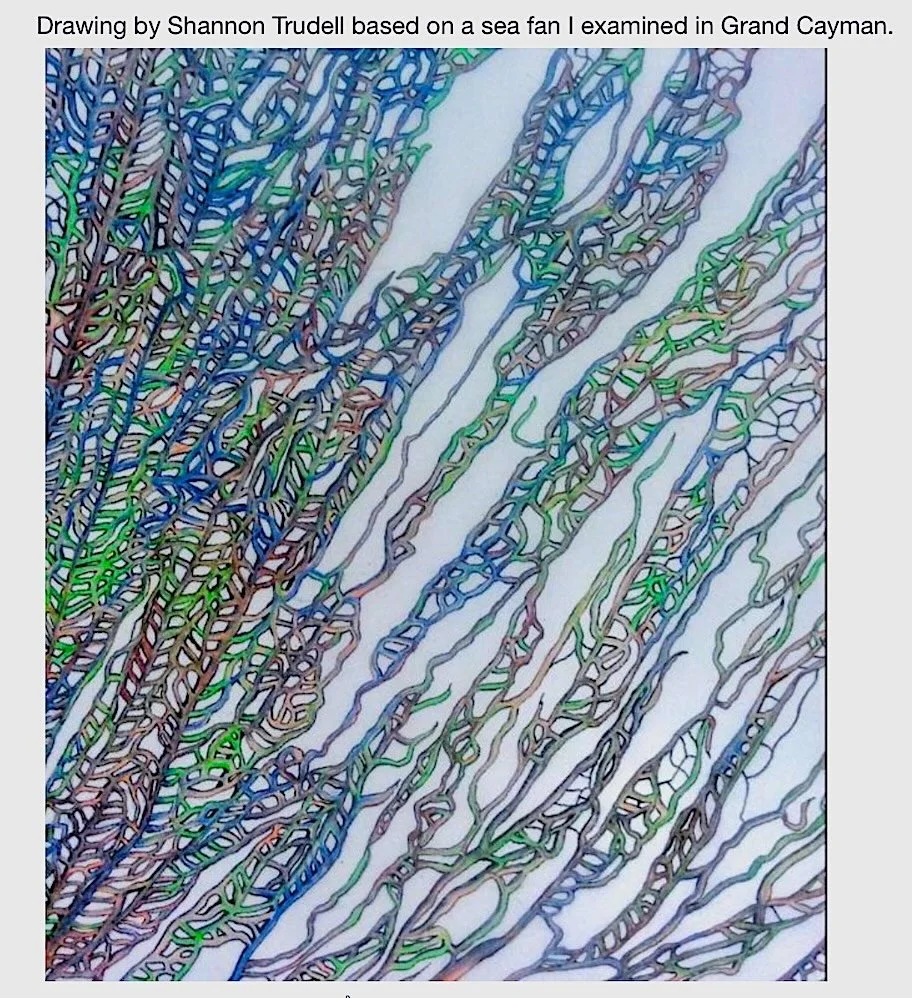
The first is the theory of reticulate evolution, which has been developed to explain how coral species evolve.[10] According to the prominent coral reef biologist J.E.N. Veron, reticulate evolution differs from traditional Darwinian evolution in that coral species have “no time of origin, no place of origin,” and are “continually repackaged in space and time.” This means that the total amount of genetic information changes little but is “repackaged into ‘different’ species,” and “extinction occurs through repackaging as well as terminations of lineages.”
I think that, like D’Arcy Thompson’s theory of the relationship between the glassblower and nature, reticulate evolution might have implications for how we understand glass as a medium for art. One way to think about art is as a branching Darwinian-style evolutionary structure, with the so-called “high arts” of painting and sculpture at the highest level of the tree and the decorative arts perched off on secondary limbs at a lower level. The two don’t intersect.
Reticulate evolution offers a different interpretation. From this viewpoint, the total amount of aesthetic information (some might call this the content of what is beautiful) has always been available and changes little, but it is continually repackaged in space and time. Repackaging results in new styles of art and in new art media. The disappearance or weakening of one style might be because the style is repackaged into a new medium. I think that this is what happened with Abstract Expressionism, when that painting style weakened in the 1960s: It was repackaged by the traditional craft media, which had evolved and were able to express color and form in ever-more-sophisticated packages.
There are lessons from reticulate evolution that we might adapt to aesthetics. They include a greater openness to the interrelatedness of all art forms (“reticulate” refers to a type of web), and an urgency to keep the web as rich as possible while also acknowledging that art media and styles sometimes do die out or are repackaged. So where is our beloved medium of glass on this web? I would venture a preliminary observation: It’s everywhere in the web, supporting all styles, although at times it needs to branch off on a lonely course all by itself (the so-called glass “ghetto”), to reinvent itself in order to better serve different art styles. Maybe that’s what happened during the early history of Studio Glass.
As a final lesson from the sea, I was intrigued by a chart I saw in The Diversity of Fishes[11]about the role of three scientific disciplines in marine conservation, arranged by the time periods they research. Systematists “identify the diverse threads of life as they arrive from the past,” ecologists “chart the life-support systems” of the present, and evolutionary biologists “seek to ensure diversity in the future.” Art historians are the systematists, and curators and journalists are our ecologists, but who are our evolutionary biologists? I realized that that role should be filled by art critics, but it is not. Art critics today are thin on the ground, at least in the field of glass, and are primarily skeptics and cynics, or more often simply cheerleaders. Just suppose, however, that the role of the critic was to ensure the diversity of art well into the future. Then the role of critics would be to fight to assure that the intricate, reticulate web of art remains maddeningly, indeed at times alarmingly, complex. Rather than setting glass aside for not being art, or for being on a lower-level branch, critics should be assuring that glass, and all the other media, thrive and diversify well into the future. That’s the last lesson I learned while thinking about the sea.
William Warmus is writing the screenplay for the independently released DVD anthology Sensational Seas II. He is a contributing editor to GLASS.
SIDEBAR:
Further Reading:
Jeffrey Foss. Beyond Environmentalism: A Philosophy of Nature. Hoboken: John Wiley & Sons, 2009.
Allen Carlson and Arnold Berleant, eds. The Aesthetics of Natural Environments. Peterborough, Canada: Broadview Press Ltd., 2004. See especially Ronald Hepburn’s essay “Contemporary Aesthetics and the Neglect of Natural Beauty,” pp. 43-62, which was published in 1966.
Gene Helfman et al., eds. The Diversity of Fishes: Biology, Evolution, and Ecology. West Sussex: Wiley-Blackwell, 2009.
Notes:
[1] Brad Matsen, Jacques Cousteau: The Sea King. New York: Pantheon, 2009.
[2] Email to the author dated September 26, 2009. I have edited his writing slightly to correct for German-English spelling and grammar variations.
[3] Cézanne’s remark was reported by E. Bernard in 1904. See: Richard Shiff, Cézanne and the End of Impressionism. Chicago: University of Chicago Press, 1984, p. 124.
[4] Cite William Warmus/Rahn essay in magazine.
[5] Warmus Blaschka essays in Ocean Realm and Glass magazine.
[6] William Warmus, Emile Gallé: Dreams into Glass. Corning: The Corning Museum of Glass, 1984.
[7] D’Arcy Thompson, On Growth and Form. Cambridge, England: Cambridge University Press, 1961, p. 287.
[8] Geoffrey Waller, ed., Sea Life. Washington, D.C.: Smithsonian Institution Press, 1996, p. 332.
[9] See Gene Helfman et al., The Diversity of Fishes: Biology, Evolution, and Ecology. West Sussex: Wiley-Blackwell, 2009, pp. 440-441.
[10] J.E.N. Veron, Corals of the World, Vol. 3. Townsville, Australia: Australian Institute of Marine Science, 2000, pp. 437-443.
[11] Gene Helfman et al., The Diversity of Fishes, p. 387.