The Wizardry of Matthew Szosz
By William Warmus
This essay appeared in Glass Quarterly Winter 2017-18 Issue 149
Through meticulous experiments using vintage industrial technology, an artist subverts glass processes to channel Foucault and meditate on the increasingly tense dynamic between art and technology.
Art has never fully resolved its relationship with the industrial and technological revolutions of the 20th and 21st centuries. The Studio Glass movement sought to take the artist out of the factory and put the furnace into the artist’s studio, while today’s computerized annealers and 3-D printers have made the studio more like the contemporary robot-filled factory. Harvey Littleton and others sought to free the medium from industrial environments and make it available to the artist in the more humane (and slower-paced) setting of the studio. And yet, some 50 years later, we find ourselves facing increasing choices of digital alternatives to making purely by hand, and also at the mercy of powerful mechanisms from beyond the studio: Many artists depend upon social media to market their work and so must adjust their daily tempo to that of Facebook and Twitter. The dilemma of the work of art in the age of mechanical reproduction, voiced brilliantly by the social critic Walter Benjamin in 1936, remains very much before us more than 80 years after publication.
Faced with a choice of artistic personas to assume, artists today can choose to follow Littleton’s model of the swashbuckling liberator of a material for expression, or to pursue an emerging identity as an early adopter and acolyte of new digital technologies. Matthew Szosz says that he is “much happier to assume the role with a nod towards Buster Keaton than to Errol Flynn. Or maybe it’s Boris Karloff.” I would say he has chosen the Keaton hero of the silent-movie masterpiece The General, wherein our hero stoically pursues a stolen locomotive: first on foot, then by railroad handcar, and finally by bicycle, pulling off hair-raising stunts without so much as raising an eyebrow. Szosz “chases” after elusive artistic goals using seemingly outlandish devices of his own invention, and yet, like Keaton, he remains immune to pain or setback, his persistence overcoming the superior forces arrayed against him, with only his intrepid, dogged, and undaunted campaign enabling him to create art out of an amalgam of antiquated but subverted industrial processes, mixed with a sizeable dose of pluck and a refreshing sense of humor about it all.
The fraught relationship between human sensitivities and frailties in the face of the increasingly digital processes that mediate our world was presciently explored by the critic of modernity Michel Foucault, whose work examined the relationship between knowledge and power, at times in bewildering and esoteric language. His formulation of the idea of the “apparatus” as representative of the technology of power has exerted a strong hold over contemporary artists, who seek to find new ways to free art from factory and market conditions. According to the theorist Giorgio Agamben in his book What Is an Apparatus?, machinery captures our actions and molds them in some way. We are enmeshed in the apparatus, struggling for the upper hand. It is this relationship that Szosz explores so adeptly: His wrestling match with technologies he’s borrowed or invented is a 21st-century mythological retelling of a well-trodden narrative.
Roots
Szosz is a RISD brat, raised in the world of sculpture as practiced by his father, Merlin, who became a professor at the Rhode Island School of Design in 1960, not long after graduating from Cranbook Academy of Art. The younger Szosz enrolled as an undergraduate at RISD from 1992 to 1997, and then returned to pursue his MFA there from 2005 to 2007. In Providence, he became conversant with the language of the academy, steeped in structuralism, deconstruction, and postmodernism, with Foucault as a guiding light. And perhaps predictably, he resisted both the neoconservative shift toward traditional technique in Studio Glass as well as the academic language of the academy whenever it detached from concrete process and innovative practice.
Szosz resists by conducting what he calls “experiments,” usually centered on the creation of a piece of machinery that pushes the limits of studio practice, but in so doing frequently fails badly but in interesting ways. These are not performance pieces because there is no script and there are no actors. I am drawn to the experiments for many of the reasons I am drawn to modernism: because they are optimistic, subtle, delicate, gently humorous, and supremely self-confident.
The Experiments
“Experiments are rarely cut and dried in terms of where they start and stop, or even what their particular aim is.… One mark of a good experiment is that you end up somewhere unexpected.” [Note: Unattributed quotes and descriptions of the experiments are from Matthew Szosz in an email correspondence with the author in the autumn of 2017.]
“Inflatables” (2005)
One of Szosz’s earliest experiments makes me think of the work of Tom Patti, whose brilliance, I’ve argued, was to find a way to combine the traditions of flat glass and glassblowing in one object, using stacked sheets of flat glass to record the expansion of a bubble of air. And I’ve always thought it peculiar that few artists besides Patti seemed to explore the rich language of flat and blown when the one is used as a counterpoint for the other.
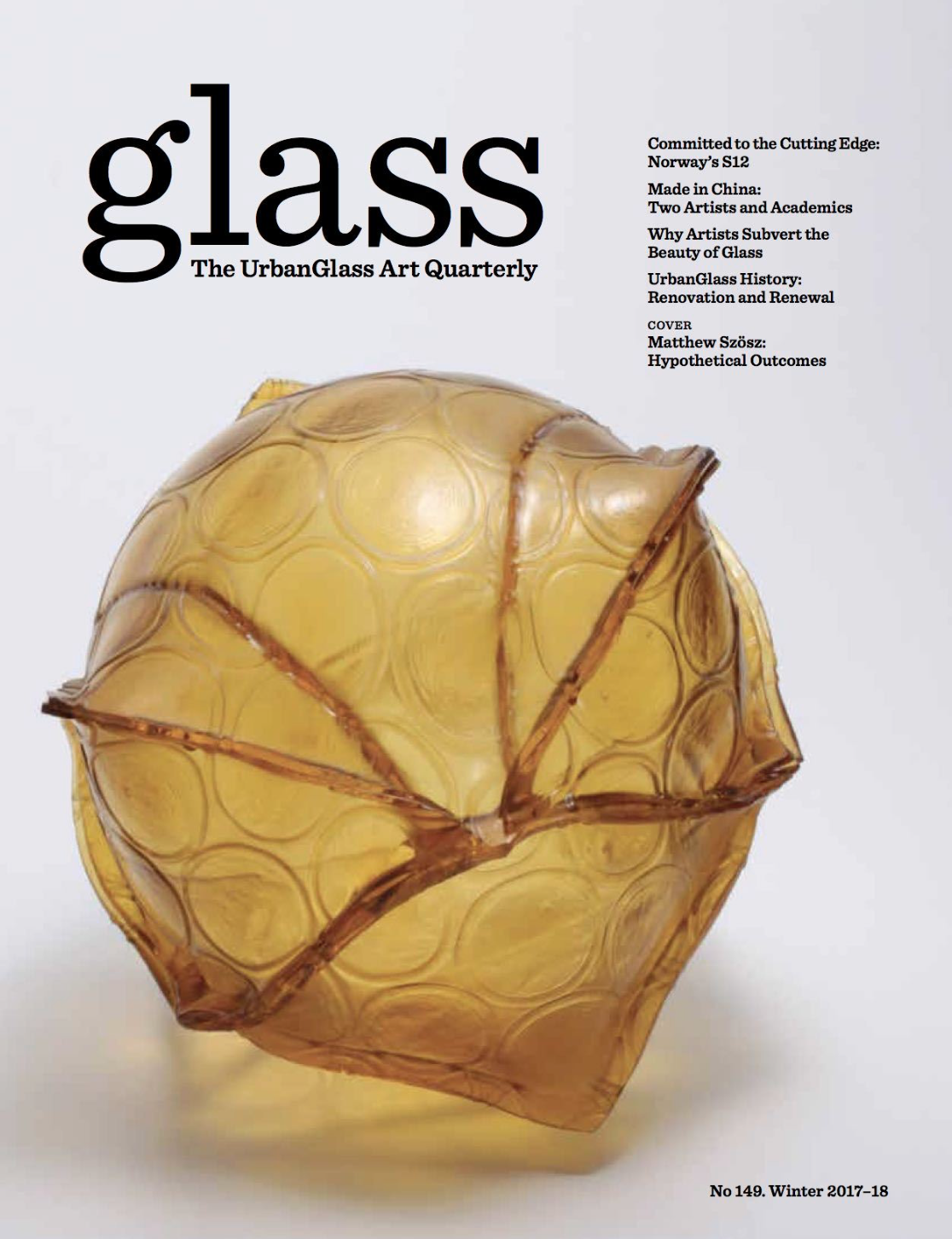
Szosz describes his “Inflatables” as “a great example of how changing process can radically change the forms available to the artist. The basic structure of the inflatable is that of an envelope.” It consists of two squares of sheet glass with a slightly smaller square of ceramic impregnated paper between them. The paper is a mask, or resist, creating an area where the two sheets will not fuse to each other when heated. When brought to a high temperature, the two sheets fuse around the perimeter of the paper, creating a sealed edge. At one point, a small brass tube crosses the seal and creates a channel into the interior area created by the paper. When the glass is at working temperature, compressed air is injected into the inner area via this tube, using an air gun with a needle-nose fitting, and the form inflates. It is easy to see how much more complex forms could be created by creating more intricate patterns in the paper resists, but it is also easy to see how many things could go wrong in the process.
Are the machines his art, or the objects they produce? If the machines are, then are the videos of how they operate a form of performance art? Thinking of Buster Keaton and his pursuit of the locomotive, I am inclined to say that the chase is the thing for Matthew Szosz. Yet in order to pursue, one must have or build the necessary machinery—and then be brave enough to operate it. And the machine has to make something, go somewhere, because that is what machines do. So objects are made. But not goblets or telephones—rather, one machine makes bubbles, another makes atmosphere, a third draws lines, a fourth makes rope models. Ultimately, however, his experiments seek answers to questions unasked by 20th-century glassmakers: Can molten glass have moving parts? Can we extract the atmosphere from within a bubble of glass and hold it for examination? Can we ever get to a place where art and technology are in balance? Some of the experiments evoke the steampunk style that so brilliantly melds Victorian and Silicon Valley technologies. But Szosz also creates machines that go beyond, intimating a style that is nameless. Maybe nameless forever, just as in certain religions there are spiritual forces that are forever hidden. Is that the only way art can remain independent of technology?
So each Szosz project represents a unique inquiry into outcomes, driven by curiosity, inspiration, and technical opportunity. Attempting to wrestle these diverse series into unified categories is to limit the creative variation and diversity of each, to try to name the style. Perhaps it is best to list some of his most important investigations, summarize the findings, and enjoy the artifacts of Szosz’s subversive and yet disciplined and meticulous process.
“Trailmobile” (2006)
After experimenting with innovative ways to control the glassblowing process with a machine, Szosz turned to dripped glass, moving from three dimensions to two, from the bulbous to the linear. He developed a mechanical control system, a melting furnace, and specialized crucibles, all in order to allow him to use the glass drip as a line to draw with, on a very large scale. Affixed to a wheel, the molten-glass crucible could be moved around the studio, even into elevators and out onto the street, all the while dripping molten glass onto the “drawing” surfaces beneath while the fiery molten glass solidified and linked the various landscapes.
“Cloud Machine” (2006)
The “Inflatables” used an atmosphere to create a hollow glass form, but for the “Cloud Machine,” Szosz has turned his attention to the atmosphere itself. He built a big machine of copper tubing on a rolling pedestal to create and hold a cloud within itself. Half the tubes created the cloud; the other half took it away. He created a model that “worked rarely and intermittently.” Although it looked great, he has never had the time to re-create a more reliable version.
“Rope Making” (2008)
Szosz returned to the linear when he “became enamored of Japanese shimenawa, the rice-straw temple ropes that are used to delineate sacred Shinto spaces.… They are giant fantastical forms made of simple materials and skillful working, and manage to be both outlandish and sublime at the same time. I decided to attempt to re-create them using glass fibers.”
Szosz refurbished an old worn-out furnace base, adding working doors at the top and a drawing aperture. He built a thread-pulling machine from bicycle parts so that by rotating the pedal cranks, an operator can draw hair-thin fibers in a continuous line from the furnace. “Five minutes would net a 10-foot bundle of fiber about as big around as your thumb,” he says. But there were substantial drawbacks. The unannealed “spruce pine” fibers would fatigue when stressed, “meaning a pretzel of glass fiber made successfully at night would break and fray by the morning,” and tight bends were impossible.
He found that gun roving, a type of industrial fiberglass, solved many of the problems, only to lead to new ones. Glass fiber, when bent, “was as dead as a doornail,” with none of the springy nature that makes shimenawa so lushly attractive. And yet:
“I still had the gun roving, and one day I decided that if it wouldn’t do what I wanted it to exactly, then maybe I should see what it would do. I twisted and wove bits of it together and produced a couple of samples.… The results were great—they reached full fuse while maintaining surface detail in a way I had not seen any other glass body be able to do.”
So he set about learning how to make rope and built an initial rope-making machine. The process took him about seven years and resulted in the “Ropework” series that he is currently producing and has exhibited recently at Traver Gallery in Seattle.
“Bear Trap” (2008)
Szosz shuttled back to three dimensions when he sought to “capture organic materials within a glass case. This is attempted through the use of a steel tool resembling a briefcase.” Sheet glass is laid over the open tool inside a kiln and heated until it slumps into the two halves of the case. The kiln is then opened while hot, an object is dropped into the tool, and the case is snapped shut around it, ideally sealing in and preserving the object relatively intact. Szosz adds: “Please note that objects with a large percentage of water in them will cause explosions.”
“Action Slumps” (2010)
These experiments include Euplectella, Clothesline, and the “Expandables” series. Going beyond explorations of inflation and linearity, they seek to treat molten glass as if it were made of moving parts. The most intriguing of these, though one that has never succeeded, is the hot-glass marionette; his goal is to create a multipart figure of hot glass that will be flexible and able to move for a minute or two before it seizes up and destroys itself. This is connected with his project to create a large musical instrument from hot glass, with many moving parts that would also render it dangerous to make and to “operate.”
“Blow Castings” (2015)
These relate back to the “Inflatables” series. The idea is to hot-cast an object or form and then use glass tubing to “implant a bubble in the middle of the casting which can be then inflated.” He has not yet succeeded with the process but hopes eventually to be able to create multiple bubbles in the same object, with patterned impressions and odd shapes. These works are also reminiscent of Patti’s early experiments with novel ways of inflating glass.
“Toss” (2017)
Szosz is excited about this current experiment, which relates to the action-slumping process. The premise is simple: “Throw plates of very hot glass across a room. The goal is to capture the changing shape of the glass as it responds to the force of the throw, gravity, and the resistance of the air.” This project remains incomplete, as he needs to find the correct camera for photographing the molten-glass plates in flight.
Contributing editor WILLIAM WARMUS is an art appraiser, a fellow and former curator at The Corning Museum of Glass, and co-founder of the Glass Secessionism Facebook group. His essay surveying the history of critical writing about glass since 1953 appears in the current issue of Critical Craft Inquiry.