The Dilemma of Flatness
William Warmus
This essay appeared in New Work: Glass in the Winter 1988 issue. Its was written in a specific style anchored in an era when we were having discussions about flat glass and stained glass and the “independent panel” and why this style/medium couldn’t seem to gain traction in the artworld. Thus the somewhat cynical style.
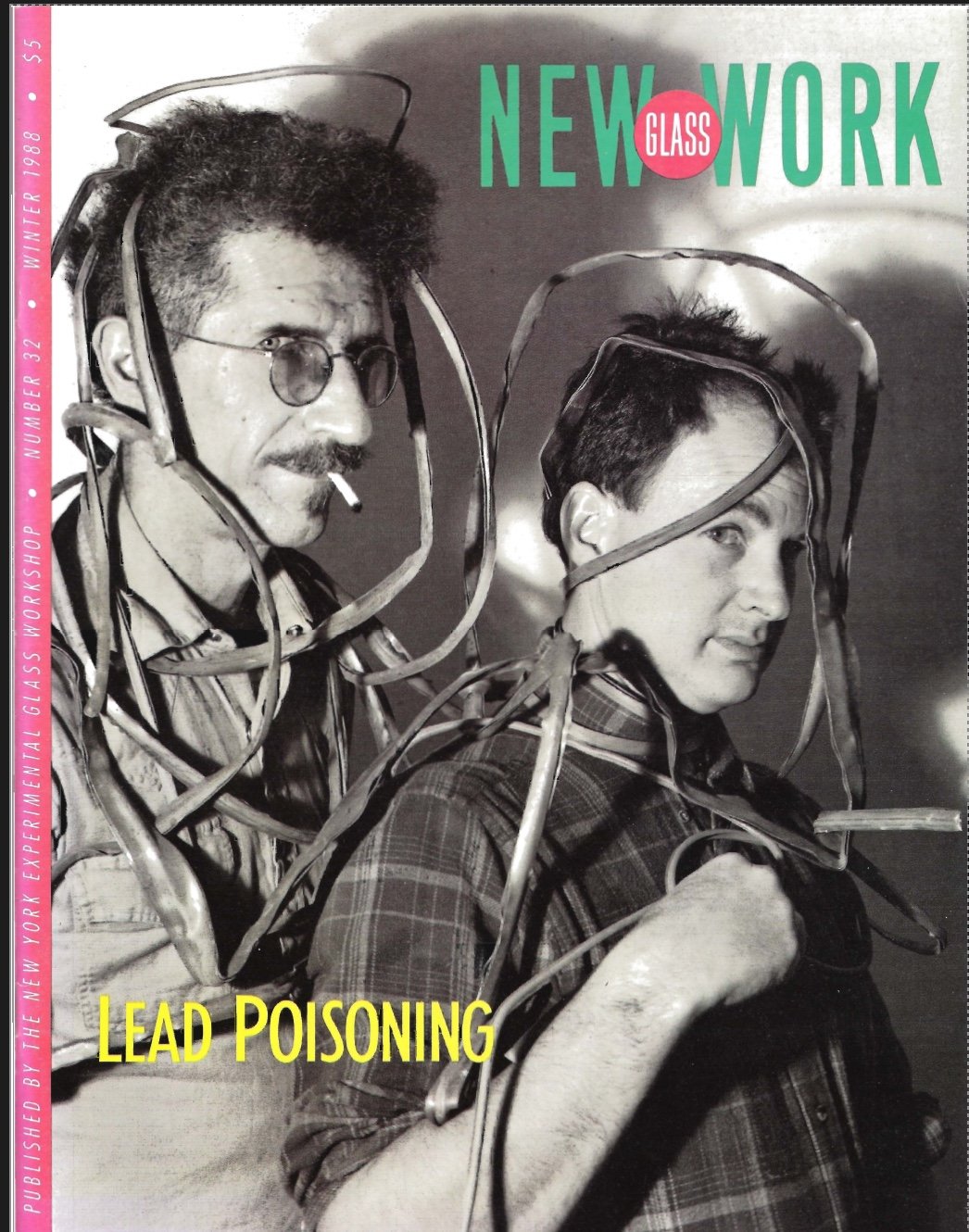
The image is the cover of the publication featuring my article, with artist Paul Marioni at right.
How far it has fallen! Stained glass was the highest art form of the Middle Ages. The first, and some say the only time, glass was to occupy a central position. Today flat glass, the successor in modern rimes to stained glass, is everywhere disparaged. The phrase implies art without fizz, scale, tasteless, a fallen angel. Collectors, dealers, museums: all are bored by flat, flatter, flattest. The diplomatic excuse we hear in public is that flat glass takes up too much room-but painting galleries are full of flat art. No. They dislike this art and won't own it. And so the average flat glass artist is flat broke.
Things are so bad that they can't get worse. Animals become extinct, styles of art only mutate. Flat glass as we have known and been bored by it is still around, but in an evolved form. A mutant. Call it plane glass. Can plane glass capture our fancy at the end of the 20th Century? Will George Bush win the 1988 presidential election? Only Wall Street has answers to these questions. What we can do is describe the development from Stained to Flat to Plane.
Flarness is not confined to flat glass. The critic Clement Greenberg saw flatness as the condition-invigorating rather than debilitating-of absrract painting in the 1950s. In his essay "Abstract, Representational and so forth" he shows that rhe significance of flatness is not only in the eliminarion of rhe illusionisric space of rhe Renaissance bur also that "The picture has now become an entity belonging to the same order of space as our bodies .... " It will be useful to keep this insight in mind: to flatten may mean to restrict illusion or to emphasize the material reality of the surface, a physical, spatial reality that our bodies also inhabit. The spin that glass puts on the concept of flatness is crucial to its success as high art.
Flatness in glass has its antithesis in glassblowing, which has been around with a vengeance since about 50 B.C. Perhaps the blown form is equivalent to the illusion of three dimensions in painting. While full bodied form in glass was replaced during the Middle Ages, there is a group of blown glasses from fifth century Rome that seems to anticipate the aesthetic of stained glass: the cage cups or diatreta. Each has been carved until a decoranon or scene stands in full relief against, but still connected to, an inner vessel. The most famous of these, the Lycurgus Cup (shown recently at The Corning Museum of Glass in its Glass of the Caesars exhibition), is dichroic: it appears a drab leaf-green in reflected light and wine red in transmitted light. The cup depicts the pagan triumph of Dionysus over Lycurgus, good over evil. In the Lycurgus Cup an expressionistic narrative transformed by light detaches itself from the blown surface and becomes an architecture protecting a chalice. Some 800 years later, stained glass becomes the vehicle for expressionistic narrarive as well as a transparent architectural substance that transforms light and focuses it on a chalice, on the altar within the cathedral.
The Medieval window protected parishioners from the cold and transformed light into a spiritual substance. Ruskin wrote that stained glass "becomes most touchingly impressive, as typical of the entrance of the Holy Spirit into the heart of man ... ": the one visits the many. lt was this unifying property that made glass beautiful to behold. But did it also make glass flat? If flatness means the assertion of the material reality of the medium, then the material reality of glass surely IS its transforming property. Paradoxically, glass asserts its material reality by denying its own existence. The flarness inherent in stained glass is its effortless ability to unify subject and object: god and man.
Stained glass began its long decline in tandem with the rise of perspectival painting in the Renaissance. Maintaining the ii lusion of three dimensional space on an opaque surface has always been a problem for glass as arr, for it denies the transformational properties of the medium. And curiously, clear glass represents three dimensional reality too precisely. Look out your window; well you are not really looking out your window, you are looking at a sheet of glass that transmits to you the image of what is outside. The transmission is so direct that the glass seems invisible. Flarness, the shining forth of the material itself, is seemingly denied. We would never consider using plate, or even mirrored, glass for our art. Or would we?
Individuals using plane glass roday must work through the traditions of the past in order to produce new work. Tom Patti, Robert Kehlmann, and Paul Marioni have done this and opened new doors. Patti has reconciled the bubble and the plane in what I venture is the first original interpretation since the Lycurgus Cup, and not unlike its architectural aesthetic. In outdoor constructions such as Survey Slider, mirrors become paintings as the reality of the glass is confounded with the reality of a shallow pool of water: an elegant commentary on the transformational properties of these two substances. Robert Kehlmann integrates flat glass and painting. In his new work, a painted underpanel is seen through a marked glass overpanel. There is distance between the two. One dilemma of painting, the difficulty of how ro go back into the paint after it has dried, is transformed inro an asset. The overpanel goes back in. Kehlmann has jumped out of the dilemma of flatness that has dogged both painting and glass for decades. Glass becomes an optical surface through which painting is newly perceived. And Marioni? The arch-politico has found a way to restore to glass the expressionism of late Roman and Medieval times. His sincere interest in politics revitalizes the possibilities of subject matter in a non-trivial manner. These three taken together signal a potential revival of plane glass of epic proportions.
We should not forget that flat glass does hold sway over the twentieth century: observe the television screen, illuminated by electron light, its memory held on plastic tape. The world has once again been transformed by glass. Will electronics forever divert our attention from the traditional media? Will the static image supplant the dynamic? These are not questions for Wall Street, they are questions of the heart.
WILLIAM WARMUS l988 NEW WORK