Emile Gallé Masterpieces
William Warmus
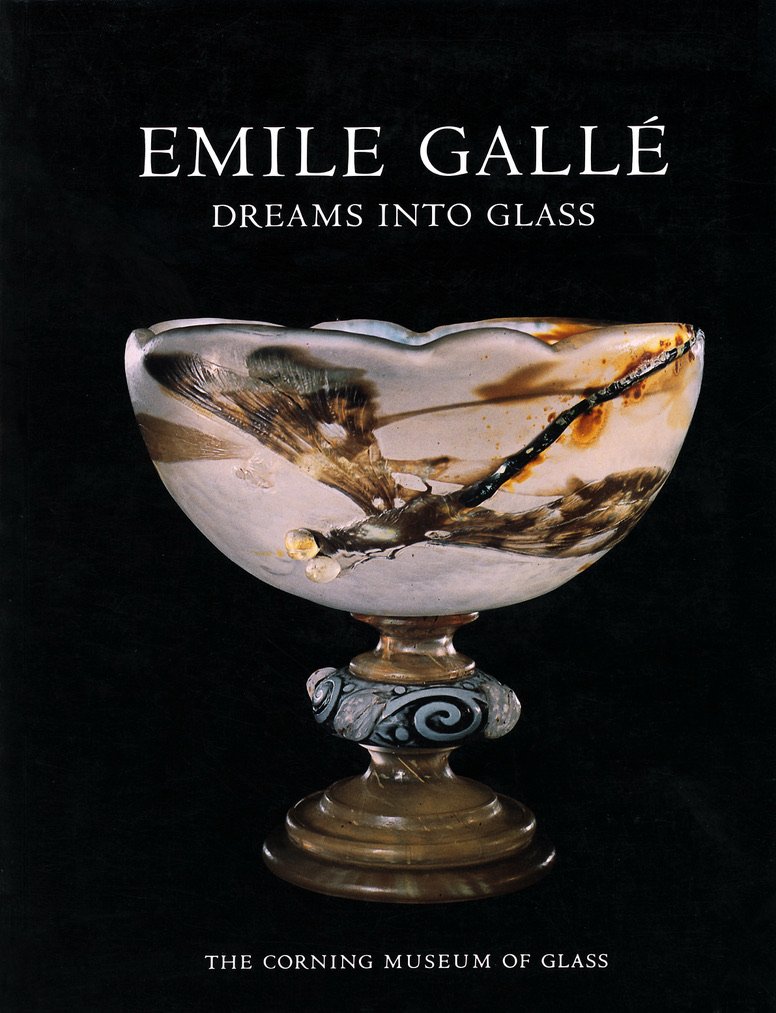
In 1984 I curated an exhibition of masterworks by Emile Gallé while curator of Modern Glass at the Corning Museum of Glass, and authored the catalog. This essay is my introduction to that book. (Warmus, William (1984). Emile Gallé: Dreams into Glass. Corning NY: Corning Museum of Glass. ISBN 9780872901094.)
The poet and art critic John Ashbery visited the exhibition and reviewed it for Newsweek, writing that "Almost all the works on display are masterpieces" making a visit "obligatory for anyone interested in the delirious excesses of fin-de-siecle France."
Play below to listen to a 5 minute podcast based on my essay, created with Google Notebook and Apple AI assistance.
Emile Gallé: Dreams Into Glass
By William Warmus
INTRODUCTION
EMILE GALLÉ, the man who turned many of his "dreams into glass," spent his creative life during an age of technological, scientific, and political explosion.
Thomas Edison invented the electric light in 1879, Alexander Graham Bell spoke on his telephone in 1876, and Louis Pasteur developed a vaccine for rabies in 1885. Henry Ford built his first car in 1893, and Orville and Wilbur Wright made the first airplane flight in 1903, one year before Gallé's death. Gallé himself, born in 1846 into a family noted for its production of utilitarian ceramics and glass, subsequently contributed his own technical innovations to glassmaking.
Just two years after Gallé's birth, Europe was swept by revolutions: the workers and craftspeople of Paris overthrew Louis Philippe's monarchy in February of 1848. Reaction to the failure of these revolutions may have set the stage for the predominant style which Gallé was later to adopt and modify:
"...the main source of the naturalistic outlook is the political experience of the generation of 1848: the failure of the revolution, the suppression of the June insurrection, and the seizure of power by Louis Napoleon. The disappointment of the democrats and the general disillusionment caused by these events finds its perfect expression in the philosophy of the objective, realistic, strictly empirical natural sciences. After the failure of all ideals, of all utopias, the tendency is now to keep to the facts, to nothing but the facts." [1]
The artists considered naturalists included Emile Zola in literature, and Millet, Daumier, Courbet, and the Barbizon school of landscape painters. They, and Gallé, however, did not confine themselves to a slavish imitation of nature, to "nothing but the facts." Rather than refine his techniques to match precisely the colors and textures of the world around him, Gallé accepted and used the accidental and tried to add a personal element to his work. His naturalism turned impressionist and symbolist, following parallel trends in literature and painting of the 1880ss and
1890s. By 1900 Gallé could speak of his "compatriots" and include Rodin, Puvis de Chavannes and Monet (Ecrits, p. 248), with whom he shared a common aesthetic.
Politically, Gallé's position is characterized by his support of Dreyfus. Alfred Dreyfus, a French officer of Jewish descent, was convicted (1894) of betraying military secrets and sent to Devil's Island. Evidence of Dreyfus's innocence was suppressed by the military. Emile Zola's stinging indictment (J'Accuse) became the cutting edge of a storm of controversy that split France into two camps. The case was a rallying point for those opposed to sacrificing the individual to the institution and to the conservative forces which had gained power since the Utopian revolutions of 1848. Yet the strong feelings were also patriotic in the sense that those defending Dreyfus believed he would never betray his country.
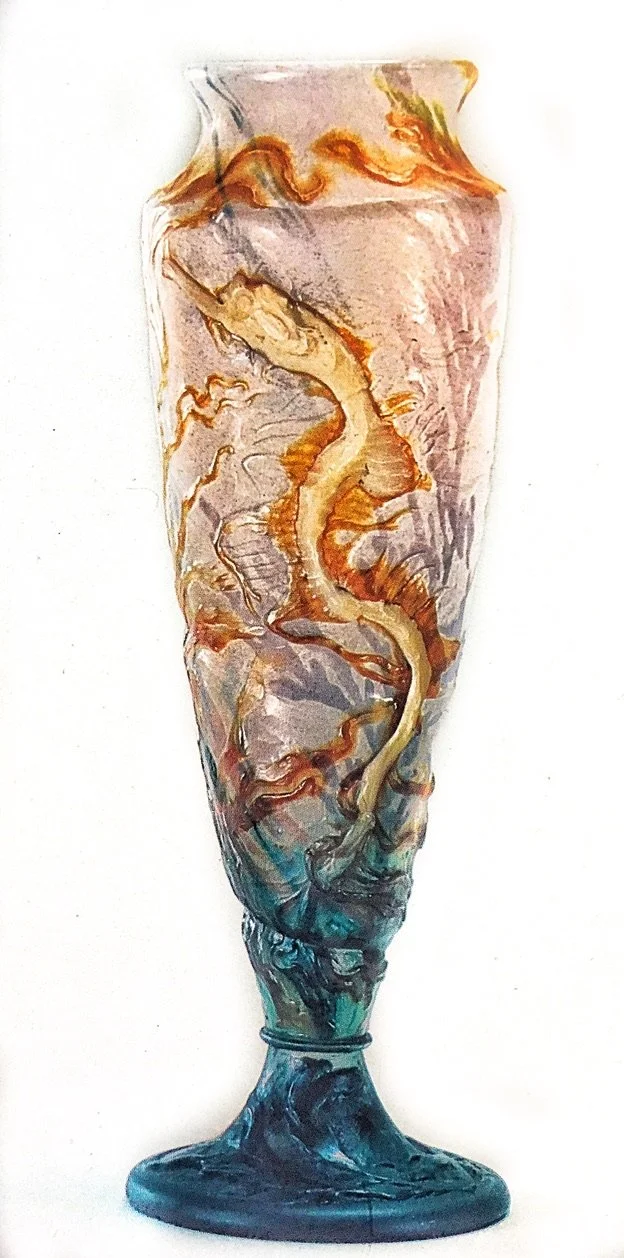
All of these events affected Gallé the patriot (see the Joan of Arc vase, 3) and lover of Justice. Gallé was deeply involved politically: he signed the petition of 1898 calling for a resolution of the Dreyfus case, even inscribed some vases urging action (one reads "All souls are ready/one of them, however, must take the first step/Why not be the one to begin?), and dedicated one important work to Joseph Reinach (Sea Horses, 34), who wrote the history of the case. Who knows what sea horses have to do with Dreyfus, but the peculiar textures of the piece may have been inspired by Reinach, about whom one of his enemies wrote "Reinach had a voice of wood and leather and used to leap from chair to chair, in pursuit of bare-bosomed lady guests, with the gallantry of a self-satisfied gorilla." [2]
The case is also significant because it "acted as a stimulus to the reexamination of the traditional ideologies on which both the defenders and the enemies of the accused captain had rested their case." [3] It represented a reaction against the naturalistic outlook, a return to ideals after hard "facts" had proven just as elusive as ideas (key evidence in the case proved to be forged). From this turbulent background of immense technological growth and social upheaval came impressionism and symbolism.
Impressionism responds to the rush of innovation, increased speeds and shortened distances brought about by technology. Its artists try to capture fleeting moments- steam puffing from a locomotive, the horizon just before sunset. They seek to portray, not the steam or sunset itself, but their own impressions of each of these events. Symbolism is a response to the irrational in human behavior, those often unconscious elements revealed in dreams or when we lose our self control. As one contemporary critic wrote," An artist like Gallé makes us think of a quintessential abstraction that attempts to materialize the impalpable and to turn the dream into glass." [4] In fact, the role of the unconscious was just beginning to be investigated - Freud's "Interpretation of Dreams" appeared in 1900.
Nearly all the works in this exhibition were produced during the last fifteen years of Gallé's life, 1889-1904. They may be seen as symbolist or impressionist or even as products of Art Nouveau or 189os' "end-of-the-century decadence." While many of the most famous practitioners of these styles openly revolted against both technology and nature-remember Des Esseintes, the chief character in Huysmans' book "Against Nature" - it was Gallé's brilliance to utilize nature and technology. This led him to a healthy sort of symbolism and a simple ethical approach to life that stressed individual welfare in the midst of rampant industrialism. In the sections that follow, Gallé's own words suggest his approaches to technique, nature, impressionism, symbolism, and illuminate his concern for alleviating human suffering.
Gallé as Glassmaker
Gallé's involvement with glass was inherited. His father, Charles, founded a crystal and ceramic business in 1845 in Nancy, about 175 miles east of Paris, although the manufacturing of objects occurred at Raon-l'Etape, Meisenthal, and Saint-Clement, all within 100 miles of Nancy. The Franco-Prussian war and German annexation of Alsace-Lorraine (where Meisenthal was located), resulted in the loss of one of his factories, and he therefore opened a factory in Nancy in 1871. [5]
The young Gallé, born May 4, 1846, was given a traditional education at the Lycée Imperial in Nancy; his preferences were for literature and natural sciences. But he complains: "I must confess that as far as I am concerned, I in no way received an education which was suited to facilitate the beginnings of my career. No professional instruction was disseminated among artistic workers, unless it was to the recruits of the straight-edge and the sawhorse.... For the artistic workman, it was something like the swimming lesson given to a dog when it is thrown into the river. (Ecrits, PP. 237-238). Galle's "swimming lessons" were postponed while he traveled and studied from 1862-1864 in Germany and England to pursue an interest in music and decorative arts. The trip ended in Paris where he became friends with the glassmaker Eugène Rousseau. By the time he was twenty-eight his father had retired, and Gallé was in charge of the business.
His responsibilities at work and at home steadily increased; in 1875 he married Henriette Grimm, and his first child, Thérèse, was born in 1877. From about 1889-1896 [6], probably because of increased demand for his products, Gallé had glassware produced for him at Burgun, Schwerer & Cie in Meisenthal.
The years 1889 to 1904 were the period of Gallé's maturity and success as a glassmaker. From 1900 there is a charming description of the workshops; at that time he employed some 300 people:
"In 1883, you built enormous studios for the production of faience, glassware and a new industry, cabinetmaking. It is in the context of this fine factory-open to the public through your own generous hospitality - that your works should best be viewed in order to appreciate fully the character and variety of your production.
The factory is surrounded by tall trees that evoke a sense of peace and calm; the tranquility of this suburban site is broken only by the occasional bugle call from the neighboring barracks. Once the visitor has crossed the threshold, however, he may look forward to more and more surprises and satisfactions. At the right time of year, in the middle of the courtyard, beds of decorative flowers delight the eye while they also provide a constant source of instruction for your personnel. In the main building, a model of genuine architectural elegance, the work is divided up methodically. In one room, the cabinetmakers select, assemble, cut out and apply the thin strips of precious wood that will adorn tables, consoles, jewelry cases, mirrors, and other furniture of all shapes that is kept in an adjoining studio. In another space, craftsmen prepare the models and painters decorate the faience-ware that will be fed into a series of muffles; from these bellies of fire they emerge in full resplendence. Elsewhere spindles and engraving wheels score and flute glass, enriching it with the most delicate engravings. In yet another room, specialists cast, chisel, and patina the bronze mounts that will complete pieces of furniture. In the middle, a room filled with drawings, plans, pieces of glass and wood, little phials and the entire arsenal of a chemist; this is your study, the scholarly retreat in which your ideas, inventions and desires are elaborated and from which they will disseminate.
It is in this room that I see you just as Victor Prouvé painted you, holding in one hand a long-necked vase in warm transparent shades that you scrutinize anxiously, searching for the right decoration that will complete it. Farther on, in an enormous hall, a number of furnaces liquify the glass that powerful lungs or the pressure of molds will transform into vases, bowls, flagons, and the thousands of fantasies that have earned your crystal-work its well-deserved celebrity. A second building contains completed samples of all these modes of production. I do not wish to push this little tour too much farther, for I fear I might be overstepping the limits of discretion in speaking of your private home and of those vast rooms in which you have assembled a selection of your most remarkable creations. There too lies a happy garden filled with the rarest plants and perfumes, like a beautiful book which you pore over endlessly, drawing your inspiration from the very source of nature." [8]
The portrait by Prouvé, done in 1892, is illustrated on page 26. Victor Prouvé, Gallé's lifelong friend and designer, had begun collaborating with him at an early age. Of this portrait he wrote to his mother: "Here is Gallé at work - not without hi's! and ho's! and ha's! and screams! and arms flung up in the air, but I couldn't care less, I have him. There is enough here to do something good... a symphony in gray and with a taste of crystal, of those crystals whose hues are so delicious." Prouvé helped design such vases as Orpheus and Eurydice (I) and Joan of Arc (3).
Gallé's successes meant medals and critical acclaim resulting from his participation in a wide variety of exhibitions, including the 1889 Paris Universal Exposition (see objects 1, 2, 3, 5), the Paris Universal Exposition of 1900(12, 18), the Exposition de l'Ecole de Nancy, in Paris in 1903 (17) the Chicago Exposition of 1893, and the Saint Louis Exposition of 1904 (see 24). Works by Gallé were added to prominent collections, including those of Roger Marx (art critic, editor of Gazette des Beaux-Arts; objects 14, 19, 21), Edouard Hannon (industrialist; for his house in Brussels, 23), and the Philadelphia Museum of Art (24); Gallé's objects were presented to the Russian royal family and Louis Pasteur (4), were ordered by writers such as Marcel Proust [10] or dedicated to such notables as Sarah Bernhardt. The famous Mushroom Lamp (30) was designed as part of a dining room with a forest theme for Gallé's patron and friend in Nancy, J. B. Eugène Corbin, publisher of Art et Industrie. Corbin's house, with its fabulous art nouveau collections, was bequeathed to Nancy and became the core of the Musée de l'Ecole de Nancy, which has lent several important pieces to this exhibition (6, 13, 32, 36, 39). An entré into French society which enhanced Gallé's reputation was affected by the same man who helped introduce Marcel Proust: the fantastic Count Robert de Montesquiou-Fezensac. Montesquiou dedicated poetry to Gallé, and wrote about his glass. [11]
The critical reaction which attended Gallé's success and continues today has been both positive and negative, ranging from Roger Marx's comment of 1911: "The boldness of his life and character shine through his work" [12] to the condemnation of Gerald Reitlinger in his 1970 "The Economics of Taste": ...Emile Gallé of Art Nouveau fame, the begetter of tortured elongated shapes in the color and texture of old, decayed bathroom sponges." [13]
But what of Gallé the artist? How did he see the working process which enabled him to achieve these triumphs (and no doubt an occasional soggy sponge, too)? A most revealing personal statement appears in his exposition notice for 1889:
“My own work consists above all in the execution of personal dreams: to dress crystal in tender and terrible roles, to compose for it the thoughtful faces of pleasure or tragedy, to assemble all the elements and carefully prepare the effective production of my future projects, to order technique in the service of preconceived works of art, and to weigh the operational scale of chance with possibilities for success at the time of the decisive operation, once called the master-work. In other words, insofar as I am capable, from the start, I impose upon it qualities I should like it to have - the material and its colorations, the material and its measures- in order to incarnate my dream and my design.
Needless to say, all of these calculations can be, and often are, disrupted by unforeseen causes; but the very hazards of a craft in which fire collaborates, violently and brutally, often serve me in the most fortuitous way.... Thus it is, Gentlemen, that I am not only responsible for the uses that can be made of crystal but also for the point of departure in this adventure. I have sought to make crystal yield forth all the tender or fierce expression it can summon when guided by a hand that delights in it. And it is I who have infused it, as it were, with the means for touching us: the worrisome blackness or the delicate morbidezza of soft rose petals.” Emile Gallé (Ecrits, PP. 350-352).
So Gallé sees his role- as both dreamer and director. Nonetheless, this dreamer always sensitively acknowledged the individuals who helped him accomplish his lifetime work, including Prouvé, the painter Louis Hestaux, and many others. The insensitivity of nineteenth-century industrialism was his greatest regret:
“This was one of the errors, one of the bitter penalties of the age of industrialism with its excessive division of labor, its organized management located in a poisoned and artificial atmosphere far from the domestic hearth, the family, and the natural environment. The century that is about to end did not have its own popular art, that is to say, no art applied to useful objects and executed spontaneously, joyously by the various artisans of each craft.” Emile Gallé (Ecrits, p. 226).
At the beginning of the nineteenth century colour in glass was something new.
From c. 1680 to 1825 transparent, colourless glass with engraved and cut decorations had been the main product of makers of fine glass in most parts of Europe. [14]
What follows is intended to outline for the non-technically oriented reader some of the processes employed by Gallé to achieve his dreams in glass. Those seeking detailed technical information are referred to the full exposition notices and patent applications. 15 The brief discussion below includes several techniques: enameling, engraving, patina, and marquetry, the latter two developed in the late 1890s by Gallé.
Many of Gallé's techniques are refinements or adaptations. The roots of his experiments with color were undoubtedly in Bohemia, Murano, and France and included Georges Bontemps (1799-1884) at the Choisy-le-Roi factory. The technical perfection required to produce paperweights during the so-called "classic" period (1845-1855) must also have provided valuable knowledge about color.
More directly, the work of the glassmaker Eugène Rousseau (1827-1891) was significant. His revival of cased glass, imitations of gemstones, and assimilation of motifs drawn from Japanese art (Perry made his voyage to Japan in 1853, and there was a display of Japanese art at the 1867 World's Fair in Paris) all influenced Galle's early work. A vase in The Corning Museum of Glass collection (Fig. 1) exemplifies all these influences: it is cased, imitative of carnelian, and assymetrical as in Japanese art. Orpheus and Eurydice (1), with its striations of color from metal oxides, also indicates Rousseau's influence; such oxides could never be completely controlled (engraving, for example, could be controlled to a much greater degree), and both Gallé and Rousseau learned how to use these accidental effects advantageously. In the case of Orpheus the red torrent of oxides becomes "a flaming meteor."
Among Gallé's earliest interests was enameling on glass, which he seems to have begun about 1873.16 Many of the enamels were inspired by historical themes drawn from ancient Egypt, Islam, Japan, etc. The technical investigations of Philippe-Joseph Brocard (d. 1896) were also important. Because we focus on the later work of Gallé, none of these early enamels is included in the exhibition; nevertheless, two pieces of later dates serve to illustrate the technique (5, 6).
In his book Le Verre et le Cristal (Glass and Crystal), Mr. Jules Henrivaux, director of Saint-Gobain, says, 'Mr. Gallé has sought to bring back into favor for a very special, and, it must be said, very restricted audience, an art which shone with some brilliance in antiquity, as well as in the Sixteenth and Seventeenth centuries, that of glass engraving, by making it yield its all and associating it with enamels on the same piece, in spite of great dangers and frequent losses. In recent years, color had completely eclipsed the charming art of etching in the public eye? (Ecrits, p.3II).
By the 1880s color in glass was so dominant that engraving would appear, as above, in need of revival! The enameled Magnolia vase (5) is a good example of the unusual combination with engraving that Henrivaux describes.
Gallé had definite feelings, however, about how contemporary engraving should function:
“How I Have Interpreted Crystal Engraving”
“You are no doubt familiar, Gentlemen, with skillful examples of engraving where the crystal, beautiful as it may be in itself, is overwhelmed, as it were, beneath the weight of such long, meticulous handiwork - work that seems unconscious of time, of the object and of life itself. It is almost as if one had forgotten to turn off a magical machine that robot-like engravers use to create the lasting, impeccable and imperturbable sculpture of cold master-pieces. 'Admirable workers, exclaims M. Bonnaffé, 'as remarkable to be sure as the galley-slave who carves a fully rigged ship out of a coconut with the tip of his pocketknife? ' Cold, hard objects,
' responds in turn M. Eugène Guillaume, with reference to certain engravings on precious stones,
' like those produced by Jeuffroy at the turn of this century. They express only the boredom of the artist and the difficulties that the practice of his profession set in his wav.'
In keeping with the noble lessons of these masters of French art, I have found in engraving above all a means of expression, a means to bring forth out of warm and living material all the elements that have been consolidated within it. Even in those pieces that took longest to elaborate, I never forgot the need for moderation: the enthusiasms of the artist must not suffocate the material from which he composes his work.
I would hope therefore that you might discover in the materials that I set before you and in the execution of the hand, all the flaws - this sooner than silence, than dryness of execution, than mere love of prettiness, than the monotony of technique or the impression of boredom! In order to avoid the appearance of mechanical work, we have therefore been more casual in the description of accessory detail: we have concentrated all our attention on one given point. In the presentation of a harvest of fine, ripened fruit, one sees the side of the sun just out of focus. We have sought to avoid the appearance of stamped impressions, of molds and of reproductions; we have let the contours of our engravings flow into the background. Our tools have marked their form in crystal, and with that form marked too all the tenderness and respect of the craftsman for his material.
If one were to make plaster molds of my engraved works, stripped of their color and soft relief, there would remain, no doubt, very little to speak of; nevertheless, it would be clear that these were crystals and not bronzes or ivories. Emile Gallé (Ecrits, pp. 347-348).
This approach to engraving is evident throughout the exhibition; as in the head of Orpheus (I), or the fins of the Sea Horses (34). In some cases, Gallé also used acid etching to rough out a form, for example in Joan of Arc (3). "Acid reaches easily into those areas that the spindle cannot touch." (Ecrits, p. 347).
Notice Galle's remarks about allowing the tools to leave their mark, and so convey the artisan's tenderness and respect for the material. As we have seen, one of Gallé's critiques of industrialism was that it displaced the workman's joy in his own work-something which Gallé is obviously trying to restore in his new approach to engraving. With the development of patina and marquetry he underscores his convictions.
One way to encourage a sense of freedom in the worker, a joy in working, and understanding of the whole object, is to provide an opportunity for spontaneous decisions. The marquetry and patina processes offered such opportunities. Partly inspired by ancient glassmakers who applied threads and other types of decoration to the hot mass of glass and by paperweight makers who arranged numerous glass canes to form floral bouquets and then trapped them forever within a sphere of colorless crystal, marquetry involved the addition of bits, fragments, thin lamina-tions, or other kinds of glass onto the hot glass body of a vessel. Patina utilized ashes from wood or coal and other specially prepared particles to produce textures on or under the vessel surfaces. Both approaches were often combined with engraving, acid etching, etc., for maximum effect. Thistles (12) is a good example of marquetry, while the surfaces on Sea Horses (34), Rhubarb (17), and Sea Lily (33) are patinated. The Dragonfly (24) and Pines (21, 22) combine both processes with engraving.
The successful development by Gallé of these various approaches to glassmaking restored self respect to the workman and has been beautifully summed up in relation to marquetry by Jules Henrivaux (director of Saint Gobain):
“To be sure, the technique demands great skill. It is hardly a simple task to insert and place one hundred or more pieces of glass mosaic on a vase -no more simple than the successive reheatings that must be done each time or the regular process of stripping and fashioning that is called in the specialized language of engraving ciselure [sculpture], a process quite distinct from that of cameo. Nevertheless, it must be said that the craftsman, charged with doing this inlay, derives great pleasure as he goes along from the delightful effects produced by the assemblage of glass pieces that he transposes one at a time. At that moment, he becomes a decorative artist, a landscape artist and a colorist; as he carefully works his stained glass into the mass, he produces, like the painter, a thoughtful work of feeling and taste. He himself sees and understands the significance of everything that emerges from his efforts. He brings something of his own imagination to the work of his fingers and then stands back to judge the charm that is born of that fruitful collaboration. In short, he develops his faculties of attention and discernment out of an obligation to his own very special talents.” [17]
It is this working process which encourages spontaneity and freedom in the work-man. This seems especially true in objects such as the small Pines (22) where the exceptional detail could have only been achieved by an artist/workman working with understanding and inspiration.
We should remind ourselves, however, that it was Gallé's ideal to turn craftsmen into artists. One wonders to what extent he was able to transform his workmen with this system and to what extent he already employed artists who were simply best suited to work this way.
Gallé: Naturalist, Impressionist, Symbolist
In her introduction to Gallé's collected writings, his widow Henriette Gallé-Grimm asserts that
"...if Emile Gallé has renewed the decorative arts, it is because he has studied plants, trees, flowers, both as an artist and a scholar." (Ecrits, p. VI).
When confronted with issues of design, Gallé often asked himself "how nature had resolved the problem." (Ecrits, pp. 267-268). Here, his education served him well:
"Luckily- and here, I must once again speak of myself-the love of the flower reigned in my family: it was hereditary passion. It was salvation. I knew something of the natural sciences. I had followed the botanizatons of Godron, the author of the Flores de Lorraine et de France. On his crystals, his porcelains, my father had made studies of fields and meadows, reproductions of Graminacea and blooming grasses." (Ecrits, p. 239).
The extent to which Gallé depended on nature for his decorative themes is revealed in this catalog- there is no single object that does not draw on nature. Nearly every piece includes plant life, and only Orpheus and Eurydice (I), Joan of Arc (3) and Geology (I3) confine themselves to classical or inorganic subject matter. But no pieces are slavish imitations. Instead, nature served Gallé as a launch pad, allowing him to break away from tradition and reach new heights:
"The jury will please note that Gallé always takes nature as his point of departure, and that he takes pains to free himself from it in time to attain a personal character and accent." (Ecrits, p. 317).
In discussing furniture design, he rejected Greek classicism and welcomed nature (Ecrits, Pp. 256-7). Even the influence of Japanese art is significant because of its focus on nature (Edmond de Goncourt-Gallé's friend-writer, a leader of the Naturalism movement, collector, was among the first to introduce Japanese art in France): "Amid so many reasons for which to honor this benefactor [Goncourt] of spontaneous art, there is one which the school of modern crafts must loudly proclaim: in his writings he declared that 'ancient Japan is desperately monoto-nous.' That all the enchanting decoration in Japanese art which is worthy of appreciation by people of taste is modern, yes, modern, of the nineteenth century, that the most pliant bronzes are those of artists dead twenty, thirty, or forty years ago?, that this 'marvelous, unique, incomparable art' must be attributed to the revolution introduced into design by the liberation of classical styles and by a return to direct, loving observation, to the very collaboration of nature." (Ecrits, p. 178).
Again in the essay on contemporary furniture design, we get a rare glimpse into how he translated nature's gifts into decorative motifs, in this case, moldings:
“Take directly the peduncula either of the leaf or of the flower of certain of the Orchidea, the Umbellifera of our woods. Study the striations which furrow them. They are alternatively thick and thin. Examine them under strong magnification. They have the look of veritable cabinetmaker's, architect's moldings, with lights opposed to darknesses, roundnesses to planes. You will find there moldings other than the bec-de-corbin, and cymaises from the Greeks which are not repeated. Moreover, this structure sometimes moves from bottom to top, from left to right, in reverse direction. Here and there it is interrupted at regular intervals, masterfully, by the insertion of leaves and branches. To learn the secret of these combinations, take cuttings, multiply the sketches, but compare them to the living model. You will be surprised to find these anatomies increasingly full of charms and secrets, always superior in beauty to the adaptations based on it. You will be surprised that man has so little delved into this infinite repertory to replenish his arts of furniture.” (Ecrits, Pp. 262-263)
Still, Gallé's naturalism was never very close to the precision of writers like Goncourt or Zola. Rather, he thought of nature as full of messages to be deciphered:
"Baudelaire has expressed for us most grandly this concept of the harmonies that resonate throughout the immensity of creation.
The pillars of Nature's temple are alive
And sometimes yield perplexing messages;
Forests of symbols between us and the shrine
Remark our passage with accustomed eyes.
(Trans. Richard Howard, Les Fleurs du Mal, Boston:Godine, 1982) (From Ecrits, p. 220)
Gallé worked in many styles, from revivals of ancient Egypt, medieval Islam, classical Greece and Rome (Orpheus and Eurydice, 1) to naturalism. Two styles, symbolism and impressionism, were especially relevant for their effect on his later work.
In a sense, impressionism is a refined naturalism as defined by the writer Emile Zola, who noted that impressionists study " ...the changing aspects of nature according
to the countless conditions of hour and weather.... They pursue the analysis of nature all the way to the decomposition of light, to the study of moving air, of color nuances, of incidental transitions of light and shadow, of all the optical phenomena which make a horizon appear variable and so difficult to represent." [18] This theory is supported by many of Gallé's own remarks, for example: "Thus in nature the most disparate colorings melt under the magic spells of the atmosphere." (Ecrits, p. 209).
Look at Autumn (7), where the leaves change so dramatically as the light changes.
Or the Hazel Tree II), receptacle for a premature, tentative decoration almost washed away by winter rains. Pieces like Orchids (19, 20) and Tadpoles (32) reflect the changing seasons, while in Blue Melancholy (38) the flowers seem covered in spots by a misty haze. The marquetry process itself parallels experiments by some post-impressionists. The "cut out," flattened figures in Seurat's La Grande Jatte might be compared to the thin glass inlays used by Gallé.
It was natural for artists to move from impressionism to symbolism. Instead of recording nature, many artists recorded their own ideas. "Symbols are the points at which ideas become concrete," Gallé wrote. (Ecrits, p. 218). A few of his early works are allegorical. Allegory in symbolism parallels the historical revival of antique styles in the decorative arts. In Orpheus and Eurydice (1) a popular classical theme is translated into decoration for a vase, and our interpretation of its meaning is determined by the Orpheus legend.
But many symbolists came to feel that allegory lacked potency for at least two reasons. First, the themes from which allegories were derived were often esoteric, forgotten, outmoded- much as imitation mosque lamps could never hope to serve the functional purpose of their prototypes and so became dust-gathering curiosities.
Second, allegory was too precise; it didn't allow the viewer to exercise enough imagination and so evoke the sense of mystery symbolists sought. New symbols, in tune with the 1890s, had to be found.
Gallé found his symbols in nature: "Indeed, love of nature must always lead to symbolism: the popular flower loved by all will always occupy a principal role in ornamental symbolism." (Ecrits, p. 218). For example, the thistle (12) could represent defiance; Olives and Pines, peace (1o);Grapes (I5) the transforming qualities of wine.
It may be that the most powerful symbols, those most like dreams, are the least allegorical, evoke the greatest mystery, and make us guess at their meaning. In Gallé's work, pieces dealing with sea themes (Deep Sea, 36, or the Hand, 39) illustrate this most forcefully:
Man- a free man- always loves the sea
And in its endlessly unrolling surge
Will contemplate his soul as in a glass
.. .
-who has sounded to its depths the human heart?
And who has plucked its riches from the sea?
So jealously they guard their secrets both!
(Baudelaire; Trans. Richard Howard)
“These secrets of the Ocean are brought forth to us by brave deep-sea divers. They empty their marine harvest which passes from the laboratory to the studios of decorative art and to the museums of models. They draw and publish these undreamt-of materials for the artist: enamels and cameos from the sea.And soon, crystalline jelly-fish will inspire new shadings and original curves in chalices of glass.”
Emile Gallé (Ecrits, pp. 224-225).
From the turn of the century, Gallé's workshops produced objects of astonishing virtuosity, each fraught with symbolic mystery. One wonders... could he have had an intimation that only four years remained to see that his dreams were realized? We recall that while still vigorous he had written: "Coldness indeed! Is it not the business of snow to be white, of the glacier to be blue? Anemia! Not everyone can be anemic. I happen to like anemia. If everything were all strength and force, we would have to bid adieu to grace, adieu to harmony.” Emile Gallé (Ecrits, pp.224-225).
Gallé died on September 23, 1904, from an illness diagnosed as leukemia. [19] At fifty-eight, he was the premier glass artist of his generation, deeply involved in the pursuit of innovative techniques to turn dreams about nature into glass.
His disillusion at the failure of industrialization to meet the needs of individual workers and his involvement with the Dreyfus affair, where a single individual had been so unjustly persecuted, reinforced his philosophy that suffering is inevitable, but through suffering we may reach a state of grace and harmony. He therefore saw his work as part of a healing process to share with mankind the beauty scattered throughout the world: "The path is rocky. And I am weak. What do I care for the painter? Give me the decorative artist: he is the good Samaritan that I long for. From the glassmaker I ask for perfumes in his vases..." (Ecrits, p. 199).
Today we revere and appreciate Galle's work for its revealing interpretations of nature's mystery. The photographs and catalog which follow portray a man of his time who probed beyond his time and one who both drew from glass and imposed his philosophy upon it. Gallé makes us look at his vases not only as fantastic works of art but as purveyors of his own heightened sense of the symbolism of nature and the value of human endeavor.
Footnotes
1-Arnold Hauser, The Social History of Art, Volume 2, New York: Vintage Books, 1951, p.
65.
2. George D. Painter, Marcel Proust: A Biography, Volume 1, New York: Vintage Books,
1978, P. 227.
3. Stuart H. Hughes, Consciousness and Society, New York: Vintage Books, 1977, P. 41.
4. Jules Henrivaux, quoted in Janine Bloch-Dermant, The Art of French Glass 1860-1914
New York: The Vendome Press, 198o, p. 132
5. Charles de Meixmoron de Dombasle, "Résponse du Président M. Ch. de Meixmoron de Dombasle au Récipiendaire M. Emile Gallé. Académie de Stanislas, Séance solanelle
17.5.1900." Mémoires de l'Académie de Stanislas, Nancy 1899/1900, PP. I-25. Readers are reminded that the earliest biographies of Gallé are not free from error; Charpentier discusses some of these in "Remarques sur les premieres biographies de Gallé parues de son temps."
6. Bloch-Dermant, p. 54.
7. Ada Polak, Modern Glass, London: Faber and Faber, 1962, P. 20.
8. Meixmoron, pp. L-LII.
9. Victor Arwas, Glass: Art Nouveau to Art Deco, New York: Rizzoli, 1977, p. 84.
10. Philippe Garner, Emile Galle, New York: Rizzoli, 1979, Pp. 118-120.
11. Garner, p. 59.
12. Bloch-Dermant, p. 132.
13. Gerald Reitlinger, The Economics of Taste, Volume Three. The Art Market in the 196os, London: Barrie and Jenkins, 1970, p. 537.
14. Polak, p. 20.
15. Technical information about Gallé's working process is available in the Exposition Notices in Ecrits pour l'Art (see bibliography); an English translation is available in the Library of The Corning Museum of Glass. The Library also has correspondence, drawings and working instructions by Gallé and his associates. Patent requests made by Gallé pertaining to patina and marquetry processes are published in English by Bloch-Dermant Pp. 121-125. The section on glass from the 1889 Exposition notice is reprinted at the end of this catalog.
16. Bloch-Dermant, p. 98 and Garner, p. 95.
17. Jules Henrivaux, La Verrerie au XXe siècle, Paris, 1903, P. 583.
18. John Rewald, The History of Impressionism, New York: The Museum of Modern Art, 1973, P. 426.
19. Bloch-Dermant, p. 55.